

Authors Note: I wrote this article before last night’s nail biter at San Diego. Think of the ninth inning last night as confirmation of what I wrote. It was poetic justice that it occurred in San Diego. You’ll know why if you finish the article.
I continue to resist the urge to parse into various statistics and metrics until they’ve had a chance to stabilize. Gosh I want to dig into Walker’s metrics like nobody’s business. But we haven’t hit that point with most yet, and discipline is required. However, K% supposedly stabilizes around 70 batters faced, and there aren’t too many K oriented pitchers on this roster. Riley O’Brien is right near that threshold, and I’ve been curious what some of the under-the-hood metrics look like with him. We will look together.
Riley was originally drafted by the Tampa Bay organization in 2017 (8th round). He made it as far as AA, when he was traded to the Reds during the infamous 2020 season, in which there was no MiLB season. He opened 2021 at AAA and made a cameo (as in one) MLB appearance with them that year. He was traded early in 2022 to Seattle for the even more infamous PTBNL. He was 27 years old and idled at AAA the whole year. His story was consistent across his MiLB career – his K%-BB% ratio was too poor to suggest MLB success, although his raw stuff was clearly appealing. Interesting, back then, he had an arsenal of Cutter, Sweeper and Change. He came to the Cardinals in a cash consideration trade in November of 2023. That season, at Tacoma, his stats had veered noticeably. Higher K rate, lower BB rate, FIP < 4. I assume that is what the Cardinals saw … a late bloomer with K and BB rates bordering on elite.
Advertisement
I got a chance to see him early the following Spring (2024) and he certainly had impressive stuff, so he passed the eye test on day 1. He got hurt late in camp as I recall and he was out until late July. His 2024 Spring appearances were impressive enough that a month of rehab at AAA brought him to the MLB team. It was a bit rough, and I believe he got dinged up again. He started the 2025 season at Memphis but made it back to MLB in late May. Not everything was roses, but in the aggregate, he had some really nice season totals. FIP 3.61. ERA- 51. FIP- 89 (on those last two, 100 is average and lower is better). He did enough to be included on the short list of pitchers expected to close in 2026, following the trade of Ryan Helsley the previous deadline. You pretty much know the story so far this year, so I won’t repeat. Now we look under the hood.
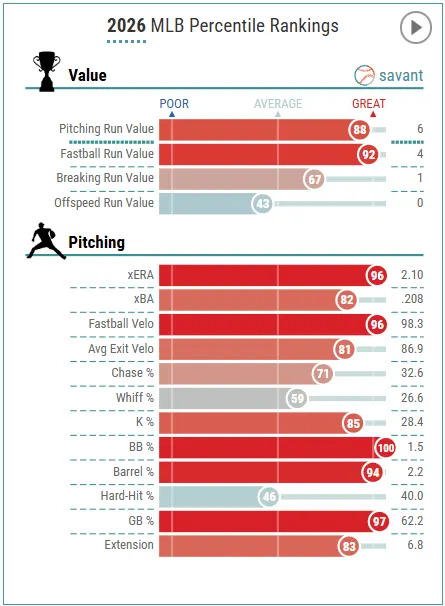 High level – the results
Off to the left we see Riley’s current season Statcast page. A sea of red. Always a good thing. Without sharing last year’s image with you, I can tell you he has improved Chase%, Whiff% and K% and BB% from 2025 to 2026. All but the Whiff% are now in the elite zone.
Advertisement
What is not to like? One might not care for the below average run value of the off-speed pitches. For the record, he has thrown 2 of those pitches this year (changeups). So, ignore that.
The pitch mix
Down below, you can see the pitches Riley has used and how they get allocated. 58% sinker (who wouldn’t?) averaging 98.3 mph. Note that the sinker has higher than average drop. As in about 10% more drop that MLB average and also about 10% more ride (in on RH batters).

His second-most used pitch is the Sweeper (ST) at 25% usage. Similar to the Sinker (SI), the Sweeper action is well outside the average range, both in sweep (horizontal run) and in drop. Both values are 20% more than MLB average.
Advertisement
His third-most used pitch is reserved for LH batters. Overall, he uses it 16% of the time, but to LH batters that number is closer to 22%. The slider is pretty much an average pitch. As I wrote earlier, he has thrown 2 changeups (CU). Not sure why. Since it looks and acts like his Sinker, I would think it would keep batters honest. Maybe he just hasn’t needed to yet.
Note that early in his career he was Cutter and Sweeper oriented, with a few 4S FBs thrown in. So, he has ditched the Cutter and added a Sinker to replace the 4-seam and sharpened his Sweeper. That, folks, in the St. Louis Cardinals pitching lab for you, right there.
Pitch Shapes
To go another layer deep, let’s look at the movement profiles of these pitches.

You can see the top-scale red for both vertical and horizontal movement associated with his Sinker and Sweeper. That tells me he has elite level movement on two-axes on two different pitches. No wonder he is not a starter. He is just a two-pitch pitcher! Oh, wait. That is what an elite reliever looks like. Am I sure? Here are the pitch shape characteristics of another reliever who is pretty good. Mason Miller.

Of course, Mason is of the Mariano River devastating slider class of closer, but you get the point (I hope).
Advertisement
Ok, one more level down in the data and I’m done.
 Deception
A key for a pitcher is to be able to disguise their pitches, which they do a number of ways. One of the most looked at is spin direction. Really sharp-eyed hitters can detect the direction of the ball’s spin. Some spin angles look like red dots (the seams) while other look more like a fan.
In Riley’s case, his two best pitches (SI and ST) have the exact opposite spin direction, meaning the hitter won’t see a difference. By the time a RH hitter detects whether the ball is riding in on him (SI) or floating away (ST), it’s hard to adjust, especially with the velo difference between the two. Part of his success is how these two pitches play off each other.
Advertisement
How the stuff plays
No charts, but some data points. Riley has showed improvement in Stuff+ 4 years running. Last year he was 106, this year 110. That is the look of a pitcher refining, not making leaps. His Location+ has followed the same general trend. Last year, Location+ was commendable 107 and this year has risen to 118. While a 1.5% walk rate is probably not where he will end the year, these numbers suggest his command is not fluky, either.
Historically, O’Brien’s big bugaboo has been walking batters. His 2026 walk rate is currently at an unsustainable 1.5%. BB% rates don’t stabilize until closer to mid-year, so this will be one area where we can expect regression. His K% rate is 28.4% (good) and has reached the stabilization level I referenced earlier. Looking at his career, he could regress a bit, but unlikely to move too much.
The future
If Riley O’Brien was 25 years old, we’d be looking at a long-term closer gig ala. Helsley. But he is not. He is 31 years old, presumably on the downward side of the aging curve. While he has six years of team control (2025 included), he is unlikely to be a long-term closer here (or anywhere). But short-term?
Advertisement
Come the trade deadline, the Cardinals are going to have an interesting choice to make. Closers, especially elite ones, tend to command a handsome dowry around Aug 1. If you look into the Cardinals pipeline, there are a few guys in that line that have “reliever risk” attached to their name, and closer stuff on their Prospect Savant page.
Will the remaining control make him valuable to the Cardinals upcoming window of contention? Or will his age and the burgeoning pitching make him expendable? Almost with certainty, they will ask for and require a king’s ransom to move a player with the kind of stuff and control he has. I would tend to think last year’s Mason Miller trade might be a decent guidepost and if I remember, that took a #1 prospect (De Vries) to pry him off the A’s roster. That might be a little rich for some teams, but probably not much less than would be needed to move him. Bloom is in a win-win with this one.