
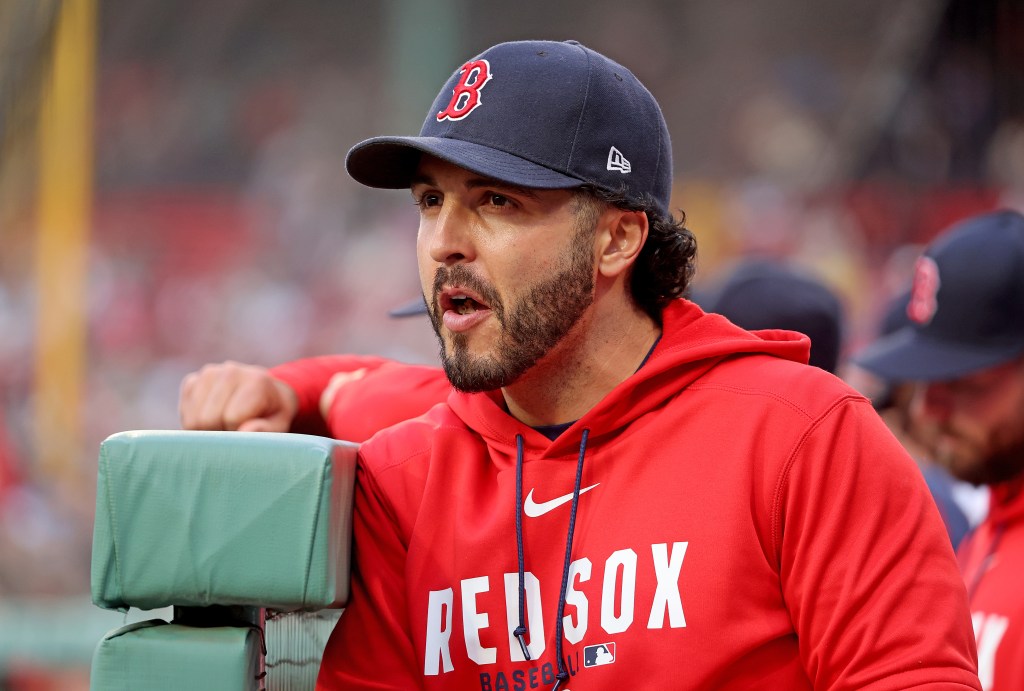
When John Soteropulos left the ballpark on April 25, the Red Sox offense had just delivered its best performance of the season, a 17-1 shellacking of the Baltimore Orioles. The club’s hitters seemed to have taken out weeks of frustration on the Orioles’ pitching staff. So as far as he knew the plan for the rest of the weekend was simple: Grab some dinner, get some sleep and return to Camden Yards in the morning and try to finish the series strong.
The Red Sox assistant hitting coach had no idea what the next 24 hours would entail.
Following the game, top Red Sox decision makers met with Alex Cora and six members of the major league coaching staff and informed each that they were fired. Hitting coach Pete Fatse and two of his assistants were also caught in the purge, and when the dust settled, Soteropulos was the last man standing in the hitting department.
In the blink of an eye, the all-important task of getting the Red Sox offense back on track rested on his shoulders.
“I mean, it’s crazy,” Soteropulos said of that whole weekend as he was elevated into Fatse’s role. “It was a whirlwind for sure.”
Soteropulos now finds himself leading the Red Sox hitting department barely a month into his first big league season. Alongside his new, hastily assembled staff — which includes Nelson Paulino, Collin Hetzler and Jack Simonetty — Soteropulos has gotten to work trying to jumpstart an offense that remains stuck in the mud more than a quarter of the way into the season.
Whether or not he can pull it off might mean the difference between a second straight playoff appearance or an early offseason.
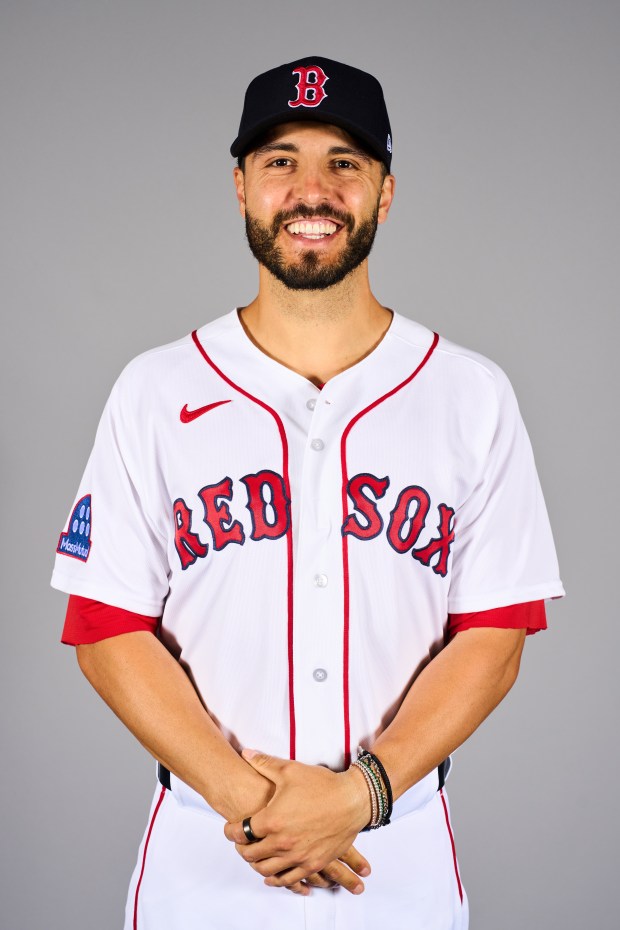 Red Sox hitting coach John Soteropulos poses for a head shot during spring training. (Daniel Shirey/MLB Photos via Getty Images)
A straightforward approach
Originally hired by the Red Sox in early 2023 during Chaim Bloom’s final year leading the front office, Soteropulos served as minor league hitting coordinator prior to his promotion to the big league staff this past October. In that role he worked closely with a number of the club’s up-and-coming prospects, many of whom are now in the majors, like Roman Anthony and Marcelo Mayer.
Before that he spent three years working as a hitting trainer at Driveline Baseball, a prominent training facility that specializes in data-driven player development and biomechanics. He also played Division 1 college baseball at the University of California, where he was teammates with former Red Sox director of scouting Devin Pearson.
Asked how he would sum up his hitting philosophy, Soteropulos said he’d break it down into three simple bullet points.
“Number one would be swing at strikes,” Soteropulos said. “We want to swing at strikes and we want to swing at strikes in the heart of the strike zone, because that’s where the most damage occurs.”
“We want to hit the ball hard, and we want to hit the ball hard on a line in the air,” he continued. “So if we are consistently swinging at pitches in the heart of the strike zone and we’re hitting them on a line and in the air, as a group and on a player basis we’re going to be in a pretty good spot.”
Since taking over as the club’s hitting coach Soteropulos said he’s focused on developing a deeper rapport with his players and doing whatever he can to put them in the best position to succeed. Generally that hasn’t involved big changes to the club’s pregame routine, which is structured the same as it was prior to the staff shakeup, and he hasn’t tried to force any radical adjustments upon the players.
“Nothing wholesale or anything like that,” Soteropulos said. “From a consistency and training standpoint, a lot of those guys have a pretty good idea of why they’re successful, and from our coaching standpoint, especially at this level, it’s a lot of small dial turns.”
Chad Tracy, who succeeded Cora as the Red Sox’s interim manager, also worked with Soteropulos during his time as Triple-A manager and said his familiarity with the players has been an asset to the club.
“It’s been good,” Tracy said. “I’ve known Johnny for a while because we’ve been in the minor leagues and we worked in the minor leagues, so I think Johnny being the one that was here and had a good familiarity with the hitters that were already here, what they do, their routines.”
Recognizing the challenging situation he’s been put in, several Red Sox players asked by the Herald said Soteropulos has done well since taking the reins.
“He’s doing an awesome job. He’s reading the reports, sending the message that we need to hear,” catcher Carlos Narvaez said. “I bet it wasn’t easy for him to adapt but he’s been doing a really good job.”
“He shows up ready to work, he comes well prepared, he wants to be great and that’s half the battle,” shortstop Trevor Story said. “A lot of good things to say about him and he’s kind of thrust into a crazy situation.”
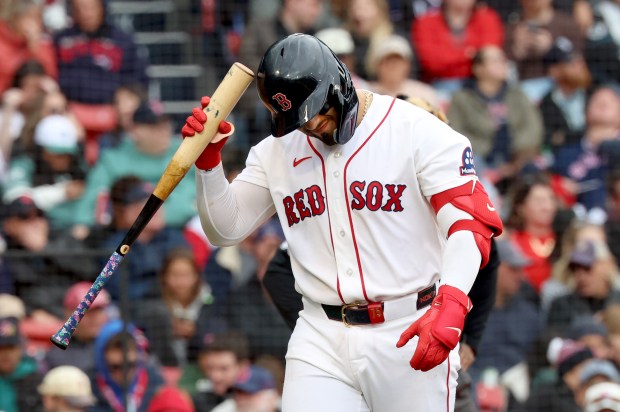 Boston Red Sox catcher Carlos Narváez reacts after striking out during the sixth inning of a baseball game against the Houston Astros on Sunday, May 3 in Boston. (AP Photo/Mark Stockwell)
Driveline influence?
Before his elevation to hitting coach last month Soteropulos was not a well known figure within the Red Sox fanbase. But if there was one thing casual fans knew about him it was likely his background working for Driveline.
In recent years Driveline has been at the forefront of a new wave of data-driven player development approaches that have contributed to the increases in velocity and bat speed seen across the sport. Many people associated with Driveline have been hired by MLB organizations, and the Red Sox in particular have embraced Driveline’s philosophies, hiring Driveline founder Kyle Boddy as a special advisor to chief baseball officer Craig Breslow.
But Driveline has also become a somewhat polarizing entity within the sport, and among the more traditional-minded in particular. the word “Driveline” has essentially supplanted “Moneyball” as shorthand for a new way of doing things that they think is hurting the game.
People from that segment of the Red Sox fanbase might label Soteropulos as a “Driveline Guy,” but is that fair? Asked how Driveline has impacted his development as a coach and to what extent he’s incorporated its methods into his work with the Red Sox, Soteropulos said there are inherent differences between what Driveline does and the constraints big league teams operate under.
“I worked there from ’19 to ’22 as a hitting trainer and their philosophy and training and environment and ecosystem, they just have more time and no games,” Soteropulos said. “So a lot more of it is training focused, and it is a little bit more intensive with the biomechanics and the training aspect, where here, especially at the major league level, you want to develop the players and make sure they’re getting better, but at the same time you want to make sure that they’re going into the game with the best version of their swing and a clear-cut gameplan.”
“Because they don’t play games so they’re able to be probably a little more aggressive with long-term stuff, but it’s very objective driven,” he continued. “It’s just data-driven training is what it is.”
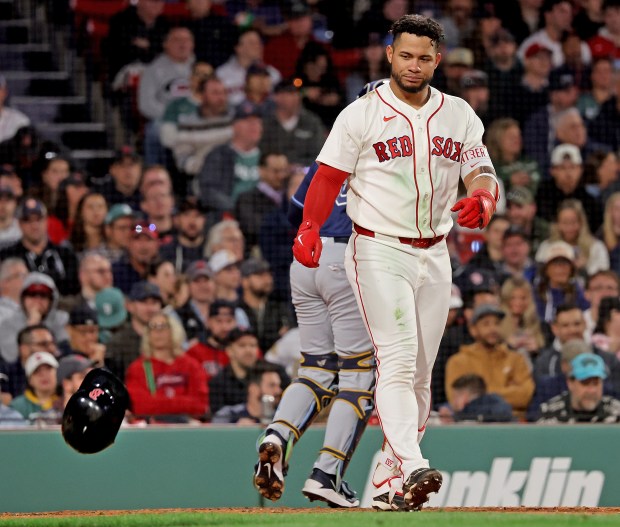 Red Sox first baseman Willson Contreras spikes his helmet after striking out during a recent game. The Red Sox offense is still looking to turn things around after a poor showing through the first quarter of the season. (Matt Stone/Boston Herald)
Chasing better results
Ultimately Soteropulos will be judged by how well the Red Sox offense performs, so how have things gone since he took over?
In 27 games prior to the coaching changes the Red Sox averaged 4.1 runs per game and collectively batted .233 with a .667 OPS. Those numbers were somewhat inflated by the 17-1 blowout on the day of the change, which took place after the decision to fire Cora and his staff had already been made.
Take that game away and the Red Sox averaged 3.7 runs per game with a .226 average and .641 OPS, and overall the club scored two runs or fewer in 12 of their first 27 games, going 10-17 over that stretch.
Since Soteropulos and the new hitting staff came together, the Red Sox have averaged 3.0 runs per game, batted .237 with a .670 OPS and have scored two runs or fewer in eight of 17 games entering Saturday. The club went 8-9 over that stretch.
To put those numbers in perspective, the league average this season is 4.4 runs per game with a .240 average and .708 OPS.
Needless to say, the offense is still trying to find itself, but Soteropulos said he’s encouraged by the signs he’s seen even though the results haven’t always been apparent on the field.
“I think guys are starting to slug more, I think guys are starting to control the process more or damage to different pitch types in 3-2 strike counts,” Soteropulos said. “We’re showing steady progress in those areas, albeit we definitely want to better in those areas but overall we’re showing some good trends.”
“And it’s a long season man, it’s a long season, there’s a lot that goes into it especially from like an ebbs and flows standpoint, the season is (seven) months long and when you look up at the end of the season it’s 600-650 plate appearances,” he continued. “But I’m confident in the group, in the players, we have a lot of talented players that work really hard and are focused on the right things, and those outcomes, doubles, home runs, we’re just going to start seeing more of those as the season goes on.”
But as Soteropulos has come to understand, baseball season doesn’t stop no matter how much chaos or upheaval you might encounter. The only way out is through, so for the Red Sox that means showing up every day and working in the cages until things finally click.
“We don’t just get three off days in a row to figure it out,” Soteropulos said. “Trace said it best, once the first pitch comes we’re playing baseball and it’s our job to execute and hit the ball hard.”