
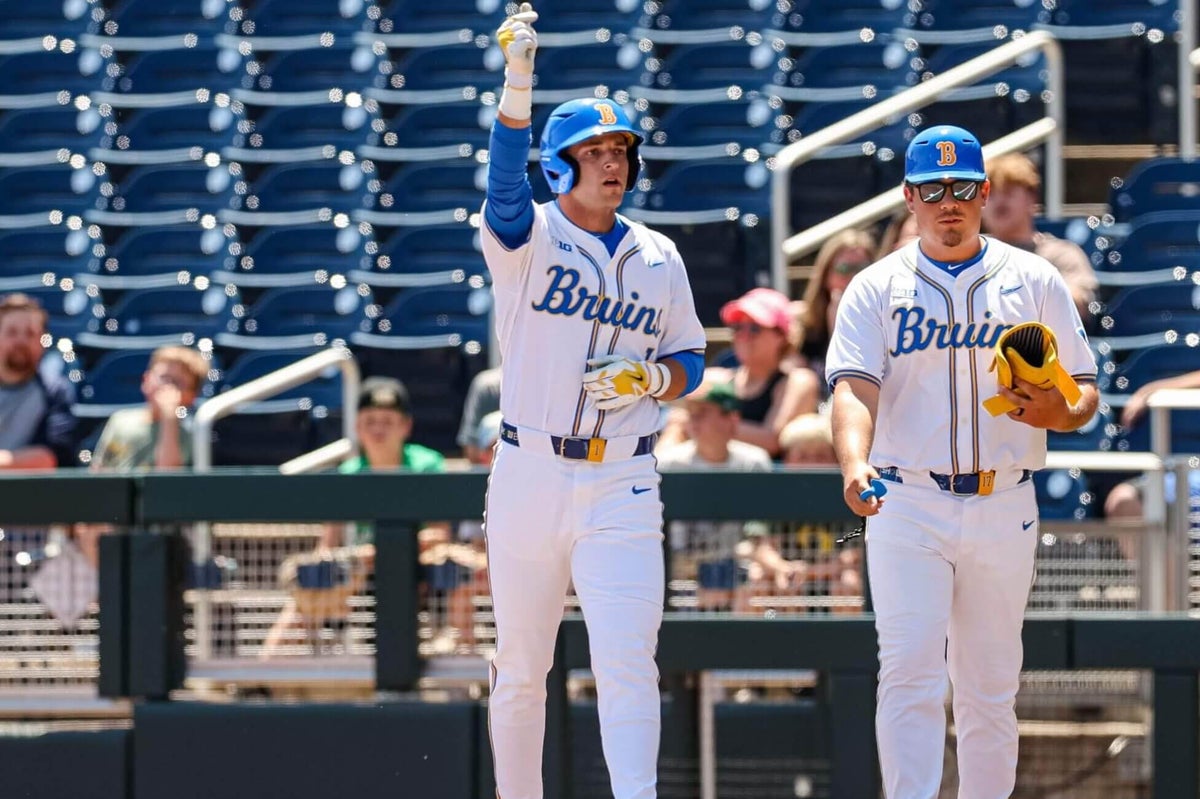
UCLA earned the No. 1 overall seed in the NCAA baseball tournament after winning a program-record 48 games in the regular season and following up with a Big Ten tournament championship.
The Bruins, who advanced to the College World Series last season, were one of four Big Ten teams to make the 64-team field. The SEC led the way with 12 teams, including five of the top eight seeds.
Georgia Tech, which won the ACC regular-season and tournament titles, is the No. 2 seed.
The remaining eight national seeds are Georgia, Auburn, North Carolina, Texas, Alabama and Florida.
The other eight Regional hosts are Southern Miss, Florida State, Oregon, Texas A&M, Nebraska, Mississippi State, Kansas and West Virginia.
Notably absent are LSU, the defending national champs, and Vanderbilt, which was the No. 1 overall seed in 2025 and had made the field in 19 consecutive seasons.
The 16 Regionals will feature four-team, double-elimination competitions, which will be played this weekend. The Regional winners advance to the Super Regionals for a best-of-three series to be played June 5-8. The eight Super Regional winners advance to the College World Series in Omaha, Neb., beginning June 12. The CWS championship series begins June 20.
Bruins claim top seed
UCLA went wire to wire as the No. 1 team in the nation and enters the NCAA Tournament with a 51-6 record. The headliner is All-American shortstop Roch Cholowsky — the likely No. 1 pick in the 2026 MLB Draft — but this team’s strength is its pitching staff. The Bruins rank second nationally in ERA (3.27), third in WHIP (1.18) and fifth in batting average against (.219).
There are some concerns, however, with the health of No. 1 pitcher Logan Reddemann. The junior is 8-0 with a 2.87 ERA and 1.00 WHIP, but has been sidelined since mid-April with what UCLA is calling arm fatigue. There was speculation that Reddemann might be used out of the bullpen in the Big Ten tournament, but he did not pitch in any of the three games. If Reddemann, who is draft-eligible, is unable to pitch, the Bruins’ path to Omaha gets trickier.
And despite its gaudy record and consensus No. 1 ranking in the polls, UCLA was not the no-doubt-about-it top overall seed. A solid argument could have been made for Georgia Tech (48-9), which won the ACC regular-season and tournament titles, played a more difficult schedule and had twice as many Quad 1 wins (22) as UCLA (11). Or even Georgia, whose RPI is “only” No. 7 but won the SEC regular-season title and rolled through the league tournament with wins over Mississippi State, Florida and Arkansas.
But in the end, UCLA was rewarded for its consistency — the Bruins didn’t lose a weekend series and did, after all, lose only six games. — Mitch Light, college sports senior editor
Pick to win it
I’m jumping on the Georgia bandwagon. The Bulldogs might not be elite on the mound, but they were good enough to win the SEC regular-season title by 3.5 games and hold Mississippi State, Florida and Arkansas to a combined 11 runs in the SEC tournament. The offense is arguably the best in the country, led by the dynamic duo of catcher Daniel Jackson and third baseman Tre Phelps. Georgia leads the nation in home runs (149) and ranks second in OPS (1.053) and runs scored (541).
Georgia won’t have to leave Foley Field until the College World Series, but it has proven it can win away from home. In addition to the three wins at the SEC tournament over the weekend, the Dawgs have series wins at Texas A&M, Mississippi State, Arkansas, Ole Miss and Auburn. I’m not sure an SEC team has ever put together a better road resume. — Light
All roads lead back to the state of Georgia. I’m taking Georgia Tech, the ACC regular-season and postseason champs. This group has a chance to supplant the legendary 1994 squad that featured Nomar Garciaparra and Jason Varitek as the best in program history.
That season, 32 years ago, marked the first in charge for coach Danny Hall, who retired a year ago on the heels of an ACC title. He set the table for his successor, James Ramsey. The 36-year-old former Florida State player and assistant has taken Tech to new heights. The Jackets’ 48 victories rate as the most for the school since 2006, which also marks the most recent of three Tech appearances at the College World Series.
Akin to 1994, the Yellow Jackets feature first-round talent in catcher Vahn Lackey and outfielder Drew Burress, part of a ferocious offense that has produced a nation-leading 10.8 runs per game and a .358 team batting average, in addition to 125 home runs. — Mitch Sherman, college sports staff writer
Dark horse
My first thought was USC, due to its elite starting pitching: No team has a better one-two punch (at least statistically) than Mason Edwards and Grant Govel. But I can’t trust a team that went 1-9 in its 10 games against the top three teams in the Big Ten (UCLA, Nebraska and Oregon).
So I’ll go with Arkansas, probably the most talented No. 2 seed. The Hogs aren’t nearly as scary as last year’s team — at the plate or on the mound — that reached the College World Series, but there is still a lot to like about the Razorbacks. Hunter Dietz, assuming he’s healthy after getting hit in the foot by a batted ball in the SEC tournament, gives them a true ace, and the lineup still has some pop, especially if Camden Kozeal stays hot and Ryder Helfrick gets going.
The Hogs are battle-tested, with 31 Quad 1 games, second-most in the nation, and they have series wins against five NCAA Tournament teams, including a sweep at No. 7 overall seed Alabama. — Light
Outside of West Virginia’s home region, who’s thinking about the Mountaineers? The Big 12 didn’t earn a host site a year ago. It got two this year, evidence that the league is on the upswing after the seismic effects of conference realignment. And WVU is a representation of the improvement.
Second-year coach Steve Sabins has this program playing in the postseason for the fourth consecutive season. Omaha is the next step. WVU won its first Regional championship two years ago at Kentucky, then fell against North Carolina in a Super Regional. Last year, it won in Chapel Hill but was shipped to eventual national champion LSU for the next round.
West Virginia has played its best in May, earning a sweep at Big 12 champion Kansas. Sabins’ team appears built for a run behind ace lefty Maxx Yehl (95 strikeouts in 79 1/3 innings), the Big 12 Pitcher of the Year, and fellow All-Big 12 first-team arms Chansen Cole and Ian Korn. Do-it-all catcher Gavin Kelly (team-high 13 homers and 1.160 OPS), a possible top pick in the 2027 MLB Draft, powers the offense. — Sherman
Toughest Regional
North Carolina historically has hosted difficult Regionals because of the numerous high-level programs in the Carolinas. Staying with tradition, East Carolina, tourney champ of the American Conference, is headed to Chapel Hill for its eighth consecutive postseason appearance. The Pirates have won three Regionals in that time.
A bigger name yet, Tennessee fits as the second seed at UNC. The Vols, despite a 15-15 SEC mark under first-year coach Josh Elander, are dangerous and experienced as a program, having won Regionals in five straight seasons en route to three trips to the CWS since 2021. VCU, at 37-23, is far from an easy out as the No. 4 seed in the Regional. — Sherman
Storylines to watch
Look for boisterous, overflow crowds for Regionals in Lincoln, Neb., and Lawrence, Kan. Nebraska is hosting in the postseason for the first time since 2008. For Kansas, it’s the first time ever. Kansas increased the capacity of Hoglund Ballpark by some 1,500 to more than 4,000 for the Regional weekend.
Nebraska, seeded 13th overall, and the 15th-seeded Jayhawks, are accustomed to visiting SEC destinations in June. But Ole Miss is headed to Lincoln, and Arkansas will play in Lawrence. To further spice up these Regionals, traditional power Arizona State will join the field at Nebraska, and Missouri State, a geographical rival of Arkansas, will face the Razorbacks in the opening round at KU. — Sherman
The implosion of the Pac-12 is arguably the worst thing to happen to college sports in the past decade, so I am very excited for the unofficial Pac-12 Regional in Eugene, Ore., where the top three seeds are Oregon (Big Ten), Oregon State (Independent) and Washington State (Mountain West).
Oregon and Oregon State are bitter rivals and are the obvious headliners, but Washington State is a great story, too. The Cougars, who won the Mountain West tournament title, are in the field for the first time since 2010.
The other team in the Eugene Regional, No. 4 seed Yale, might have the best pitcher among the four teams. Jack Ohman struggled a bit as a sophomore (5-2, 5.23 ERA), but he was nearly unhittable in a freshman in 2025, when he went 8-1 with a 1.34 ERA and 0.88 WHIP. He could present a significant challenge for Oregon, assuming he pitches on Friday. — Light