
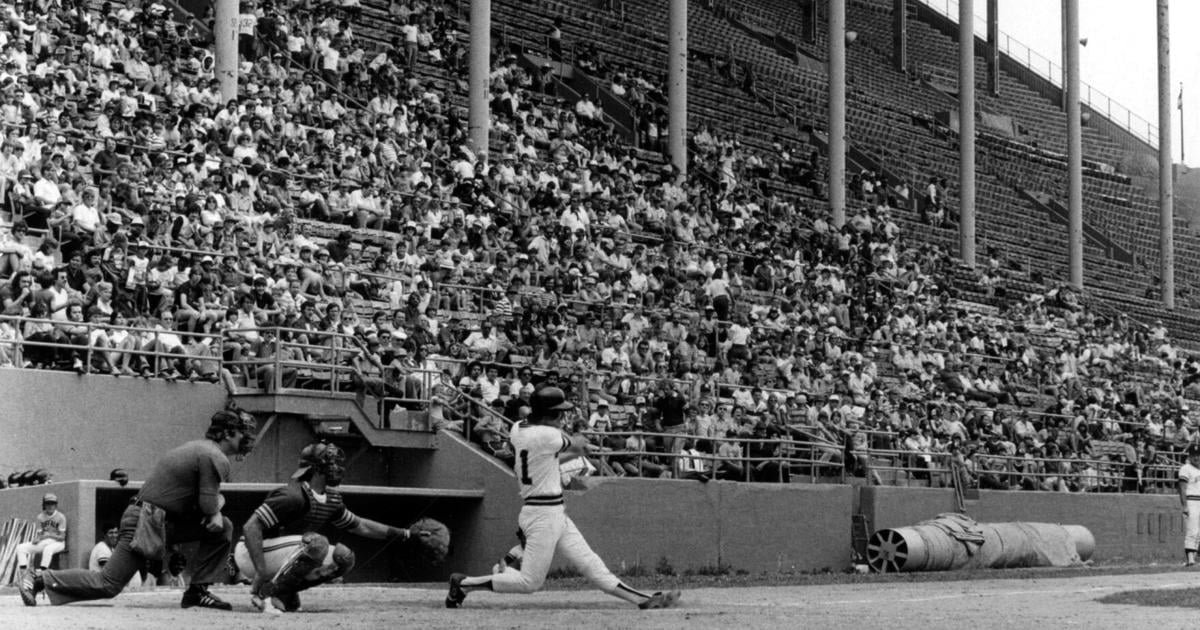

The Buffalo Bisons at War Memorial Stadium on July 1,1979
Photos courtesy of the Buffalo History Museum
Baseball’s nickname, America’s pastime, certainly feels true in Buffalo, which first saw professional—though unaffiliated—baseball all the way back in 1877. “Buffalo was a major player back then. The Pan-American Exposition would be here in 1901. It just made sense that we were on the forefront of professional baseball, too,” says Pat Malacaro, Manager of Baseball Communications and the Voice of the Buffalo Bisons.
Buffalo’s team was eventually invited to become a major league club, the Bisons of the National League, and played from 1879 to 1885. In 1886, the Bisons shifted down to the minors, joining what was then known as the Eastern League and beginning a long stretch as one of the most stable franchises in the sport’s early development.
The 1878 Buffalo Bisons
Photo courtesy of the Buffalo History Museum
The 1899 Buffalo Bisons
Photo courtesy of the Buffalo History Museum
The game looked far different than it does today.
“A pitcher [could] throw multiple times in a week and throw the entire game,” Malacaro says. “Pitchers [could] get to 150 innings in basically a month back then.” It was a rugged, fast-evolving version of baseball, and Buffalo was right in the middle of it.
In 1899, the Bisons joined the Western League, which soon announced plans to become the American League. For a brief moment, Buffalo appeared on the verge of regaining major league status. But by 1901, Boston got the spot, and the Bisons were sent back to the minors, where the team remained constant until the 1970s.
“From 1971 to 1978, Buffalo had no professional baseball team. That was just the economics of baseball at the time. War Memorial Stadium, the Rockpile, was aging, and without proper ownership and investment, the sport could not sustain itself locally,” explains Malacaro, who notes it wasn’t for long. “Bob Rich Jr. found out that there was an opportunity to get AA baseball back in Buffalo and jumped at the opportunity. That decision helped spark a revival, bringing the Bisons back in 1979 and eventually restoring AAA baseball to the city in 1985.”
A 1987 artist rendering of Pilot Field
Photo courtesy of the Buffalo History Museum
That resurgence set the stage for one of the most important moments in team history: the move downtown in 1988. Leaving behind the Rockpile, the Bisons opened what is now Sahlen Field, a ballpark ahead of its time.
“It was kind of a test pilot,” Malacaro says in describing the shift to a retro-style, baseball-only stadium in the heart of the city. The design that emphasized intimacy, nostalgia, and a true baseball atmosphere inspired a wave of similar ballparks across the country.
The stadium itself reflected bigger ambitions. Built with expansion in mind, it remains the largest in Minor League Baseball. “It was built to be a potential major league venue,” Malacaro says. “If you take the roof off, everything is in place to build a third tier on top of that. Most stadiums have around 10,000 seats. Ours is 16,600 give or take.”
Photo courtesy of the Buffalo Bisons
Photo courtesy of the Buffalo Bisons
In the years since, our home team’s reputation has only grown. When the Toronto Blue Jays needed a temporary home during the pandemic, Buffalo stepped in. Hosting Major League Baseball games in 2020 and 2021 gave the city a rare moment on the national stage. Through it all, the franchise has leaned into what makes baseball in Buffalo special: the fans.
“We try to make every game an event,” Malacaro says, noting themed occasions like Star Wars Night, a beloved annual tradition. “Our family-friendly ticket and concession pricing allows us to offer a product that fans can enjoy on an affordable budget.” After nearly a century and a half, the game has changed, the stadiums have evolved, and entire eras have come and gone, but, in Buffalo, baseball remains part of the city’s story.