

We’re more than one-third of the way through the season, and things haven’t gotten any better for the Red Sox.
Can the club still turn things around, and with so many key players sidelined, why have the Red Sox settled on the roster they’re carrying right now? We answer your questions in today’s Red Sox mailbag.
Why is Mickey Gasper on the team, never mind catching? — J. Baum
Why is Gasper on the team? You could make a case he’s been one of Boston’s best hitters this season.
Entering Saturday, Gasper was batting .306 with a .740 OPS in his first 20 games in the majors this season. He’s been even better when facing right-handed pitchers from the left side of the plate, and he earned his call-up after starting the year with a .296 average, six homers, 27 RBI and a .947 OPS in 28 games at Triple-A.
Considering how punchless the Red Sox offense has been at times, Gasper has legitimately made a difference. He’s been so productive that for a while Red Sox interim manager Chad Tracy played him at designated hitter over Masataka Yoshida even after Roman Anthony went down with his injury — theoretically freeing up an everyday lineup spot — until he later decided the better plan was to start Gasper at catcher instead.
Which leads to the second part of your question. Why is Gasper catching? It probably has a lot to do with the fact that Carlos Narvaez and Connor Wong have both been having difficult seasons at the plate. Narvaez is the best defensive catcher of the bunch and has been great against lefties, but Wong has seen his playing time really dry up.
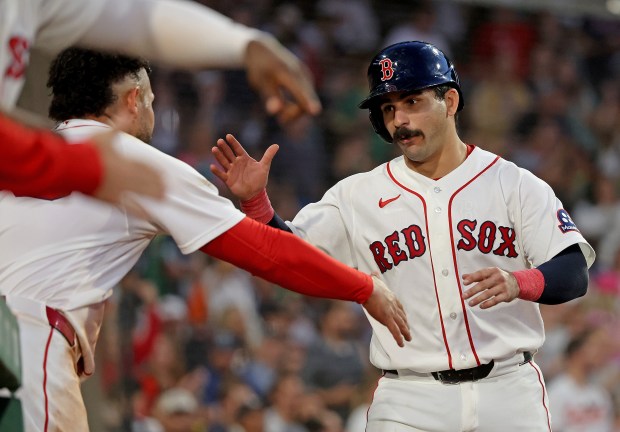 Boston Red Sox catcher Mickey Gasper celebrates scoring during the fifth inning at Fenway Park. (Photo By Matt Stone/Boston Herald)
If Gasper is catching regularly, what is the point of rostering Wong? — @YirmiyahuLaw on Twitter/X
Candidly, I’m not sure.
Entering Saturday, Wong had only played in six out of a possible 15 games since May 19. In one of those he came off the bench as a pinch runner, and in two of the others he started at DH. At this point its safe to say he’s been surpassed on the depth chart at catcher by both Gasper and Narvaez, and other than being a right-handed bat and a change-of-pace backstop, he doesn’t have an obvious role.
So why is he still in Boston? It probably boils down to there not being any better options.
The other healthy position players on the 40-man roster currently in Triple-A are Nate Eaton and Kristian Campbell, both of whom have exclusively played outfield this season, and infielder Tsung-Che Cheng.
Of the three, Eaton would be the obvious candidate for a call-up given that he bats right-handed and came into the weekend batting .291 with five home runs and an .822 OPS. But unless the Red Sox could play him at third base the only spot he could realistically start is DH, and it’s not likely he’d sub in for one of the starting outfielders often enough to justify him being on the bench. At least Wong can play catcher from time to time.
As for Cheng, he could play either shortstop or second base, but since he bats left-handed, having him, Marcelo Mayer and Anthony Seigler on the roster together would be redundant.
So for now Wong remains, though once Anthony, Nick Sogard or Romy Gonzalez come back his spot on the roster could become untenable.
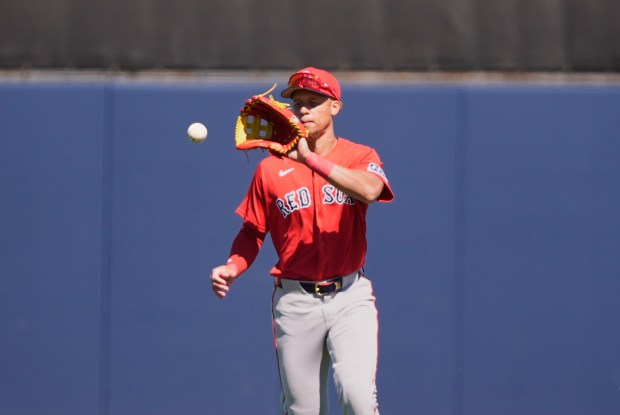 Kristian Campbell has exclusively played outfield in Triple-A this season. (AP Photo/Gerald Herbert)
What’s the mood in the organization around Kristian Campbell’s development? What does he need to prove in Triple-A to make it back to the big league roster? — Todd C.
Like with Eaton, Campbell’s path back to the majors is basically blocked.
Unlike last year where he broke camp as the starting second baseman but bounced around the outfield and even dabbled at first base, this season Campbell has exclusively played in the outfield. Considering the Red Sox are struggling to find playing time for the outfielders they already have, Campbell wouldn’t be a candidate to play regularly anywhere except maybe as a designated hitter.
Of course, if Campbell can start hitting and prove he can be a difference-maker in the majors then the Red Sox would need to figure out a way to get him in the lineup. But right now that isn’t happening.
Entering the weekend Campbell was batting .227 with two home runs, 19 RBI and a .665 OPS in 49 games at Triple-A. To put that into perspective, Campbell hit four home runs in 19 games at Triple-A at the end of 2024 when he was called up to Worcester near the end of the season, and last year he had eight home runs and a .799 OPS in 73 games after being sent down.
The obvious difference between Campbell at his best and Campbell today is he just isn’t driving the ball the way he used to. He actually got off to a decent start, batting .294 in April, but even then it was a lot of singles. Since the start of May he’s been trending downward, batting .164 since then with only five extra-base hits over 22 games.
Campbell has proven he can produce at a high level before, but right now the guy who set the minor leagues ablaze two years ago is nowhere to be found.
Is Triston Casas in the witness protection program? Where is he? — Brian S.
The good news with Casas is the catastrophic knee injury that ended his 2025 season has basically healed. Tracy said recently that they’ve reached a point where nobody is really talking about the knee anymore, and now the focus is on the left abdominal strain he suffered swinging earlier this spring.
The last update we’ve gotten on Casas came May 27 when Tracy said he was nearing a point where he could resume swinging.
“The knee is OK, just still doing rotational stuff for the side and I think he’s getting closer to maybe starting some light swinging progression,” Tracy said.
Once Casas starts swinging it will take some time before he progresses to a point where he could potentially be activated, so fans probably shouldn’t expect to see Casas in Boston anytime soon. But if he can avoid any additional setbacks and rejoin the team during the second half, he could provide an immediate and badly needed power boost to the Red Sox lineup.
 San Francisco Giants infielder Casey Schmitt would be a logical trade target the Red Sox could pursue in the coming weeks. (AP Photo/Geoff Stellfox)
Who are some realistic bats the Red Sox could trade for in-season? — @Nomar05Fan on Twitter/X
The way the standings are right now there aren’t many obvious sellers, and frankly if the Red Sox are still in a similar spot this time next month, they should really consider selling themselves. But as far as available bats go, a good place to start is by looking at some of the other underperforming clubs.
For example, take the San Francisco Giants.
As disappointing as this season has been for the Red Sox, you could argue things are even bleaker for the Giants, who have assembled a high-priced core of veterans that collectively might not be any good. There’s two players in particular the Red Sox might want to consider adding, Casey Schmitt and Luis Arraez.
Schmitt is a 27-year-old infielder who came into Saturday with 15 home runs and an .883 OPS. He can play all over the diamond, including at both second and third base, and will still have three years of team control remaining after this season. He also bats right-handed, so he pretty much checks every box and would theoretically give the club a major boost.
Arraez wouldn’t move the needle much in the power department, but the contact-hitting savant is in the mix for his fourth career batting title and has arguably been San Francisco’s best hitter overall. Arraez came into the weekend with a higher-than-you’d-think .803 OPS, led the Giants in Wins Above Replacement (2.2) and as a pending free agent should be reasonably priced as a rental. He bats left-handed, so that part isn’t ideal, but he could slot right into the lineup as the starting second baseman.
Other names who might be worth looking into include Angels infielders Zach Neto and Oswald Peraza and Miami infielder Xavier Edwards. One wild card, New York Mets infielder Bo Bichette. He’s been a disaster in New York, but he’s proven he can perform in the American League East. Perhaps he’d benefit from a change of scenery, and if the Red Sox were willing to take on some of his money, maybe the Mets would consider it a chance to wash their hands of the signing and move on.