
Chicago White Sox rookie center fielder Tristan Peters has some extra pep in his step when he shows up to the ballpark these days.
It’s hard not to when you’re third in the American League in wins above replacement (1.9) among center fielders, per FanGraphs, and playing your way into the All-Star Game conversation.
The Sox are tied with the Cleveland Guardians for first place atop the American League Central as they prepare for a three-game series against the AL-leading New York Yankees. Peters has been a welcome surprise, helping them to a hot start.
“I’d be lying if I said it wasn’t more fun,” Peters told the Tribune before Sunday’s series finale against the Los Angeles Dodgers at Rate Field. “It’s just that confidence going up to the plate and like, ‘OK, I’m swinging well, just let everything else happen.’”
That free feeling in the batter’s box comes from some adjustments he made in his swing that have led to profound success.
Peters was known for his hit tool coming up with the Milwaukee Brewers, San Francisco Giants and Tampa Bay Rays, who traded him to the Sox in the offseason. The Canadian had a unique path to the majors, playing junior college ball in Arizona before a season at Southern Illinois. In 2021, he appeared in 17 games and learned a few dances for the Savannah Bananas before the Brewers drafted him in the seventh round.
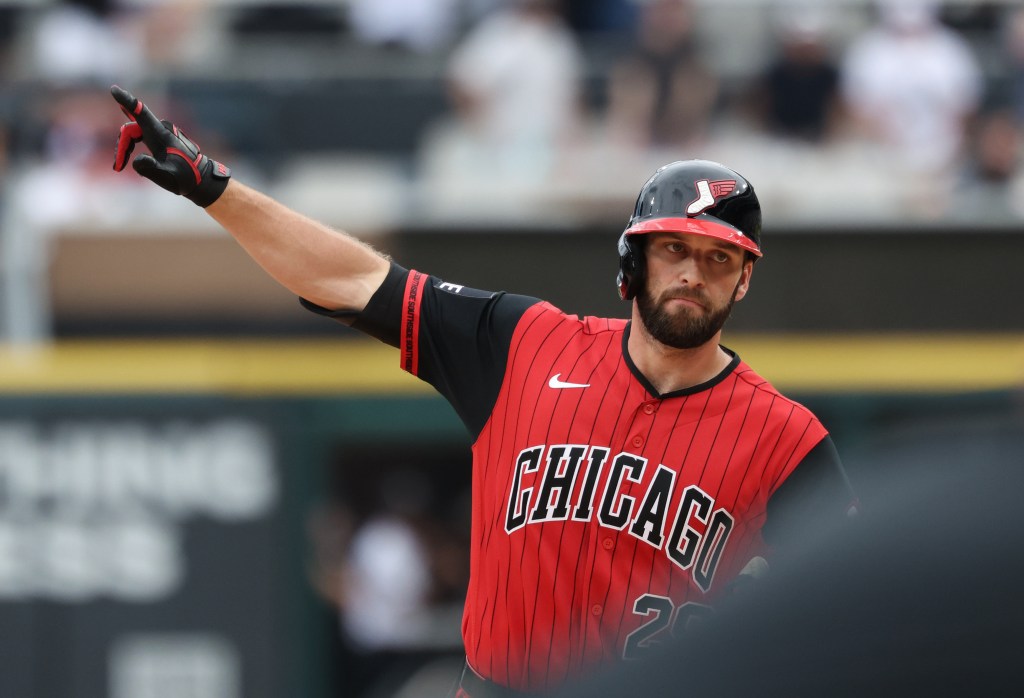
 White Sox center fielder Tristan Peters celebrates as he rounds the bases after hitting a three-run home run to put the Sox ahead of the Cubs on May 17, 2026, at Rate Field. (Eileen T. Meslar/Chicago Tribune)
But when Peters made his MLB debut with the Rays last season, he went 0-for-12 in four games. He started this season hitting .209 with a .509 OPS in his first 19 games.
That’s when Peters, hitting coach Derek Shomon and the Sox brass convened to try to unlock more of the bat skills that had made him an intriguing prospect.
“It can be scary (to make adjustments),” Shomon said. “I just want to hold on and sustain and survive, but a lot of credit has to go to Tristan and his willingness to say he’s willing to try new things.
“It takes an admittance to say: ‘I am a good player, but maybe I can be better. Maybe what I’m doing isn’t necessary enough.’”
The 26-year-old worked on reducing some of the extra movement in his pre-swing load and worked on his pitch-selection approach. That led to unlocking the potential the Sox had seen in him.
“There was an ‘aha’ moment with him,” Shomon said. “How he was interacting with the ground, how his lower half was operating, just trying to get it to be a little bit more efficient, which then influences what the upper body was doing and then influences his bat path and his timing. So definitely an ‘aha’ moment, and it’s cool.
“He’s got a pretty simple routine built out right now, but he’s putting it on rinse, repeat every day, and it’s been cool to see a transition in in-game performance.”
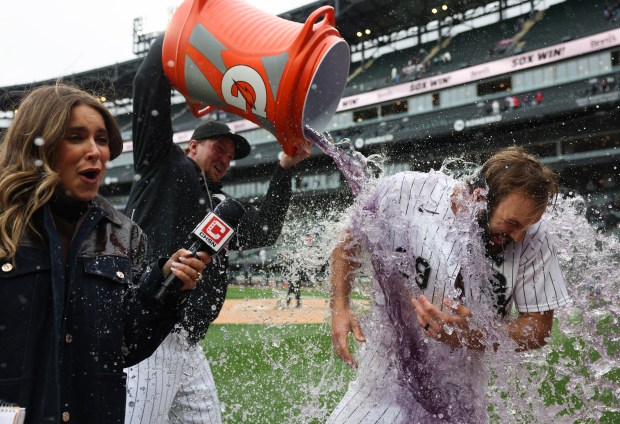 White Sox right fielder Tristan Peters gets a Gatorade bath from pitcher Erick Fedde after hitting a game-winning RBI single against the Blue Jays in the 10th inning April 3, 2026, at Rate Field. (John J. Kim/Chicago Tribune)
Peters swung at 75.9% of pitches in the zone in April and missed 26.7% of the time. In June, he has increased his swing percentage on pitches in the zone to 78.1% and is missing just 10.5% of those pitches. Since May 17, Peters is hitting .361 with a 1.084 OPS.
“That’s kind of who I’ve always been. I make contact,” Peters said. “So that was kind of odd in the beginning of the season.”
Part of that success, too, is comfort at the major-league level.
The velocity that exists day in and day out can’t be replicated in the minors, and that leads to a natural learning curve for hitters facing the best pitching in the world. For Peters, it was no different.
“That transition from Triple A to big leagues, it’s a big jump,” he said. “That was evident in my performance at the beginning of the year, just chasing more and stuff like that. They pitch you different, so there’s that, and everybody throws hard nowadays. If you can’t hit the heater, it’s going to be tough.”
Peters is hitting .295 with a .492 slugging percentage against four-seam fastballs this season, showing his adaptation to the heater. But being ready for the fastball has allowed him to adjust and be competitive with off-speed pitching too. He’s hitting .316 against sliders and .421 against changeups.
“A lot of credit to (Peters) for the work that he’s done,” Shomon said. “It’s been fun. Every time he goes up to hit, you know it’s going to be a good at-bat, a lengthy at-bat and likely ending with something on the barrel.”
That has lengthened the Sox lineup, as he routinely has been in the seventh or eighth spot in the batting order. A quality at-bat from Peters can help turn it over to Sam Antonacci, Miguel Vargas and Colson Montgomery at the top of the lineup and make the Sox order a slog for opposing pitchers.
His offensive success has put him in the conversation for an appearance in the All-Star Game this summer in Philadelphia while helping the Sox race out to a tie for first in the division. It also has rewarded the Sox for their belief in him.
“Credit to the player development group and the evaluators in acquiring him,” Shomon said. “They acquired him because there were things in his game that could continue to be developed and ultimately show up in what we are seeing on the field today.
“He’s done a great job being not only coachable and receptive, but just like it’s scary to make adjustments, especially when you are getting this type of runway in the big leagues.”
Andy Martinez is a freelance reporter for the Chicago Tribune.