

This isn’t shaping up to be the Red Sox’s year.
With each passing week the Red Sox slip further back of the pack, and after initially taking an optimistic posture top club decision-makers like CEO Sam Kennedy have recently begun acknowledging they may have to sell at the trade deadline.
That’s a painful admission to make for a franchise that entered the year with playoff aspirations, but the way things are going selling is the only responsible approach.
With so many teams still within striking distance of a playoff spot, the Red Sox could capitalize on what’s expected to be a seller’s market, commanding high prices for its trade chips and potentially positioning the franchise for a quick bounce back in 2027.
Bad as they’ve been collectively, the Red Sox have no shortage of players who’d be highly sought after on the trade market, and selling could also give the club an opportunity to clear some of the roster logjams that have plagued the franchise for years.
One thing’s for sure, by the time the dust settles on Aug. 3, the Red Sox could look a whole lot different.
Top trade chips
Aroldis Chapman, LHP
The Red Sox’s most obvious and valuable trade chip, Chapman is trending towards earning his ninth All-Star nod and again ranks among the most dominant closers in baseball. Even at age 38 Chapman remains one of baseball’s hardest throwers and has been among the few bright spots of an otherwise dismal season.
He would immediately provide a massive boost to any contending club’s bullpen, who would certainly get more use out of him than the Red Sox, who have found themselves in save situations so infrequently that Chapman only appeared in three games over a span of nearly a month.
Though Chapman’s deal technically runs through the end of this year, he has a vesting option for 2027 that would guarantee him $13 million if he reaches 40 innings this season. Chapman is already more than halfway there and if traded to a contender would likely surpass that threshold, giving his new club an extra year of team control and potentially making him an even more valuable commodity.
Sonny Gray, RHP
Though his strikeout totals have been down after back-to-back seasons with 200 punch outs, Gray has otherwise been very good since joining the Red Sox this season. The veteran has a wide-ranging pitch mix and could conceivably start a playoff game for any contender, though unlike Chapman there are a couple of hurdles that might hinder Gray’s market.
One potential sticking point is Gray still has a no trade clause that carried over from his original deal with the Cardinals. That might limit the teams who could potentially acquire him, but given how this season is going, it seems likely Gray would be amenable to playing for a contender rather than playing out the string for a last-place team.
The other issue is Gray’s salary. Though the Red Sox will only owe Gray another $3.6 million or so over the last two months of the season, he’ll also be due a $10 million buyout when his 2027 mutual option is declined, as nearly all mutual options are. That’s a decent chunk of change for a rental, so the Red Sox might need to cover some of that salary to maximize their potential return.
Willson Contreras, 1B
This would probably be the most painful trade the Red Sox could make.
Despite all of Boston’s offensive woes, Contreras has given the club everything it could have possibly hoped for and more at the plate. The first baseman is on track to set a new career-high in home runs and has perfectly tailored his game to Fenway Park’s unique dimensions. He also has two more years of club control and a no trade clause, so the Red Sox would probably prefer to keep him as an anchor for what should hopefully be an improved lineup next season.
That being said, if a contending club with a need for a middle-of-the-order masher came along and made Boston a Godfather offer, the club might have no choice but to accept.
Garrett Whitlock, RHP
In many ways trading Whitlock would signal a new era for the Red Sox. The right-hander is the club’s longest-tenured active player and after several years battling through injury has emerged as one of the game’s most dominant late-inning relievers. He also earned a spot on Team USA’s roster for this past spring’s World Baseball Classic and is an active participant in both the organization’s charitable endeavors and in MLB Players Association affairs.
Losing a guy like that would reverberate well beyond the clubhouse, but the fact is Whitlock would make any contending team’s bullpen better and he comes with two years of club control at an affordable price.
The Red Sox could fetch a great return for Whitlock, though admittedly if they trade both him and Chapman then what’s left of the club’s bullpen could be a horror show over the final two months.
 The Red Sox have an outfield logjam, and trading Jarren Duran would likely be the most straightforward way to clear it. (Matt Stone/Boston Herald)
Flawed veterans
Jarren Duran, OF
The Red Sox probably should have traded Duran this past offseason when his value was higher, but even after a rough start to the season the outfielder still possesses plenty of tools that could help bolster a contending club, including his speed, sneaky power and defensive abilities.
He could also probably benefit from a change of scenery, and the Red Sox need to do something about their outfield logjam regardless.
Though Roman Anthony’s extended absence has rendered the issue moot for now, at full strength the Red Sox have more outfielders than they have available lineup spots. Anthony, Ceddanne Rafaela and Wilyer Abreu project as the club’s outfielders of the future, so moving Duran would pave the way for those three while representing the first step towards building a more sensibly-constructed roster.
But to truly make the puzzle pieces fit, moving Duran won’t be enough.
Trevor Story, SS
Story’s time in Boston has been marred by frequent injury setbacks, and a sports hernia suffered during the spring effectively ruined his season. Story ranked among the worst everyday players in MLB over the first two months, and eventually things reached a point where continuing to play through the injury was untenable.
The saving grace for the Red Sox is Story’s early struggles have a straightforward explanation, so if he can return after the All-Star break it might be possible to find someone willing to buy low, especially if Boston eats a good portion of his remaining $25 million salary for next year.
The other consideration here? If this is going to be a lost season, the Red Sox really need to see what they have in their younger players. Marcelo Mayer has taken over as Boston’s everyday shortstop since Story went down and should remain in that spot for the rest of the year, and even if Story were OK with bumping over to second base, he’d still be blocking top infield prospect Franklin Arias, who the club might otherwise give an extended look over the last couple of months.
Masataka Yoshida, DH
The Yoshida situation has dragged on far too long, and one way or another the Red Sox have to move on.
Originally viewed as a potential franchise building block when he signed a five-year, $90 million contract ahead of the 2023 season, Yoshida has battled frequent injuries and is now little more than a part-time designated hitter. When the Red Sox had their full complement of outfielders Yoshida barely saw the field, and even after Anthony went down he’s still struggled to compete for at bats with Mickey Gasper.
Yoshida needs a change of scenery, and as long as he’s taking up a roster spot the Red Sox won’t be able to field a workable bench.
This would probably be a pure salary dump and the Red Sox might even have to attach another prospect to get a team to bite, but like with Duran, moving on from Yoshida would free up the roster space needed to eventually build a better team.
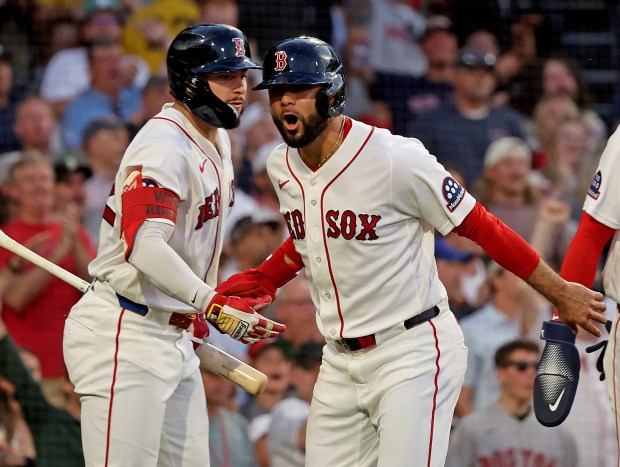 Infielder Isiah Kiner-Falefa, right, is among a handful of veterans who the Red Sox might make available ahead of the trade deadline. (Matt Stone/Boston Herald)
Complimentary pieces
Connor Wong, C
The Red Sox are carrying three catchers on their big league roster, and with Mickey Gasper moving to the top of the depth chart Wong’s playing time has effectively dried up. Yet Wong does have a track record of big league success, so a contender looking to add a second catcher might find him an appealing target.
Isiah Kiner-Falefa, INF
Kiner-Falefa is having a good season at the plate by his standards and is a veteran who can provide quality defense all over the diamond. He could provide a boost to a contender as a utility bench infielder, something the Red Sox have plenty of to fall back on.
Patrick Sandoval, LHP
Sandoval hasn’t pitched since 2024 due to Tommy John surgery but appears to finally be nearing a return to the mound. His role with the Red Sox remains uncertain, especially once Garrett Crochet returns from injury, but if a club were willing to take a flier on him as a rental he could provide a boost as a back-of-the-rotation starter or as a multi-inning lefty reliever.
Greg Weissert, RHP
Weissert’s had a tough season, especially with runners in scoring position, but when given a clean inning he tends to pitch well more often than not. He also won’t hit free agency for another three years, so a club looking to bolster their middle-relief group might find him a useful piece.
Danny Coulombe, LHP
Veteran lefty relievers are always in high demand come trade deadline season, and Coulombe has mostly pitched well for Boston outside of a couple of blowup outings that have skewed his overall stats. The Red Sox also have a ton of lefty reliever depth, so if the club can pick up something for the 36-year-old pending free agent that would probably be worthwhile.
 Boston Red Sox pitcher Greg Weissert is booed as he’s taken out during the sixth inning of a May 7 game at Fenway Park. (Photo By Matt Stone/Boston Herald)