
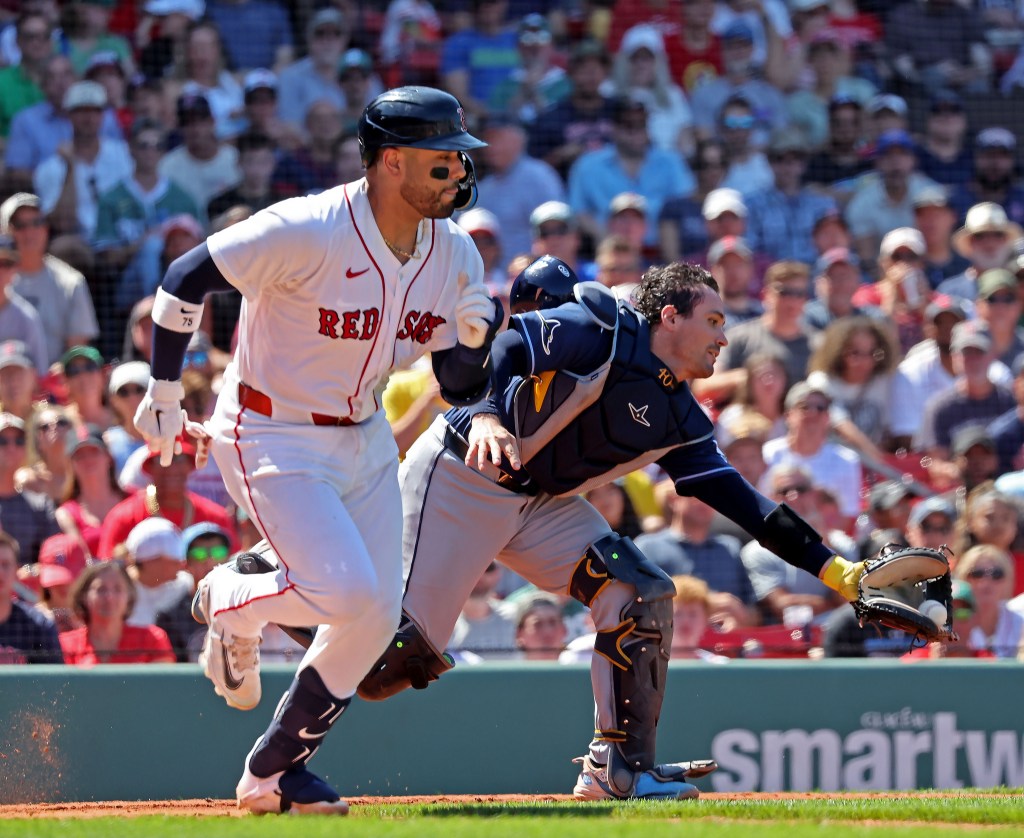
The Red Sox homered, but it was really the little things that put the big numbers on the scoreboard in Friday’s 10-0 victory over the visiting Tampa Bay Rays.
Boston entered Game 2 of Friday’s doubleheader with an MLB-best 18-5 record since June 19, 15 wins in their last 17 games, and on a nine-game win streak.
“It was about time,” said catcher Carlos Narváez, whose three-hits in the Game 1 win included one of the two homers. “The energy has been up. If you break down the games before this streak, it was really, really close games, missing opportunities by just a little. It was about time to click.”
But for all their recent success, the Red Sox entered the day with the lowest overall home-run total in the majors, 85 in 94 games. The difference-maker, several players said after Game 1, has been small ball, the savvy manufacturing of runs through stolen bases and sacrificial hits, like bunting.
Small ball put six runs on the board for Boston in an 11-batter bottom of the sixth. The Red Sox loaded the bases on a Caleb Durbin hit-by-pitch, Masataka Yoshida single and Romy Gonzalez walk. After Jarren Duran’s two-run single deflected off the glove of leaping second baseman Ben Williamson, Narváez and shortstop Tsung-Che Cheng drove in a run apiece with back-to-back RBI bunt singles.
“That’s what it’s all about,” said Narváez, who touched home on Ceddanne Rafaela’s team-leading 23rd double. “Get the job done, no matter which way it is. … I had the sign. OK, let’s go.”
Durbin is well-versed in small-ball strategy from both sides of the equation. He went 3 for 4 with two runs and an RBI Friday afternoon, and is making himself the frontrunner for the Gold Glove Award at third base by hindering opponents’ attempts to play small.
“I think we’ve played good defense all year, and that’s what’s kind of kept us in games, even when we weren’t winning as much, we’ve been in every game, it feels like,” Durbin said. “Now the offense is clicking a little bit, and we’ve got some momentum. And those close games that we were kind of falling on the wrong side of, we’re on the right side now. And then we’ll have games where we’re kind of blowing it up, too, scoring a lot of runs.”
Durbin beamed as he spoke about watching his teammates execute on Friday.
“Oh, it was awesome!” Durbin said. “I was fired up, I was fired up. We’ve been playing more of that brand of ball lately. It’s kind of, I think, loosened up other aspects of our offense.
“It takes the pressure off of guys like Willson (Contreras),” Durbin explained, referring to the team’s first baseman, who leads the club with 20 home runs. “We don’t have to hit the long ball. We can kind of score in different ways, and that’s what we’re going to need to do. That’s what good teams do, and it’s fun that we’ve been able to do that recently.”
Narváez credited the team’s unified focus to their recent success. He spoke of a meeting Tracy called in New York last weekend, and how nearly the entire team attended the optional workout at Fenway on Thursday.
“The message was, ‘OK, we’re good. But after the break, we have series against our division teams, so everybody locks in,’ ” Narváez recalled. “I mean, yesterday we had the workout and pretty much every guy was here. So that tells you a lot, where we’re at as a team, where’s the mentality of it. … First game was very important, and everybody was ready. So that was the whole message, and I think everybody, (we) understand and received that message very well.”
Small-ball success is indicative of a well-oiled machine. All parts of the game contribute to the sum of the whole, but small ball hinges on connection and teamwork. A solo homer, for instance, only requires a batter who can hit the ball out of the yard. A well-executed RBI bunt single requires situational awareness, perfect placement, and a speedy baserunner.
So, is small ball the emphasis for the second half of the season?
“I wouldn’t say we’ll call it the emphasis, it’s just take what the game gives you,” Red Sox interim manager Tracy said. “We have guys in our lineup that are gifted bunters, they can get it down. It doesn’t mean we’re going to do it every time … We’ve been doing that for a while now, and credit to them, they buy in and they get asked to do a job and they execute the job. That’s what baseball is all about.”
“We’ve talked a lot about like, execution,” Tracy said, “and the game gives back to you if you’re playing team baseball.”