
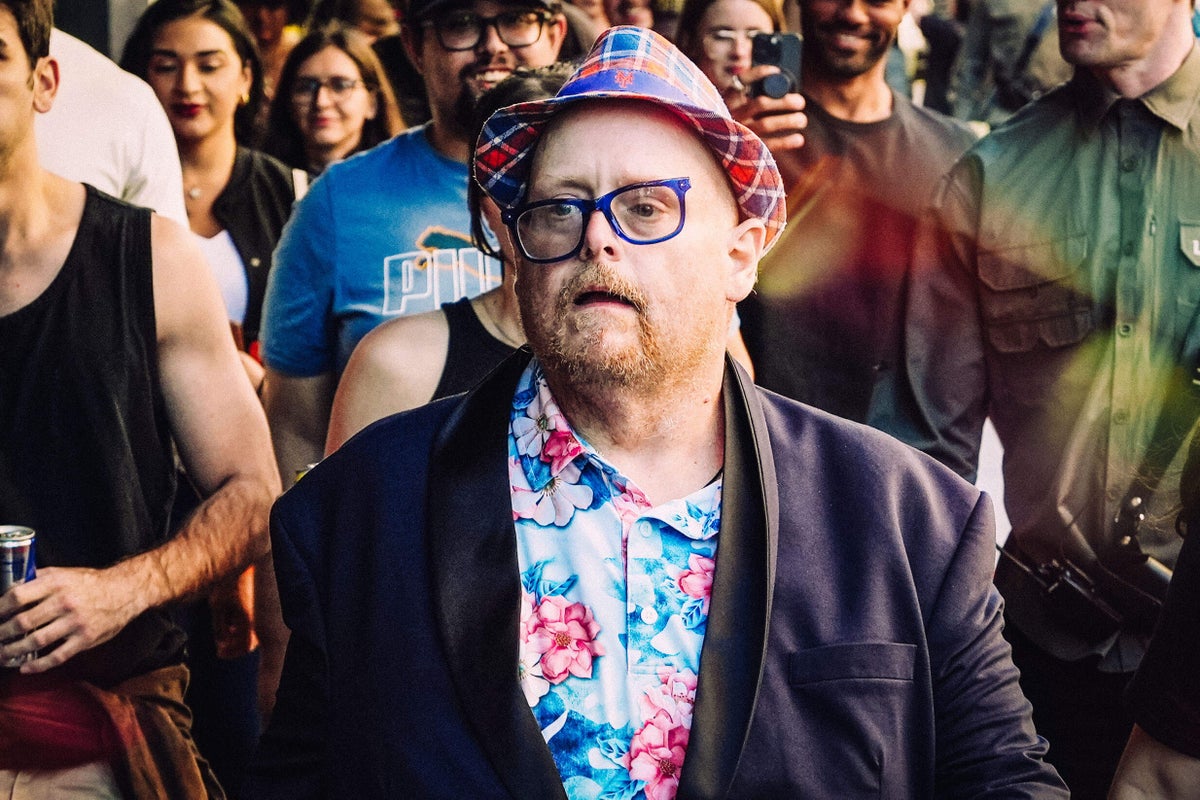
NEW YORK — For a brief moment, Frank Fleming was silent.
The Mets were leading by three runs, after their offense put up five in the first three innings. Their ace was on the mound. By the standards of this godforsaken season, things were going about as well as they possibly could.
That was until shortstop Bo Bichette, or, as Fleming sometimes calls him, Bo Bis—t, was unable to make a difficult play on a soft grounder in the hole. It was a single, elongating the inning, as the Mets’ lead withered away.
Then it was clear that silence was merely a pause, a moment for Fleming to gather and focus his fury, before finally unleashing it.
“$42 million, Bo,” he shrieked. It was audible to everyone in the section, everyone from fanatics like him to families with children, but likely not to the shortstop himself. “You’re a bum. You’re the worst Mets signing of all time.”
Fleming is famous for his rants. Some criticize them for being purposefully mean-spirited. Others say they’re contrived to generate clicks. This anger, in that moment, seemed natural. It was coming out whether or not there was a camera.
“B-U-M,” he continued yelling at Bichette.
“S-H-U-T U-P,” an exasperated Mets fan yelled back at Fleming.
“So you think this is good,” Fleming retorted, the pace of his voice becoming faster and louder. “He stinks. $42 million. He’s robbing us.”
“We’re in the fourth inning,” she said. “Relax.”
Here at Citi Field, “Frank the Tank” Fleming was in his element. To observe one of the sport’s most polarizing and notorious fans on his home turf is to learn about what drives him in a way that goes well beyond the one-off, 40-second clips that inevitably creep into the algorithms of so many baseball fans.
At the stadium, Fleming may seem to be simply another loud, occasionally obnoxious fan, but his rants and bellows resonate far beyond the mezzanine; Fleming is one of the most marketable faces of Barstool Sports, the massively popular and often controversial sports content machine.
The site’s founder, Dave Portnoy, discovered Fleming in a viral local news clip in 2017. In the years since, Barstool has featured Fleming as a media star across all its platforms, building his brand through podcasts, YouTube shows, live-streaming and short social media hits.
Fleming has amassed nearly 1 million social media followers across his various platforms, including X, Instagram, TikTok, YouTube and Facebook. He’s developed friendships with high profile celebrities such as Arnold Schwarzenegger. From the walk to the subway to departing Citi Field after the three-hour plus game, Fleming was stopped for photos more than 100 times.
Some love him for his candor, some hate him for his rancor. Many are inspired by his massive weight loss — dropping from 550 pounds to his current 280 through daily walks and diet, posted through monthly weigh-ins. Others believe his temperament crosses the line of a polite society.
In many ways, he is the originator of this genre of content — inspiring legions of copycats screaming into their phones, turning anger into clicks. What started as Fleming Periscoping his tirades more than a decade ago has taken on a life of its own.

Fleming is a regular presence at Mets games, and a vocal one. (Sam Blum)
Fleming says he does not care about being beloved; that is residue from the first 40 years of his life, when he says he got used to surviving without much love or support. His controversial antics generate skepticism and frustration, both at a man who many believe is over the top, and at a company, Barstool, that critics say exploits someone who, by his own estimation, has an undiagnosed form of autism.
Still, for perhaps the first time in his life, Fleming feels like he has a purpose, whether you like it or not.
“Anybody who says that … ‘Oh, Barstool is exploiting the ranting,’ A. He was ranting before,” Portnoy said. “And I mean it, there is no clearer example of somebody who’s benefited (more) from having motivation than him.”
“I just try to be myself,” Fleming said. “That’s all I ever try to do.”
Typically a place to release vitriolic tirades and capture unedited reactions, the watch room at Barstool Sports’ main office in New York was still. The TVs that lined the walls — normally alit with games to capture live-streamed reactions — were all turned off. The large reclining chairs were empty. The office space, replete with table games, cubicles and areas to relax, lay barren as the weekend was just beginning.
There was, however, one man in the room. Fleming, clad in a black Carlos Beltrán jersey, was focused on the laptop in front of him. About four hours before first pitch on this late May afternoon, a man known for ear-piercing screeds was in this moment quiet and reserved — seemingly nervous and uncomfortable in a way he’d likely never admit.
The rise of Fleming coincides with the evolution of Barstool’s business model. The company first drew attention as a foul-mouthed blog that highlighted the Smokeshow of The Week. The content can still be sophomoric at best and offensive at worst, but the method of delivery has changed.
Their flagship podcast, Pardon My Take, can now be found on Netflix. The company hosts a morning talk show on FS1. At bottom, Barstool makes its bones as a content generator with deep ties to the gambling industry. They do short-form video, long-form podcasts and watch-along livestreams.
The company is searching for characters who can connect with consumers and stars who command attention. Within this milieu, Fleming has become something of a version of both.
“I was hired to monetize him,” said his producer and close friend Matthew Piper Jenks, who has also been a source of support in Fleming’s massive weight loss. “Get sponsorships. He’s doing more for the company than he ever did in the past. He’s doing more for himself than he ever did in the past.”
Who is Frank ‘The Tank’? The always angry Mets superfan
Sam Blum and Johnny Sweet
Portnoy recruited Fleming after seeing him scream about delayed New Jersey transit service before the Mets home opener. They looked him up, found his (now defunct) website, which Portnoy estimated had “a great grand audience of zero.” It kept an encyclopedic history of every professional team, updated daily for decades.
“People make such a mistake believing that he’s fake or simple,” Jenks said. “No dude, he’s real, and he’s complicated.”
Fleming is in his comfort zone when talking, or more often ranting, about Mets infielder Mark Vientos’ low on-base percentage, or now-former manager Carlos Mendoza’s poor in-game decision making. He is less certain when talking about himself, how he got here, why he acts the way he does.
When talk turns personal, Fleming can become fidgety and evasive. His laptop remained open as he scrolled relentlessly through his email and socials, sometimes turning questions about himself back to the Mets.
Why, he was asked, was it so hard for him to talk about himself? Why after all these years of instinctually shredding everyone else, could he not turn the microscope back on himself?
Finally, he opened the door just a little bit.
“I guess,” Fleming said, “I never really got any compliments growing up.”
So, as an adult, he struggles to give them, too. Renaming Mendoza, then the manager, Mendozeoff. Screaming at Bichette, Marcus Semien and numerous other underperforming, overpaid players. Ranting about the team playing Chappell Roan’s “Pink Pony Club” on a nightly basis.
And during this catastrophic season — churning one of the most expensive rosters in baseball into a last-place laughingstock — Fleming’s anger more closely mirrors the emotions of the fanbase. His megaphone is louder, his rage more palatable, and his voice more aligned with that of the average fan.
The art of watching a game on camera for an at-home viewing audience has Fleming at its core. It’s the kind of content Barstool, Jomboy and others lean into: Individuals hoping to build an audience by livestreaming their viewing experience. Fleming’s must-see reactions have built that brand.
“There’s certainly a lot of people, who I think nowadays, who will put on an act for their teams because they want to go viral,” Portnoy said. “But a lot of times you can tell it’s genuine from the nod. Frank is somebody who so clearly does it with or without the cameras.”
Fleming left the office about three hours before first pitch at Citi Field and walked to the 7-line subway station at Hudson Yards. People approached him at nearly every New York City block.
Once a man unseen by the world — unless stared at for his obesity — he has found a lane doing something that’s given him a purpose. Even if it doesn’t make sense to everyone.
The autumn of 1986 should have been a core memory for Fleming. The then-10-year-old, however, had a 9:30 p.m. bedtime, which was frustratingly non-negotiable.
The Mets would go on to win the only World Series of his lifetime, with Fleming sent to bed in a room that felt to him like a prison, devoid of a way to experience it. Now a middle-aged man, he still regularly brings up that form of psychological torture. It eats at him.
“Yes,” Fleming said. “Every day I feel that.”
Fleming’s father never took him to Mets games; not once did they ever go to Shea Stadium together. He said his dad never showed him much affection. As Fleming put it, “My father wasn’t the warmest soul on the planet. … He just wanted to sit in front of the TV all day.”
In 1988, the Mets lost in Game 7 of the NLCS. Fleming’s father, Frank said, blamed the failure on his son. This time, he’d allowed Fleming to watch. This time, they’d lost. His childhood trauma is intertwined with a team that continues to provide more on a nightly basis.
Fleming said his parents berated him as a child, sending him to a high school that they told him was for “emotionally disturbed” children. As he tells it, his life has been a checklist of receiving insults, from everyone to his parents, coworkers and acquaintances.
In adulthood, he was morbidly obese, eclipsing a scale that maxed out at 530 pounds. He was at risk of a far-too-early death and numerous other diseases. When Fleming began working as a court clerk in New Jersey — a job he’d have for 16 years — he received HR complaints because of his smell when he’d come back from lunch breaks.
“Then I just sat,” Fleming said. “I sat at lunch. I didn’t do anything. And over the next 10 years, I got to 500 pounds.”
“I didn’t really care. (The Mets) mattered. But nothing else really did.”
For so long, the Mets were all he had. That’s why, to Fleming, the stakes of every pitch were magnified.
In March, Fleming’s father died from complications following an infection. His mother, with whom Frank continues to have a complicated relationship, lives in Idaho. He said his parents moved there late in life to escape into isolation.
Fleming still struggles to absorb compliments. When Jenks, his staunchest supporter, texts him that he’s proud of him, Fleming often doesn’t respond. Jenks has led the charge in Fleming’s weight loss — encouraging daily walks, promoting his journey online, and holding him accountable. He posts Fleming’s weigh-ins, good or bad.
Jenks is not offended when those texts go unanswered. It’s not that Fleming isn’t appreciative. It’s just difficult to respond to communication that feels so foreign.
“I’ll give him the most heartfelt ‘I love you, I’m proud of you,’ text, and he just doesn’t respond,” Jenks said. “I don’t get upset. I’m just like, ‘That must have touched his little heart. He doesn’t even know what to say.’”
“I don’t know how to respond to it,” Fleming admitted. “I don’t know how to process it.”
One of the last times Fleming saw his father was in December, he said. They were flying across the country for Christmas, and had a lengthy layover in Denver.
In the airport, fans came up to Fleming, much as they do most everywhere he goes. But until that point, his father had never seen that. He was still the loser son — overweight and underaccomplished.
“My father was never physically abusive, but he was verbally abusive,” Fleming said. “Very emotionally abusive.”
That trip, Fleming believes, showed his father that he’d made something of his life.
“That really resonated with him,” Fleming said. Sensing his dad’s affirmation, he said, gave him a feeling that he’d rarely experienced.
“Some sort of pride.”
Do you think it’s a bit? Do you think it’s genuine?
Pete Alonso, a beloved Met of seven seasons — a player who often faced Fleming’s ire and sometimes even received his adoration, considers this idea.
“I…” Alonso said, stammering a bit as he tried to answer. “That’s a really good question.”
“It’s complicated,” the now-Orioles first baseman finally said.
That, ultimately, is the question so many have of Fleming. What’s real and what isn’t? What’s fair game for a New York caricature? What’s crossing the line — particularly when that anger comes with a profit for a massive media empire? As Portnoy noted, Frank “makes a lot of money.”
“It’s not just in New York,” Alonso said of the increasing cascade of viral criticism he and his teammates receive. “It’s probably the most apparent it’s ever been. Especially with how social platforms have grown.”
Alonso said he knew what came with playing in his former city, and he knew how to block out the noise. But he also didn’t deny knowing Fleming and his content, and he didn’t minimize the anger with which he spoke, or its impact.
“He’s still gonna say what he’s gonna say after every win and loss,” Alonso said. “I know the gig. I’m not stupid. I’m very aware of why he’s a personality.”
Many in the Mets’ orbit have complicated views on the team’s most controversial fan. For others, it’s simple. Seated across from Fleming on the MTA’s seven line to Queens was a woman whose gaze was unwavering. It was easy to clock her noticing Fleming off the bat, but Fleming either didn’t see or didn’t care.
Eventually, she mustered the courage to say something. “Are you Frank? I think you’re the greatest. You’re saying what we’re all thinking. When we get off, can I take a picture with you?”
“Yeah, go ahead,” Fleming muttered, not looking up from his phone.

Around Citi Field, it’s hard for Fleming to get around without being stopped by fans. (Sam Blum)
In this small subsection of the sports world, those requests are constant. Some are respectful. Some treat him with reverence. Some scream at him like a zoo animal, hoping to capture first-hand video of him snapping back. Still, he says yes to every request.
The rants have spurned a love-hate relationship with the Mets. While other MLB teams have invited Fleming to throw out the first pitch, the Mets organization, he believes, despises him.
At a charity event last season, Fleming claims that billionaire Mets owner Steve Cohen told him to “be nicer.” At the same event, he says another Mets player gave him an elongated stare down. He contends the team has a standing order never to show him on their broadcast.
“I’d make sure the clouds rained down upon them,” Fleming said, when asked his thoughts on the team potentially restricting his access to the ballpark.
The Mets did not respond to questions for this story.
Still, Fleming said, the family of one Mets player are fans, and stopped by the Barstool office in an attempt to meet him. And that charity event he attended was Alonso’s, who said he appreciated Fleming’s attendance.
He’s also developed a friendship with Mets legend Darryl Strawberry, who supports his weight loss and has encouraged Fleming to let go of his father’s criticisms. Strawberry is unafraid to text Fleming, and call him out for overly critical and emotional analysis.
“When I see him go off on social media, sometimes I’ll be like, ‘C’mon Frank,’ said Strawberry, an All-Star right fielder on that 1986 team. “And he’ll respond back maybe a day or two later. I guess he’ll think about it. I’m just trying to calm him down, ‘Easy does it, Frank. … He goes, ‘Yeah, you may have a point there.’”
The Mets had blown a four-run lead. Their bullpen had been mismanaged. Their defense had made mistakes and their offense had left runners on base. It was, in so many ways, just another night at Citi Field.
Fleming is at home on nights like those.
Fleming publicly blasts the team’s rave-like in-game entertainment. He wears a bag over his head when things get ugly, and yells blood-curdling screams from his seat in the last row of the field level. He estimates he spends “a couple thousand” dollars a year on glasses, which he chews and breaks when stressed about his team.

Still, his first move inside the ballpark was to slap down his credit card for a $50 random memorabilia draw. He won a Luis Robert Jr. game-used bat pin. “Can’t be too used,” Fleming retorted, eliciting an uncomfortable chuckle from the store’s attendant.
And sometimes, even for the Mets, the unexpected happens. When it does, Fleming is seemingly at a loss.
There was no joy on Fleming’s face when MJ Melendez skied a long two-run walk-off, 10th inning homer. He stared blankly, then shook his head as the celebration ensued with flashing LED lights and joyous fans.
Fleming sat in an almost stunned silence, unable to enjoy it in the same way as those around him. Mets wins seemingly never give him joy. At best, they offer relief.
“They’re still nine games under .500. It’s meaningless,” he said of the win.
On Father’s Day, Fleming completed his 1,000th walk. His weight is down by nearly half from his peak. His A1C, which measures blood sugar, is down from 11 to 5.4. He walks every day, even if it’s painful or he’s sick.
Schwarzenegger, the legendary bodybuilder, actor and politician, invited Fleming to speak at his weightlifting summit, and wrote earlier this week that “Frank is a machine. He can’t be bargained with, he can’t be reasoned with. He doesn’t feel pity, remorse, or fear. And he absolutely will not stop, ever.”
He’s added years to a life that now has more at stake than just the Mets: Friends, work, and a support system rooting on his continued physical and emotional health.
“I need to make sure that I can trust him, and I need to make sure that he can trust me,” Jenks said. “I need to understand how this man is operating at his core. Because he’s a complicated fellow.”
Even Mets infielder Francisco Lindor, often in the eye of Fleming’s storm, complimented him. “Frank, keep losing weight, we’re going to try to win more games, so your stress levels stay at a good place,” Lindor said on a Barstool podcast in April. “If we don’t, you can boo us. Boo me.”
He is a part of the Mets ecosystem now, in a way he could have hardly imagined when he posted his first video a decade ago. He has built a brand on rage and spittle, tapped into the raw emotions of an entire fanbase, channeled his passion in ways that have measurably improved his life.
Yet the anger remains — unquenchable, intractable, necessary for someone who has crafted a world that now revolves around it.
Fleming was posed a hypothetical question. If Bo Bichette, the player that he’s been most critical of this season, wanted to get a beer with him, what would he say? Would forging a personal bond change the impersonal way in which he speaks of him?
“I don’t know,” Fleming said. “He really has to start turning it around.”