
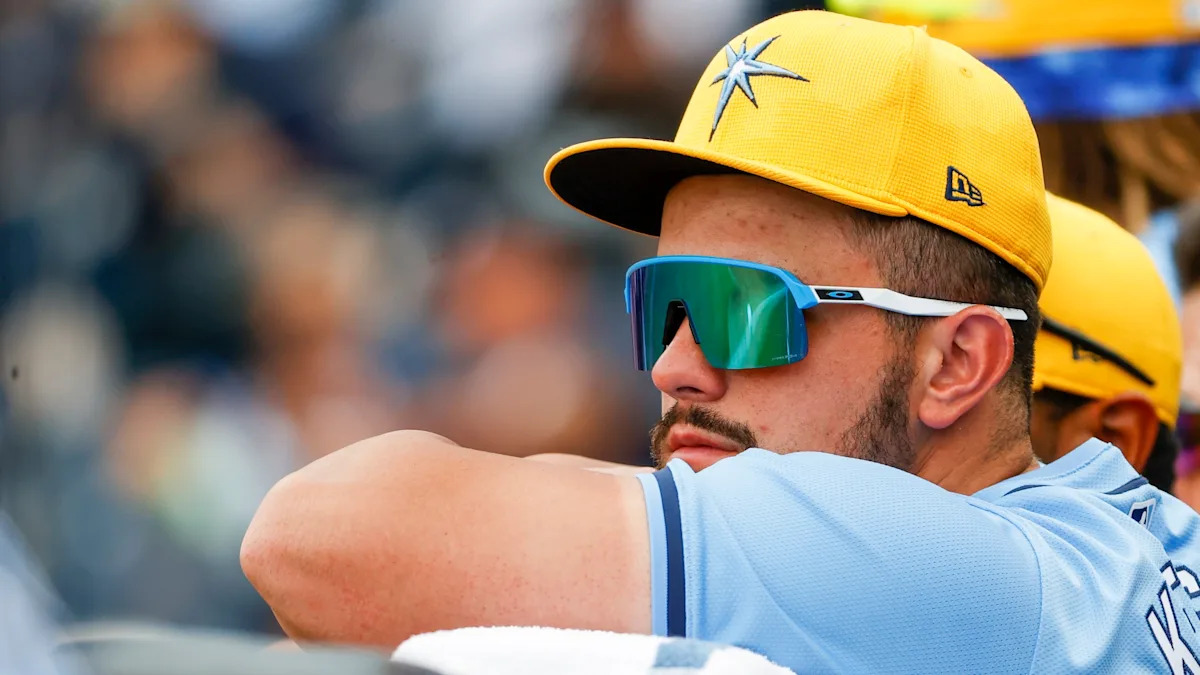
TAMPA — Recently acquired backup backstop Matt Thaiss wears No. 34 on his jersey, but the more telling number is 53.
That’s how many catchers the Rays have used over their 28 seasons in what has seemed a never-ending quest for a long-term, top-level solution behind the plate.
Advertisement
They’ve gone about it different ways — bringing in some bigger-name veterans, trying some undervalued options, gambling on relative unknowns, giving a kid a chance and, at times, scrambling for who’s available.
They’ve hit on a few over the years: Dioner Navarro, Wilson Ramos and Mike Zunino each made All-Star teams as Rays; Travis d’Arnaud resurrected his career.
But for the most part, it’s been a scramble for stability, with three seasons pretty much the longest run, then on to the next one.
You have to go back to the dark green Devil Rays days for the last stretches when the franchise had the same primary catcher for more than three seasons — 1997 draftee Toby Hall, from 2000-06; and before that trade acquisition John Flaherty from the inaugural 1998 season through 2001.
Advertisement
“Across the league, the number of anchor catchers that there are year in and year out that you can count on, it’s a shorter list than there are major-league opportunities,” Rays baseball operations president Erik Neander said.
“And we haven’t landed it. (Zunino) did a really good job for us for several years on one side of the ball, and the other, just being an anchor for our staff who was so well respected. But that’s obviously, historically, a position that in terms of having stability we haven’t found that. And I think that’s been well documented.”
Because of the premium the Rays place on pitching, they tend to lean toward catchers known more for their work behind the plate — handling the staff and, specifically, pitch-framing (and thus strike-stealing) — than at it, sacrificing offense for defense.
“The premium is we think that’s just what helps us win the most games,” Neander said. “So it’s not like, well, it’s harder to find a good player because you’re being stubborn about valuing things. We just think that’s the best way.
Advertisement
“In our opinion, it’s been easier to find catchers that can keep runs off the board than it is to put runs on the board.”
Which explains how Jose Molina made 237 starts from 2012-14 with a .564 OPS; and the opportunities they gave along the way to light hitters Rene Pinto, Jesus Sucre, Rene Rivera and Ben Rortvedt. Plus, the whole Alex Jackson thing last year.
“It’s a fine balance, right?” Neander said. “We’ve long — I think you see it just in the way that we’ve operated — the catcher’s priority is managing a pitching staff, working with the pitching staff and handling the defensive side.
“But there’s give and take. It’s like, if you can save more runs than what you’re creating offensively, then we’ll take it. If you can create more runs than what you’re giving up defensively then, yeah, you think a little bit that way.”
Advertisement
After getting close to the majors-worst offense from the position last season — a .563 OPS that ranked 28th and a .194 average that was 29th — the Rays shifted more toward catchers that create more runs than they give up.
They made a significant, for them, investment in upgrading to free agent Danny Jansen (who turned 30 in mid April) to a one-year, $8.5 million deal.
“We felt this was a team that had a chance to be competitive,” Neander said. “It’s a one-year deal, but in terms of someone established that we had confidence in could help the team at that position, we thought that was worthwhile.”
When Rortvedt struggled mightily offensively (.095 average, .297 OPS) into late May, the Rays designated him for assignment to get Thaiss, giving up promising minor-league outfielder Dru Baker.
Advertisement
“Matt Thaiss is getting on base at a .380 clip as a catcher that’s walking more he strikes out hitting left-handed,” Neander said.
“I think this is probably the most offensive-oriented we’ve been in tandem at that position in a little while.”
The Rays have tried different ways over the years to fill the spot.
Free agency, highlighted by signing Ramos and now Jansen, has yielded mixed results. So, too, have the 20-plus trades they’ve made for catchers, at the major- and minor-league level (including the 2004 acquisition of now manager Kevin Cash).
Acquiring Zunino, who’d averaged nearly 20 homers a season over his previous years with Seattle, in a November 2018 trade worked out until injuries limited his production. The Rays also made lesser deals that had some payoff, such as getting Navarro and Francisco Mejia.
Advertisement
They had serious interest when Sean Murphy was on the trade market after the 2022 season, but the A’s sent him to the Braves.
What the Rays haven’t done — since Hall, anyway — is develop their own frontline catcher. (And, yes, they could have drafted Buster Posey over Tim Beckham with the first pick in 2008.)
Eight players first signed by the Rays made it to the majors to catch for them, led by Hall, who remains their all-time leader in games behind the plate with 578.
John Jaso probably was their next best, starting 150 games from 2008-11. And Stephen Vogt was clearly one who got away, as they DFA’d him at the end of spring 2013, and he went on to be a two-time All-Star for Oakland.
Advertisement
“Obviously, we haven’t had a player come through our system, signed, developed and have that lengthened run impacting our major-league team as a frontline guy,” Neander said. “We haven’t had that.”
They’re still trying, of course. The latest hope for a homegrown answer is Dominic Keegan, a 2022 fourth-round pick from Vanderbilt who returned from injury and is playing at Triple-A Durham.
Maybe the Rays one day will find the catcher who can be that guy. Or maybe not.
“That true, two-way catcher that can dominate both sides of the ball statistically and have the respect of a pitching staff and of a clubhouse,” Neander said, “you’re into the what seems like a very overused word in the last 12 to 24 months — unicorn territory.”
Catching on
Catchers who started 100 or more games for the Rays:
Advertisement
Player, games, years
Toby Hall, 550, 2000-06
John Flaherty, 442, 1998-02
Dioner Navarro, 416, 2006-10
Jose Molina, 237, 2012-14
Mike Defelice 234, 1998-08
Mike Zunino, 234, 2019-22
Francisco Mejia, 176, 2021-23
John Jaso, 150, 2008-11
Jose Lobaton, 135, 2011-13
Wilson Ramos, 126, 2017-18
Christian Bethancourt, 124, 2022-23
Curt Casali, 118, 2014-17
Kelly Shoppach, 117, 2010-11
Ben Rortvedt, 107, 2024-25
Jesus Sucre, 103, 2017-18
Source: baseball-reference.com
• • •
Sign up for our Sports Today newsletter to get daily updates on the Bucs, Rays, Lightning and college football across Florida.
Every weekday, tune into our Sports Day Tampa Bay podcast to hear reporter Rick Stroud break down the biggest stories in Tampa Bay sports.
Never miss out on the latest with your favorite Tampa Bay sports teams. Follow our coverage on X and Facebook.