
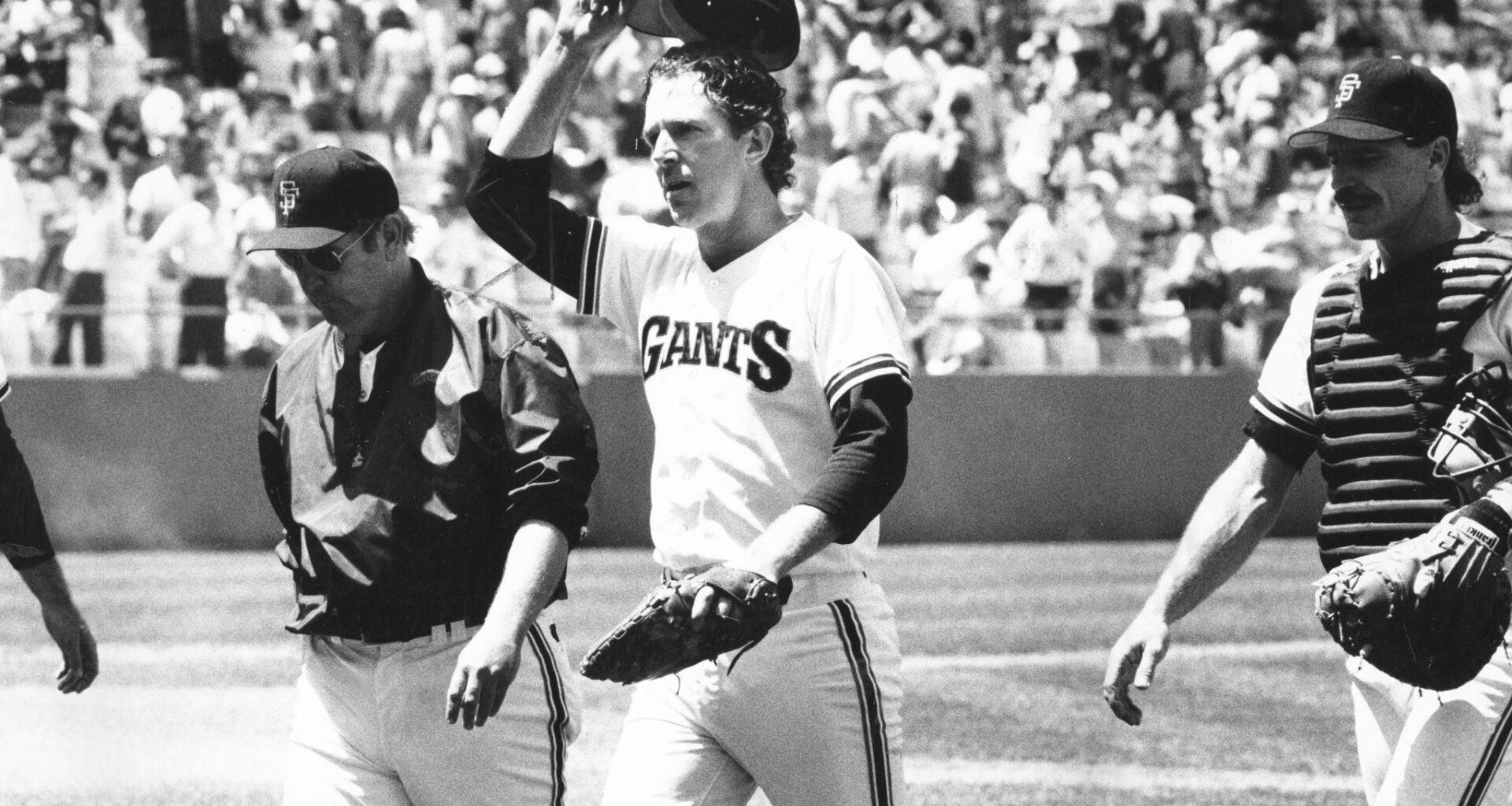
Mike Krukow tips his cap after throwing a complete game for the Giants in a victory against the Pirates at Candlestick Park on May 14, 1985, in San Francisco.
Jerry Telfer/The Chronicle
We’ll have nearly two months to digest the news about Mike Krukow, talk for hours about what he meant to his audience, and argue about whatever broadcasting plans the San Francisco Giants have in store. For now, with the man announcing his retirement at season’s end, the memories arrive like a soothing, all-day breeze — there are too many to count.
There are a few I’d like to share, though.
• I was a Chronicle baseball writer through the entirety of his 14-year playing career as a pitcher, usually for the full 162-game grind, and I never came across a player more adept at summing up a ballgame — the details and the perspective, often with penetrating wit — in the locker room afterward. I knew I had to find him not just after his own starts, but whenever something significant went down. Such players are extremely rare, then and now.
Article continues below this ad
• Through the sadness and regret, this development makes it more plausible for him to enter the broadcasters’ wing (Ford C. Frick Award) of the Hall of Fame. The rules dictate that he and Kuiper can’t go in together, so focus on Mike for now, and realize that Kuiper — who stands alone among ex-players who got into play-by-play — will also get his due.
I’ve watched baseball telecasts around the major leagues forever, still taping five or six games a night, and I’m certain Krukow is the best analyst in history. I can’t believe there’s even an argument. If he shows up on the next ballot and doesn’t get in, just shut the thing down, indefinitely. Vote called on account of ignorance.
• As a Southern California disciple of the great Vin Scully, Krukow never thought he was cut out for broadcasting. He’d been offered the pitching coach job for Giants manager Roger Craig in 1990, but executive Corey Busch saw his potential behind a microphone.
Article continues below this ad
“No question that Corey got me into it and gave me the confidence I needed,” Krukow said a few years back.
To which Busch replied on Thursday, “I guess that’s true, but getting credit for Mike Krukow’s broadcasting is like scouting Willie Mays and recognizing his potential as a ballplayer.”
Mike Krukow and Duane Kuiper before a Giants game in the 1990s.
MICHAEL MACOR
• It’s truly remarkable how he seems to have firsthand, inside knowledge about everything: bats, gloves, nuances of the middle infield, players’ tendencies, strategy as it applies to the moment, even catching — the first position he ever played. Then he explains it, artfully and precisely.
Any “homer” in the booth can blow off the opposition as just a bunch of guys out there on the field. Krukow loved Scully’s knack for letting Dodger fans know exactly what they were seeing in Mays, Frank Robinson, Bob Gibson and other greats of the day.
Article continues below this ad
“Vin would elevate the opponent, so when the home team would do something good, it would mean a little bit more,” Krukow said. “You knew how good that opponent was, and all of us paid attention. That’s the way it should be.”
Who should replace Mike Krukow in the San Francisco Giants broadcast booth?
Mike Krukow announced he will retire at the end of the year. Who should be in the broadcast booth with Duane Kuiper next season?
Christine
Santa Cruz, CA
08/07/26
0
I am way biased for Hunter Pence and then Javier Lopez. They have both remained very loyal to the Giants and the team and I like both of them on air. I am not a fan of F.P.
Edward
San Rafael, CA
08/06/26
0
Whomever it is, it will never be the same. An era is over.
• He’ll buy into certain analytical data, but it generally bores the hell out of him, and he believes the residue of numbers-driven obsession has done great damage to the game. He talks in batting average, runs scored, hits and walks per inning — the language of reality, in other words. Get into a ball-talk conversation with Krukow, and you realize the sport has become trapped in a sinkhole of comparatively useless information.
• For a pitcher to win 20 games, in any era, is a monumental achievement. Krukow did that in 1986, finishing it off at Dodger Stadium on the final day of the season, and he completed 10 games along the way. Teammates knew him as the ultimate competitor, someone familiar with pitching through the excruciating pain of injuries, and there was a moment of truth in the 1987 NLCS after Krukow went the distance at Candlestick Park to beat the Cardinals, 4-2, to square the series at 2-2.
When it came down to Game 7, it was Atlee Hammaker’s turn to pitch. Without denigrating Hammaker, a good guy and friend, Krukow begged Craig for a chance to start that game on three days’ rest — something he’d done countless times in his career. Craig backed off, Hammaker took a 6-0 loss in St. Louis, and there went the World Series.
Article continues below this ad
• On his everlasting friendship with Kuiper: “One night we’re in New York, and the news comes across that Don Drysdale had been found dead in his Montreal hotel room. As a kid, ‘Big D’ was my guy. I idolized him. So it hits me like a sledgehammer, and when I announced it on the air, I almost couldn’t get through it. Then I just went silent. I looked down and completely forgot about the game. All of a sudden, Kuip, the big-handed Dutchman, reaches over and puts his arm around me. And it was quiet. A moment that was ours.”
• From a long-ago conversation over drinks after a game at Dodger Stadium: “My first year in Triple-A was 1976, the Cubs’ team in Wichita. So we’re playing the White Sox team, we’re down 6-0 in the third inning, and they bring me in to replace a guy who was just getting hammered. The first guy I face tries to bunt, fouls it off. And I’m thinking, you chicken-s–t. So the next one I put right in his armpit — and I’m throwing 95 (mph) back then. All the way down the baseline, he’s yelling, ‘I’ll kill you! ’ with the worst language you can imagine.
“That was Tony La Russa.”
It wasn’t long before La Russa was managing the White Sox, and it came to pass that both Chicago teams had representatives at a promotional event. “And Tony’s still mad at me,” Krukow recalled. “I’m lookin’ across the room, and there he is, givin’ me the stank eye, like I’m gonna have to fight him. And if you do that, you better bring some game. Everywhere I go, I look at him and he’s staring at me.
Article continues below this ad
“So our paths come together. He walks up to me and says, ‘You hit me.’
“‘I like that,’ he said. ’You can play for me, man.’
“Wow. That’s old school. Complete hard-ass.”
• More from the after-hours: “My dad was a cop. Big man, 6-3 and about 300 pounds. Enormous arms. He played for the sheriffs’ softball team, and when I’m 6-7 years old, he was always bigger than life. He took me everywhere I went, and he and my uncles taught me how to play sports. Out on the golf course, if you didn’t mark your ball, walked across somebody’s line, or scuffed your spike on the green, they didn’t say anything — they’d whack you on the back of your legs with a putter. And I took to that, learning what you’re doing wrong and how to think. That definitely had everything to do with how I approach a broadcast — where the wind is blowing, what’s the grass like, what the umpire’s strike zone is like. The game within the game.”
• “In my background, confrontation was how you dealt with things, head-on, and I learned to fight early. My seventh-grade year, we had kids going to different schools in the same area, and some of my classmates weren’t too happy about where I was playing public-school football. So it was a fight, every day. And if I came out on top, I’d be fightin’ the cat’s brother, who was a 10th-grader, you know, waitin’ for you outside. It got to the point where I couldn’t go to recess. Came home with a bloody uniform every day. I did fine. I wasn’t afraid to get hit. But I wasn’t very good against left-handers (laughter) — 0-and-4 lifetime.”
• “My mother? Oh, she was the life of the party. She had the greatest laugh God ever gave a woman. Played the piano without reading a note of music. Always had a schmag (cigarette) goin’. She was a nurse and worked nights when I was growing up. Get home around 7 a.m., get us off to school, sleep like 9 to 1:30, get things organized around the house, pick us up, take us to wherever practice was, come home, make food, sleep a couple hours, strap it on and go to work. Sweet Elaine.
“We’d go to about 25-30 Dodger games a year, and the first one I ever went to, Cardinals at the Coliseum, my dad caught a ball behind home plate. Stan Musial hits it, my old man snags it, bare paws, hands it to me. Awesome. I just stared at that thing, greatest thing ever. Two days later, it had no cover on it. Just electrical tape. Come on, we’re playin’ on the street and we needed a ball.”
• Mike and Jennifer raised their five children in a television series from some other time. That’s exactly how it felt, the best kind, where kids ride around the neighborhood on their bikes all day, checking in with families of like-minded folks, stopping in around lunchtime and right back out, then home for dinner. Concern among the parents: None. Just hope that skinned knee doesn’t need stitches.
My wife and I saw a lot of this on a couple of visits to their San Luis Obispo home, and we noticed other kids coming over, because this was the place to be. One boy, aways solo, they called Towhead Ted. “First thing in the morning, Kruk would have an hour to himself, but then Towhead Ted comes through the door,” Martha recalled. “Went straight to the refrigerator, checked it out, then left.” So unfolds the Krukow family legend ofTowhead Ted.
• Krukow’s kids are really a separate story, but start with Tessa, with all those brothers, growing up tough and kind and talented. Every now and then she sings the national anthem at ballgames, and it’s a beautiful thing.
Three of the kids were “all boy,” as they say, playing all sports and tossing scruffy clothes into a pile that would become laundry. They’re all distinctly different — Baker, Jarek, Chase — and successful. The fourth boy, Wes, was especially different. He wasn’t that into sports, and he took to wearing tutus in the house, the better to dance joyously about and put on shows.
Mike and Jennifer loved it, from the beginning. They never once questioned his budding sexuality or recoiled from it. They were with him every step of the way. Wes can’t begin to express his gratitude these days (“my dad is my hero”), with a body of work including the Smuin Ballet in San Francisco, the Lyric Opera of Chicago, andthe first national tour of the musical “An American in Paris.”
Mike was a strong, powerful athlete. He could powder a golf ball, snowboard down a near-vertical face, swing a bat as if that had been his calling. He looked great throwing a football, shooting a basketball, anything. When the disheartening news came down about the degenerative condition in his legs, he knew he’d be losing all that.
It’s all about his wheelchair now, and that wears on him, something you realize with stunning clarity as he ends his career. But I’ve spoken to him countless times over the years, at all hours of the day, and not once have I heard him anything less than stoked (great word) and enthusiastic. No one gets a glimpse through the window of his agony, for he simply won’t allow it, and what a blessing that his kids bask in his unrelenting spirit. That fine athlete has long since vanished, but they never lost their dad.
Bruce Jenkins writes the 3-Dot Lounge for the San Francisco Chronicle. Email: jenksurf@gmail.com Twitter: @Bruce_Jenkins1