
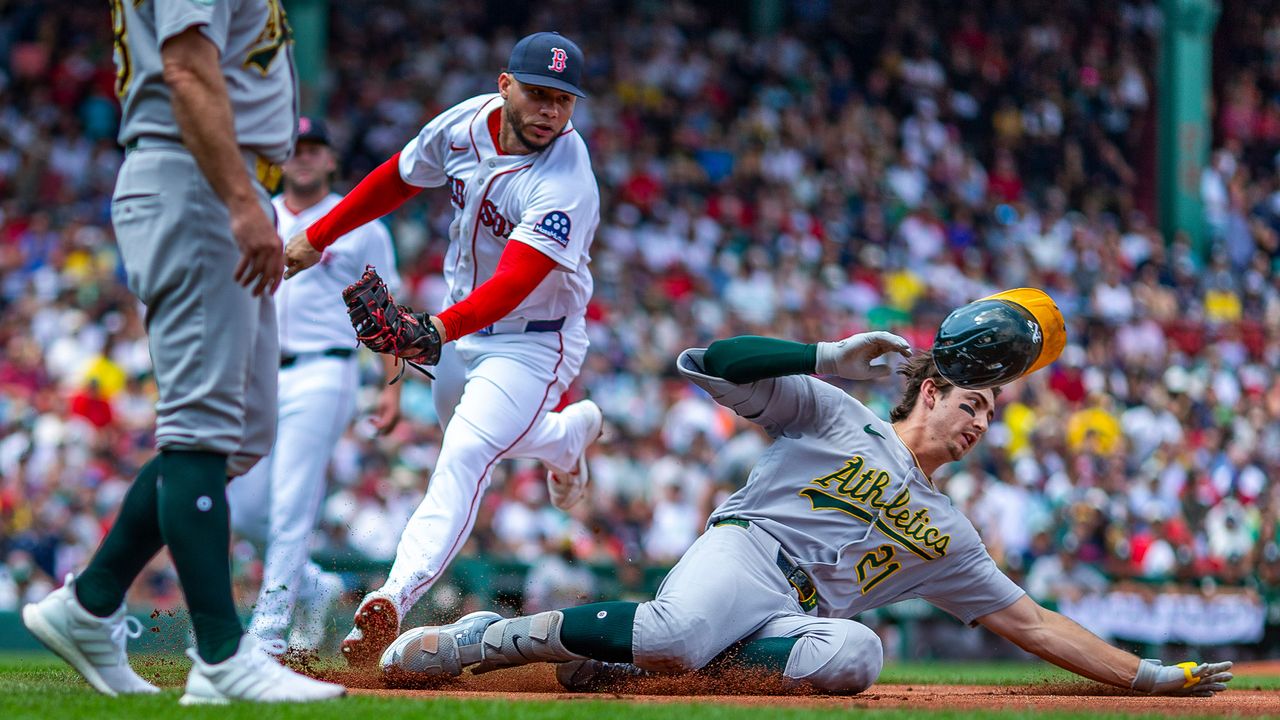
By then, the Red Sox were being called the best team in baseball, or close to it. Except the A’s—who, for their part, had finished the month of July with a lowly record of 5–19—won the next game, too. And then the Toronto Blue Jays took the next three, handing the Red Sox their second five-game losing streak of the season. The bleeding wasn’t done: although the Red Sox beat the Blue Jays on Thursday to avoid a sweep, they got pummelled the next day by the Pittsburgh Pirates, who sat last in the National League Central. Teams get hot, then cold; they get lucky, then unlucky; injuries always play a part. Records rarely paint a full picture of a season. But normally the thermodynamics of a baseball season find some sort of homeostatic balance. If a team is really good, it is not also really bad, unless there is some big event or clear explanation.
Surely, the postmortems of the team this fall will tell a story, with compelling causal details. Caleb Durbin started working with a private hitting coach. The video coördinators made a hype video of the fans at Fenway Park, to remind the players of what the stadium sounded like when the team was winning. Jarren Duran shouted at Willson Contreras at the end of an inning for no good reason. Credit might be given to Ceddanne Rafaela’s cleats and arm sleeves, as bright as a French’s yellow mustard bottle.
Maybe it will all add up to something that sounds plausible. And yet it seems to me that the 2026 Red Sox cannot be made to make any sense at all.
True, for most of the first three months of the season, the Red Sox were probably better than their record. Before their turnaround, they were on pace to win only around a third of their games, but their expected wins—calculated using a formula that relates the number of runs they scored to the runs they gave up—would suggest a five-hundred team, a reflection of some bad luck. Play enough games, and the luck swings; balls that were caught in April started falling. You could justify, too, some of the team’s more recent cooling. Durbin played through the hot streak with a dislocated left pinkie; when he came to bat on Thursday, the finger poked through his torn left batting glove—a sign that the swelling was becoming harder to tolerate. The bullpen, which had been baseball’s best for a long stretch, was wearing down; eventually, the cost of so many innings comes due. And so on. The Red Sox were never as bad as they looked, and never as good. Their over-all record right now—the good and the bad jammed together—may tell us who they really are and who they’ve actually been all along. (They’re currently projected to win around eighty-seven or eighty-eight games—right around where many analysts’ models had them during spring training.)
So what meaning is there to extract from any given game, or even a streak? Baseball “is a game of the long season, of relentless and gradual averaging-out,” John Updike once wrote, in a piece set at Fenway Park. Viewed a certain way, no particular instant much matters. “Irrelevance—since the reference point of most individual games is remote and statistical—always threatens its interest,” as Updike put it.
From that perspective, perhaps it was unwise for the Red Sox’s front office to trade away a handful of the team’s best prospects for the Orioles’ Adley Rutschman, an injury-prone All-Star catcher, just before the trade deadline. The Sox might not be quite the juggernaut they briefly seemed. And yet, there the fans were, rally caps on, ready to believe in another mighty comeback—to read heroism into a story that could also be told, perhaps more accurately, in terms of swing decisions and contact points. Good for them. We live in the present moment, not in abstractions. One way or another, the Red Sox are making those moments count. ♦