

On the internet exists a spreadsheet tracking the names of 2,719 players to undergo Tommy John surgery in Major League Baseball history.
At the top of baseball researcher Jon Roegele’s meticulously-kept database is Cincinnati’s Hunter Greene, who had the procedure most recently, on Aug. 12.
All the way down at the bottom of the page at No. 2,719 is the real No. 1, the man for whom the surgery is named.
Tommy John, the left-hander who became synonymous with the elbow surgery that revolutionized Major League Baseball, died Saturday. He was 83.
John pitched 26 MLB seasons between his 1963 debut with Cleveland when he was 20 years old, and final game with the New York Yankees on May 25, 1989, three days after his 46th birthday.
In the middle was the game that changed John’s life and baseball forever. The Los Angeles Dodgers left-hander was leading the National League with 13 wins when he took the mound for a home game on July 17, 1974. John threw a fastball to Montreal Expos first baseman Hal Breeden, and knew immediately something was wrong. After attempting another pitch, he called time out and left the mound.
“It felt as if I had left my arm someplace else,” John told Sports Illustrated in 1978. “It was as if my body continued to go forward and my left arm had just flown out to right field, independent of the rest of me.”
John spent the next two months resting and icing his pitching arm, but to no avail. Even without the aid of an MRI – the first successful scan of a complete human body was still three years away – Dodgers team physician Dr. Frank Jobe, who had removed bone chips from John’s arm two years prior, was able to determine the injury was a torn ulnar collateral ligament (UCL).
Jobe conferred with several doctors, including polio specialist Dr. Jacquelin Perry. The two had performed a successful ligament transfer that helped stabilize a polio victim’s ankle, and Jobe thought a modified version could help John.
The surgery took place at Centinela Hospital on September 25, 1974. Jobe reconstructed John’s left elbow by drilling holes in the ulna and humerus bones, and grafting the palmaris longus tendon taken from the right wrist, in a figure-eight design secured by anchors. Nowadays the procedure takes about 45 minutes. But the first one took four hours.
Jobe gave him 1-in-10 odds of pitching in the majors again, but John had faith in his doctor. Even when he needed to go under Jobe’s knife a second time, to repair ulnar nerve damage.
“If he would have told me to go stand naked at Dodger Stadium, that it would heal my arm, I would have done it,” John said when he introduced Jobe, who had become a dear friend, at an event in 2012, the year before the renowned doctor died at 88. “I believed in Frank Jobe.”
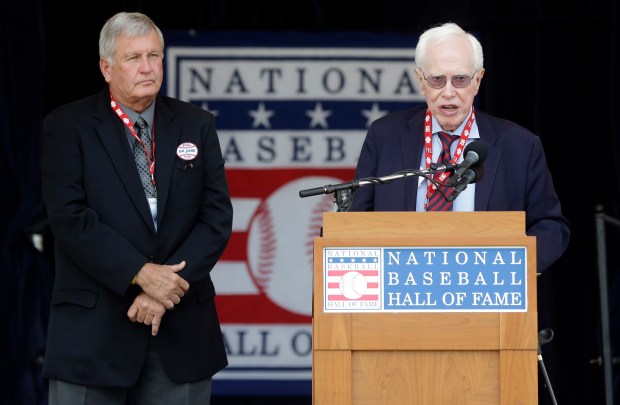 FILE- In this July 27, 2013, file photo, Dr. Frank Jobe, right, known for the development of the historic elbow procedure known as Tommy John Surgery, speaks as he and Tommy John, left, are honored during a ceremony at Doubleday Field at the National Baseball Hall of Fame in Cooperstown, N.Y. UCL has increased 10-fold in the first decade of the 21st century, Dr. James Andrews, one of the world’s top orthopedic doctors, and and Dr., Jeremy Bruce wrote in the May issue of the Journal of the American Academy of Orthopaedic Surgeons, citing a paper published by J.R. Dugas in 2010. Dr. Andrews will be meeting with a research committee on Monday at Major League Baseball’s headquarters. (AP Photo/Mike Groll, File)
John missed the 1975 season, explained on his Baseball Reference page as, “Did not play – Eponymous Surgical Procedure.” But he returned to the Dodgers in ’76 and made 31 starts, with a 3.09 ERA across 207 innings. Another 31 starts and a second-place finish in NL Cy Young Award voting followed in ’77, 33 games the following year, and 37 in the one after that. People began calling him “The Bionic Man.”
In total, John pitched 405 regular-season games, including 382 starts, for the Dodgers (1976-78), Yankees (’79-82, ’86-89), California Angels (’82-85) and Oakland Athletics (1985) after the surgeries. He posted a 3.66 ERA, and tossed 91 complete games in that 14-year span.
Three of John’s four career All-Star selections came in this remarkable second chapter, between 1978-80. Rather than a career-ending injury at 31 years old, he pitched long enough to become the oldest active major leaguer when famed knuckleballer Phil Niekro retired in 1988. In John’s final campaign, he became the fourth of seven pitchers in MLB history to make at least 10 starts in an age-46 season or older.
John’s 700 career starts are second only to Hall of Famer Steve Carlton in MLB history. His second legacy is the many thousands of games, awards, World Series trophies and rings, and Hall of Fame plaques belonging to other pitchers (and position players) whose careers were saved by the surgery he and Jobe pioneered.
John said goodbye to baseball fans on Aug. 8, in a letter shared by the Yankees:
“I want to thank the Yankees organization & the Steinbrenner family for giving me this opportunity to say goodbye to everyone, along with all the friends & fans who followed me throughout my 26-year career.
“Thanks to Dr. Jobe, who saved my arm & made it possible for me to continue pitching. That surgery has since gone on to save the careers of countless pitchers, including many of the very best in the game today.
“Thank you to all the fans who supported me & my teammates for 26 years. I will never forget you.
“The day I left for my first job as a pitcher, my father looked at me & said, ‘Good luck, Tommy. Just remember one thing: whether you make it big in the big leagues or you don’t, you’ll always just be Tommy John from Terre Haute, Indiana.’
“I’ve never forgotten those words. Thank you & God Bless.”