
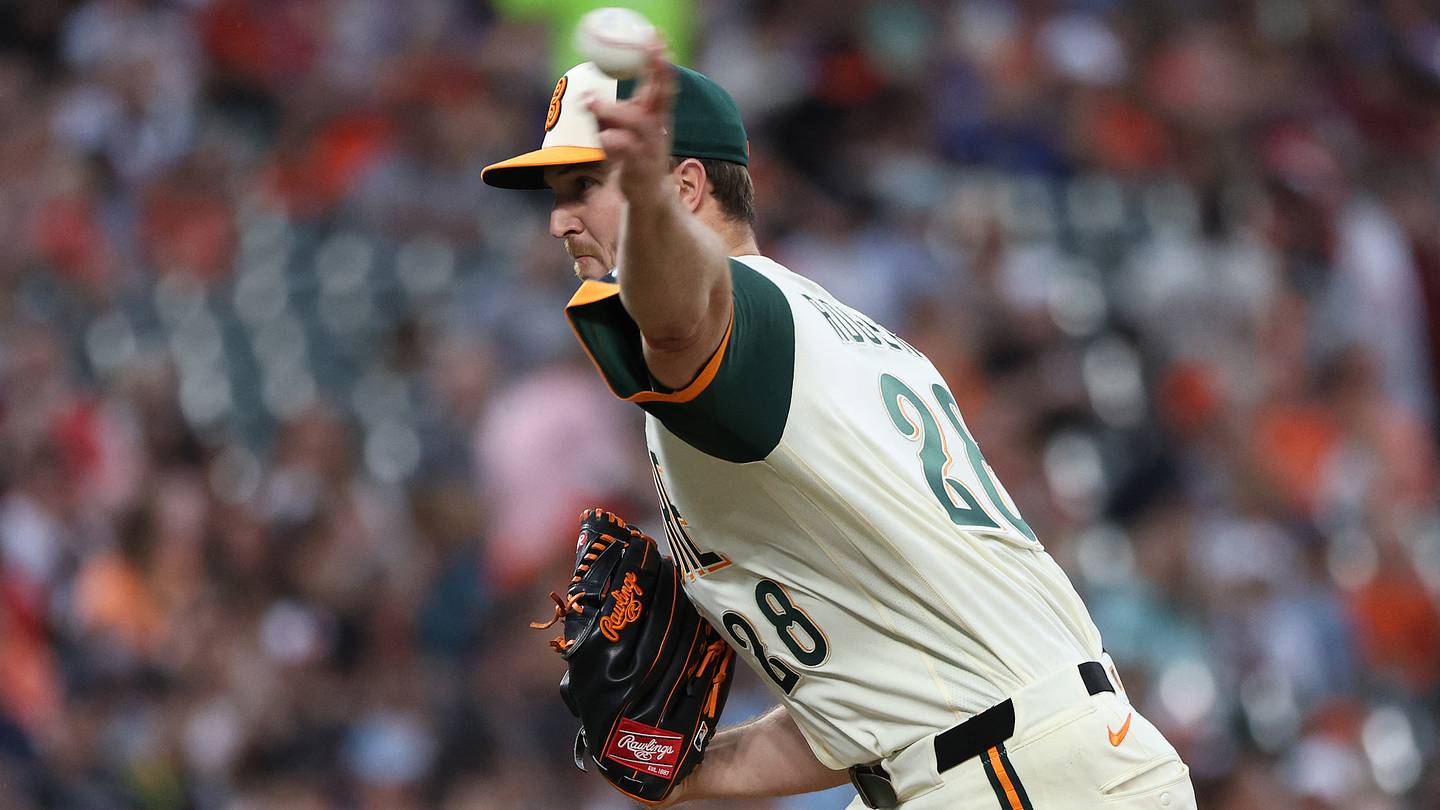
The phrase “pitching wins championships” might seem cliché, but year after year it is proven to be as accurate as ever. Which is why heading into the season, fans of the Baltimore Orioles were worried that the team’s starting rotation simply wasn’t at the level needed to compete for the postseason. And who could blame them? Orioles GM Mike Elias didn’t exactly go out and land a top-flight starting pitcher in free agency. But as we near the end of the season, fans who doubted the strength of the team’s rotation couldn’t have been more wrong.
Sure, there isn’t a single pitcher in the Orioles’ rotation that will come close to sniffing a major award come November. And sure, not one of the Orioles’ starting pitchers will be at the top of a leaderboard for any vital stat. However, the rotation as a whole has been about as solid as any fan could ask for.
And according to Birdland Metrics, that statement is backed by fact. Following Chris Bassitt’s quality start against the St. Louis Cardinals on Aug. 25, the Orioles’ rotation notched their 52nd quality start of the season, good for a tie with the New York Yankees for the sixth best mark in all of baseball. Brandon Young added another on Friday night. It leaves the Orioles just one short from their 54 quality starts in 2025.
The Orioles’ rotation needed some time to hit its stride in 2026
Since a quality start is defined as an outing with at least six innings pitched and three or fewer earned runs allowed, it means that Baltimore’s starting pitchers have been doing their job and doing it well over the course of the season. However, make no mistake, the Orioles’ rotation has dealt with its fair share of frustrating outings and underperformance. Slowly but surely, the pitching has not only kept the team in ball games, but it’s put them in a better position to win.
A large reason for the turnaround from the Orioles’ rotation has been the improvement of its three best pitchers. Perhaps no pitcher has made a sharper 180° turn on the season than Trevor Rogers. Despite throwing three consecutive quality starts to begin the season, Rogers hit a massive skid that left fans scratching their heads. Through the end of May, Rogers sported an ERA of 6.84 as he struggled to keep the ball in the yard. But over the last three months, he’s lowered his season ERA to 4.38 while tossing nine quality starts.
Through his start against the Athletics on May 9, Shane Baz had also struggled to really put everything together, but there was still plenty of optimism around him. Opposing teams were essentially taking batting practice off the 27-year-old, with Baz allowing four plus runs in five of his eight starts to begin the season.
Since May 15, Baz has 11 quality starts in 18 outings, allowing more than three runs just twice in that span. Over the last three months, Baz has worked his ERA down from 5.48 to 4.04. He’s also decreased his FIP from 4.26 to 3.34. He’s done by not only limiting the long ball, but reducing the amount of free passes he’s dished out to batters.
Not to be outdone, Kyle Bradish has stepped up his game after getting off to a rocky start this season. Since his 10-strikeout performance against the Athletics on May 8, Bradish has also collected 11 quality starts across his 19 outings. Before the Cardinals shelled Bradish for seven runs on Aug. 26, he had only allowed more than three earned runs once in the last two months. His performance in 2026 even helped him secure a long-term extension with the Orioles.
Should the Orioles clinch a postseason berth and play in a best-of-three matchup in the Wild Card Series, a mix of Rogers, Baz, and Bradish would put the team in an excellent position to advance to the Divisional Round. Despite the bumpy road that all three pitchers took to get to this point, they have pitched well as a whole and proved the doubters wrong in the process.
 Add us as a preferred source on GoogleFollow