
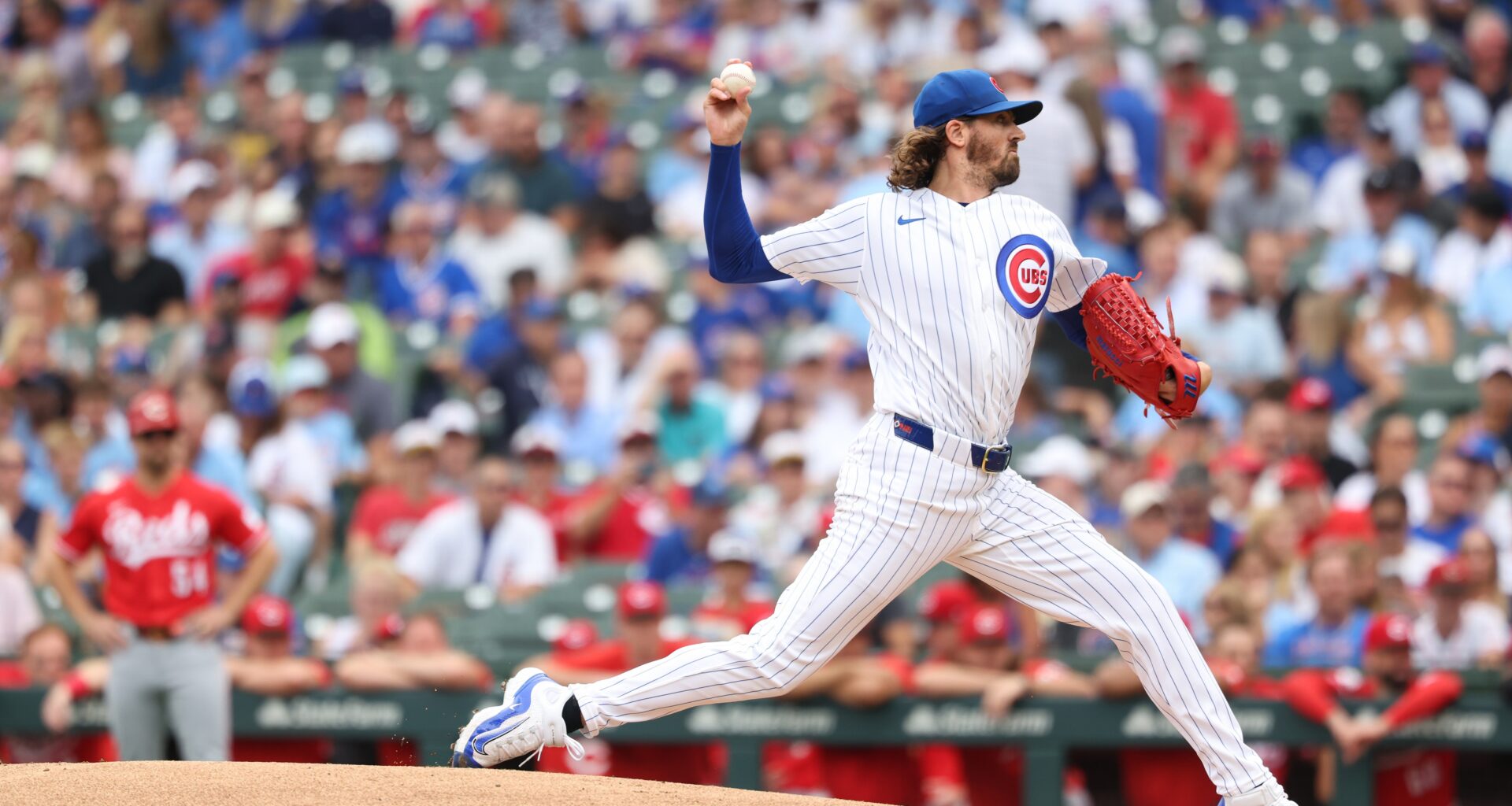
We interrupt this regularly scheduled celebration of the Chicago Cubs’ past to remind you there’s an extremely tight wild-card race developing in the National League.
After Saturday’s celebration of the 150th anniversary, and Sunday’s induction of Jon Lester, Jody Davis and radio voice Vince Lloyd into the team’s Hall of Fame, the Cubs’ 7-5 loss to the Cincinnati Reds left them tied with the Philadelphia Phillies for the top NL wild-card spot.
Catching the first-place Milwaukee Brewers seems unlikely unless the Cubs take their final two series, including a four-game set that begins Monday at Wrigley Field. An eight-game lead with 25 games left is a virtual lock for Brewers manager Pat Murphy and his wrecking crew, as even optimistic Cubs fans understand.
Perhaps it’s in everyone’s best interest to focus on fending off the Phillies and avoiding the potential nightmare scenario of being ousted in Citizens Bank Ballpark on a walk-off home run by Kyle Schwarber, who was not voted onto the Cubs all-time team.
The Cubs desperately need to hold the first wild-card spot and secure a first-round series at Wrigley Field, where they swept the Phillies in four games in April.
Manager Craig Counsell stated the obvious — the Cubs would rather play at home but know they have to win on the road to get through October.
“Frankly, it’s an incredible experience,” he said of home games in October at Wrigley Field.
Photos: Chicago Cubs’ 150th anniversary celebration at Wrigley Field
The newer Cubs — anyone not named Ian Happ or Nico Hoerner — learned last October in their wild-card series win over the San Diego Padres. Some fans believed the atmosphere was as intense as 2016, which I argued would only be possible in a World Series setting. Barring a noise-o-meter, we can only guess.
But this season has been even more electric with Pete Crow-Armstrong’s dramatics, and October figures to be dialed up to 11 at Wrigley.
Getting in is the priority, and despite a 4 1/2-game lead over the last wild-card spot, it’s still not a given. Most assumed the 2023 Cubs would hang onto their wild-card spot in early September before an end-of-season collapse. The late-inning leverage guys manager David Ross had at his disposal — Julian Merryweather, Mark Leiter Jr. and closer Adbert Alzolay — all succumbed to injuries, tired arms or lack of experience in pressurized roles.
It didn’t work out well for those three, or for Ross, who was fired after the season and replaced by Counsell.
Heading into September, Counsell’s late-inning options include de facto closer Jacob Webb, returning closer Daniel Palencia and a mystery man that could depend on Edward Cabrera’s health and effectiveness.
President Jed Hoyer reassembled his bullpen in the offseason and made multiple moves through the first four months due to a series of pitching injuries. The Cubs somehow survived and remain a real threat to get to the World Series — and win — if things go right.
One Wrigleyville corner hangs on to its roots and ballhawks as Chicago Cubs mark 150th anniversary
The would-be leverage guys entering spring training were Palencia, Phil Maton, Caleb Thielbar, Hoby Milner and Hunter Harvey. But injuries and ineffectiveness spoiled that plan, and Plan B as well, leading to the trade deadline acquisition of Ryan Zeferjahn, who has struggled with a 5.49 ERA in 10 outings.
So the Cubs are already onto Plan C, hoping to avoid going to Plan D.
While Ben Brown’s return has not been ruled out, Counsell said Saturday that the reality of the baseball calendar suggests the Cubs can’t count on his neck injury allowing him to pitch. Cabrera, the veteran starter acquired from the Miami Marlins, is scheduled for a rehab outing at Triple-A Iowa on Tuesday after a blister forced him to the IL. He should be available for the Cubs’ bullpen after three or so appearances.
Counsell’s “out-getter” mantra is relevant here since the rotation appears set, and it excludes their biggest offseason acquisition. Cabrera has allowed 15 home runs in 76 innings as a starter, and readily accepted a new role in a playoff race.
If Brown can’t return and Cabrera doesn’t succeed in a leverage role, Counsell’s other viable options to join Palencia and Webb are Zeferjahn, Ryan Rolison and Trent Thornton, who imploded in Friday’s loss.
Webb, Rolison and Thornton helped keep the ’pen in working order this summer, and Counsell’s continued faith in them is what you would expect. It’s why players like playing for him.
But the current level of stress is basically uncharted territory for all the Cubs’ late-inning relievers, except Palencia, the closer-in-waiting again. Palencia had five scoreless outings in last year’s postseason, but also gave up a three-run home run to Brewers’ outfielder Jackson Chourio in the Cubs’ 7-3 loss in Game 2 of the NL Division Series. He’s also thrown only 19 1/3 innings in an injury-plagued season, and Counsell is proceeding cautiously.
 Chicago Cubs manager Craig Counsell waves over the Cincinnati Reds coaching staff before the start of a game at Wrigley Field in Chicago on Aug. 28, 2026. (Chris Sweda/Chicago Tribune)
Javier Assad is back on the Iowa-go-round, shuffling between the Cubs and Triple A because he has options. Webb assumed the de facto closer’s role in July and ran with it, putting together a 24-game scoreless streak until giving up back-to-back walk-off home runs last week in Seattle and Arizona.
So, any bullpen concerns, Craig?
Counsell replied that the “same guys are going to be out there” after poor outings.
“‘That’s how a bullpen works,” he said Saturday. “You have a rough outing, you’ve got to come out and do it the next day. You’re going to get beat some days. But they are our guys, and we need them to pitch well and they’re going to pitch well by being out there.”
The Cubs ’pen entered Sunday with 29 saves and 22 blown saves, while ranking 24th with a strikeout rate of 7.92 Ks per 9 innings. They rely on the team’s elite defenders, but too often serve up the long ball. Cubs relievers have already given up 77 home runs, or two more than last year with a month left.
Cubs starters have also allowed an average of 1.60 home runs per 9 innings, third-worst behind the Athletics, who play in a minor-league park, and the Colorado Rockies, who play at the high elevation of Coors Field. The worst offender, Jameson Taillon, is gone, but Shota Imanaga’s 33 home runs allowed leads the league after Sunday’s performance.
A potential wild-card rotation is anyone’s guess after Clay Holmes and Matthew Boyd. If it’s against the Phillies, with left-handed sluggers Schwarber and Bryce Harper, maybe the left-handed Imanaga would have the edge over Kevin Gausman. But Gausman has a 5.14 ERA in five Cubs starts, including Saturday’s five-inning stint in a 17-5 win over the Reds. He wasn’t acquired to sit out the start of the postseason, even if Imanaga has been more consistent with a 2.65 ERA since the All-Star break. Meanwhile, lefty David Peterson’s 2.41 ERA since the break (including one relief outing) suggests he deserves consideration, especially against the Phils.
“At the end of the day, you get to the playoffs and you’re probably going to have two-three starters and there’s going to be guys that go to the bullpen anyways,” Peterson said. “I’m glad I have that experience and can lean on that (if it happens).”
Plans can change between now and the playoffs.
And if this unpredictable season is any indication, they assuredly will.