
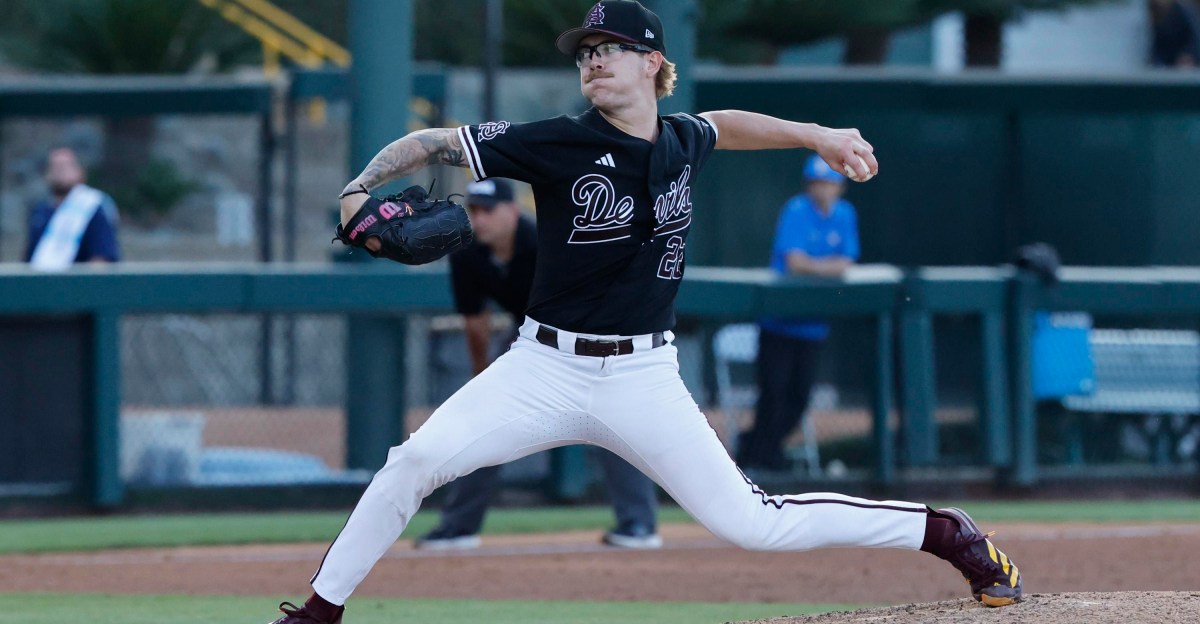
Left-handed pitching prospect Ben Jacobs was the Detroit Tigers third round pick in the 2025 amateur draft out of Arizona State University. We liked the pick at the time for his fastball shape, strike throwing, and his developing bag of secondary pitches, but there was also a bet placed on his physical projection. With refined mechanics and plenty of good muscle added in his first year of pro ball, Jacobs has already laid all concerns to rest. The draft of Cameron Flukey in the first round of the 2026 draft gives him some competition in terms of top pitching prospect in the system, but Jacobs is certainly high on the list, with a chance to break into national top 100 rankings in 2027.
In our preseason scouting report, we talked about Jacobs’ crossfire delivery, and suggested the Tigers would try to get him moving more directly down the mound to home plate, rather than the closed stride and rotation required to get back on target that was prominent in his college work. Jacobs was basically pitching out of the stretch, so it certainly wasn’t an elaborate move to the plate, but the big crossfire move was squandering energy and forcing him to compensate a lot to locate back on target, especially to his glove side.
As Jacobs told David Laurila of FanGraphs recently, he’s made short work of that requirement. By adding a rock step back toward third base with his lead leg to get him moving into his delivery rather than driving to the plate from a full stop, they improved his rhythm and repeatability and cleaned up his stride direction at the same time. That more direct move has given him more extension to the plate as well, though it only got him to a roughly average level. The delivery adjustments, along with putting on a reported 10 pounds of lean muscle since draft day, have him throwing a consistent 94 mph velocity now, with a little extra in the tank.
The changes to Jacobs’ delivery haven’t just gotten him throwing harder. Because he’s getting further down the mound with his lead leg, he’s throwing from a lower point, giving him a flatter angle to the top of the zone. With around 19 inches of induced vertical break on his heater, those two elements are helping him miss a ton of bats with fastballs along the top of the zone. His command took time to come around after making these changes, and his walk rate was a little high, but he powered right through Low-A Lakeland after just 16 2/3 innings of work in the spring.
Things were tougher in West Michigan. Jacobs was piling up a lot of strikeouts, but the walks spiked against more advanced hitters, and his were hit harder. His first 10 starts for the Whitecaps were a real mixed bag, but in late July and August everything started to come together for him. He started spotting his slider and splitter a little better, and still has a solid curveball to mix in as well. With the improved velocity, shape, and angle to the plate, Jacobs just needed to locate more consistently, and once he did, hitters have done very little against him.
Over his last five starts, covering 26 innings of work, Jacobs has only allowed two earned runs. He’s currently on a streak of three consecutive scoreless outings, and he’s punched out 33 hitters in that span. In his August 12th start against the Lansing Lugnuts, Jacobs did walk five batters in 4.2 innings of work, but he also didn’t allow a hit in that start and struck out seven on the night. In the other four outings on this five start run, he’s walked one batter three times, and two batters once. There’s still work to do in the consistency department, but no one is hitting him right now. He’s surrendered just 10 hits in those 26 innings. His 33.6 percent strikeout rate in the Midwest League is excellent, and this is his first year of pro ball. Jacobs just turned 22 years old back in June.
The improvements in his fastball and better command of it more recently is a big factor in this run, but the splitter is playing a major role as well, drawing a huge whiff rate just short of 50 percent. It doesn’t fall off the table like a classic splitter. Instead it has funky, late tailing action away from right-handers. That’s gotten it mis-identified as a changeup fairly regularly, but Jacobs set the record straight in the Laurila interview.
At this point the fourseamer and splitter are both flashing plus. A little more consistent velo and more importantly, better command of those two pitches will take him a long way. His slider and curveball are solid breaking pitches, and he’s showing some good signs of spotting them for strikes and breaking off slightly sharper versions to get hitters chasing. More often, at least until recently, his command of both has been a little hit or miss.
If hia trendline continues in terms of commanding the whole package and building himself up, Jacobs looks like a future quality mid-rotation starter. If he falls a little short or doesn’t quite prove durable enough to be a full-time starter, he’s still got a nice future as a versatile lefty relief option. It’s been a very successful year for him, and at this point it’s comfortable to put a 45 grade on him, and real optimists may go higher. Jacobs will make one more start this week for a Whitecaps team fighting for its playoff life, which will get him over 90 innings on the year. He should be clear to stretch out to 120-130 innings next season starting at Double-A Erie.
If Jacobs can take the step up to Double-A Erie and throw something like 115-130 innings in 2027, lingering questions about durability, which follow every young pitcher through the A-ball levels, will dissipate. We can hope for a little sharper slider with more work, but at this point the four-pitch mix is already good enough if his command improves a little more. He’s on his way though, and has executed complicated sequences more and more over the past month. Instead of falling back on his fourseamer too much, he’s working backwards more with curveballs and sliders to start at-bats, and then expanding the zone up with his fastball and away from right-handers with the splitter once they’re behind in the count. Jacobs is a much more polished and dangerous pitcher than he was when the season began, and the Tigers have to be pretty thrilled with his progress in year one.
At this point only Cameron Flukey really stands out above Jacobs in the Tigers’ pecking order, and Flukey himself is just getting started. If things continue to go well there’s an outside chance Jacobs could reach Detroit next summer, but for now we’ll keep to a 2028 timetable.