

The Philadelphia Phillies announced that Larry Christenson, a pitcher and part of the 1980 World Champions, died on Friday, August 28, while on a fishing trip in Washington. He was 72 years old. Christenson spent his entire 11-year career with the Phillies, from 1973 to 1983.
Larry Richard Christenson was born in Everett, WA, on November 10, 1953. He was an all-star pitcher dating at least back to his days playing for the Everett Babe Ruth League in 1968. He was both a pitcher and a quarterback at Marysville High School in Everett, and the 6’4″ athlete also played basketball. Christenson once struck out 18 batters in a 7-inning game as a sophomore in 1970, and he threw back-to-back no-hitters in 1971. As a senior in 1972, the pitcher sported an 8-2 record with 143 strikeouts and just 12 walks in 72 innings. His ERA was 0.28. Unsurprisingly, he went very high in the June 1972 Amateur Draft. The Phillies took him in the First Round as the third overall pick. The only players drafted ahead of him were Dave Roberts by San Diego and Rick Manning by Cleveland. There was one hitch. Christenson had a chronic back problem that was diagnosed as dylolisthesis, or a missing vertebra. When he was 14 years old, a doctor looked at Christenson’s back and advised him to pick up a violin rather than play sports.
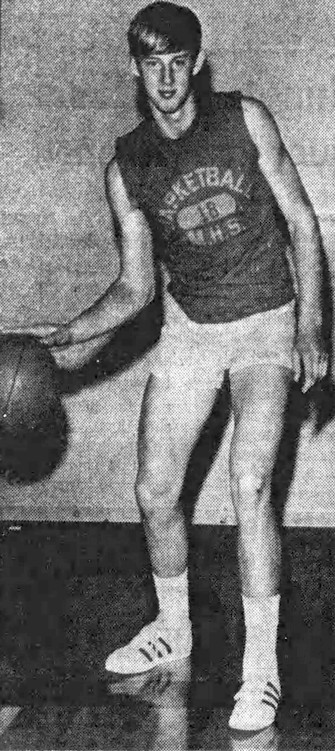 Source: The Everett Herald, December 24, 1970.
Christenson had a variety of pitches and deliveries, but his go-to-pitch — the one that accounted for many of his strikeouts — was the fastball. “It’s neat to throw fast balls and strike everybody out,” he told The Everett Herald just prior to being drafted. “I like to try. The last pitch I like to throw to a good hitter for a strikeout is a fast ball right down the middle.” For a little while, that strategy seemed to work in pro ball as well. Christenson reported to the Pulaski Phillies of the Appalachian League after signing and won 4 times in 8 appearances, 6 of which were starts. He had a 2.84 ERA and fanned 42 batters in 38 innings. He missed some time with severe back spasms and was sent to the Florida Instructional League to make up for lost time. There, he said that the Phillies’ instructors taught him to bend his arm more. “When I was throwing the fast ball, my arm was kind of straight. They taught me to break my elbow to the plate first, then go straight down with my arm,” he said. He also worked on his offspeed pitches, and the Phillies were so convinced of his potential that he was part of the team’s Opening Day roster in 1973.
Christenson came to the Phillies in 1973 with a good fastball and an improved curveball, courtesy of his work with pitching coach Bobby Tiefenauer in the Instructional League. Though he had fewer than 40 innings of pro ball under his belt, the Phillies liked what they saw of him in spring training. “The thing that really impresses you is the control he has over each of his pitches and the fact that he isn’t afraid to throw any of them when he needs a strike,” said pitching coach Ray Ripplemeyer. Christenson was 19 years old when he took the mound for a start against the New York Mets on April 13, 1973. He began his major-league career by striking out Bud Harrelson, one of just 3 strikeouts he’d register on the day. The Phillies staked him to a 1-0 lead in the first inning, and Deron Johnson belted a 3-run homer off Jon Matlack to make the score 6-0. The rookie pitcher was uncharacteristically wild, with 6 walks, but he worked out of trouble throughout the game. He came within one out of a shutout, but it was spoiled when Cleon Jones doubled with 2 outs in the ninth inning and scored on a wild pitch to make the final score 7-1. Christenson threw 130 pitches in the game, and manager Danny Ozark only had to make one mound visit to slow him down when he started working a little too quickly. “This is the highlight of my career,” Ozark said after the game. “It really chokes you up to see a kid go out there and face a team like the Mets and do such a tremendous job. I was pulling for him through nine innings.” Christenson credited his teammates after the game. “They gave me confidence because I had the runs. And they really backed me up, all those double plays, those catches in the outfield,” he said. The Phillies infield turned three twin killings to help Christenson earn his first major-league win.
Still, Christenson was a 19-year old who was a year removed from high school, and his inexperience began to show. He lost his next 3 starts, and he was knocked out of the second inning in two of them. After too many early exits from starts, he was demoted to Triple-A Eugene in June with a 1-4 record and a 6.55 ERA in 10 games, 9 of which were starts. He walked 20 batters in 34-1/3 innings and struck out 11. Management was concerned that his struggles were starting to affect his psyche, and he didn’t pitch particularly well for Eugene, either. On the plus side, Eugene’s manager was Jim Bunning, the former Phillies’ ace pitcher who’d eventually make the Hall of Fame. Bunning managed Christenson in 1973 with Eugene and in 1974 with the Toledo Mud Hens. Along with tinkering with his pitches, Bunning preached constant focus and 100% effort. His demeanor may not have worked with every player, but it worked with Christenson. After spending the offseason recovering from arm surgery, Christenson won 11 games for the Mud Hens in 1974 and was rewarded with another shot in the majors in August. He worked out of the bullpen and threw 2 scoreless innings in his first game back, a 15-2 shellacking by Cincinnati on August 19. On the 31st, he threw 5 innings in relief of Jim Lonborg against Houston, recording 4 of his first 6 outs via the strikeout. Christenson was touched for 2 runs, but the Phillies had staked him to a big lead and won the game 10-6. He had just 1 bad outing as a reliever and recorded 2 saves, including a rare 4-inning save against the Mets on September 25. He made 1 start in his final appearance and took the loss against New York, giving him a 1-1 record and a 4.30 ERA in 10 games.

Christenson began 1975 back in Toledo, but after 2 wins and no runs allowed in 12 innings, he re-joined the Phillies in May. He never returned to the minors again. His first appearance was a start against Atlanta on May 16. He lasted 4 innings and allowed 5 runs, and he also recorded his first major-league hit — a 2-run homer off Buzz Capra. Christenson worked largely as a reliever until a start in San Diego on June 10. He threw 7 innings of shutout ball, allowing just 6 hits while picking up 6 strikeouts. The Phillies coasted to a 7-0 win, and Christenson remained in the starting rotation for the rest of the year. A 1-0 win over Houston on July 19 was his fifth win in a row and first career shutout. Christenson ended up with an 11-6 record on the year and was the Phillies’ second-most effective starting pitcher after Steve Carlton. His 3.67 ERA was almost a full 2 runs lower than his career ERA to that point in his career, and he earned a permanent spot in the starting rotation — as long as he was healthy enough to pitch.
Christenson’s bad back left him pitching in pain more often than not. “It’s one of those things you can’t do anything about,” Phillies trainer Don Seger said in a 1976 interview. “Before the Second World War, kids who had this problem weren’t allowed to participate in athletics. But tests have proven it really can’t hurt you or disable you. It’s just there and he’s always going to have it.” Christenson had come into his own as one of the best young pitchers in the league, but he occasionally had to miss starts or leave games early because of his back. He won 13 games in 1976 to go with 8 losses, and he had a 3.68 ERA and 96 ERA+. He pitched 168-2/3 innings and allowed 199 hits, and opposing batters hit nearly .300 against him. The Phillies won 101 games to finish first in the NL East, but they were knocked out of the playoffs by losing 3 straight games to Cincinnati in the NL Championship Series. Over the offseason, the Phillies almost traded Christenson, Jay Johnstone and Jerry Martin to the Mets for Tom Seaver. That deal fell through, and Seaver went to Cincinnati for Rookie of the Year Pat Zachry. Christenson was relieved. “I never want to leave Philadelphia,” he said. “I talked to Zachry and he is more depressed than any man in the world about being with that club.”
The Phillies once again won 101 games and finished in first place in 1977. Christenson made 34 starts and won a career-high 19 games. His ERA rose to 4.06, and he still had more hits allowed (229) than innings pitched (219-1/3), but he also struck out 118 batters. He got off to a poor start and had a 4-5 record and 4.59 ERA on June 1. From that point onward, Christenson won 15 games and lost just once. He made 6 starts in the month of September and won all of them, pitching at least 6 innings each time. He wrapped up the month with a 15-9 win over Chicago, and he contributed to the scoring with a grand slam off Dennis Lamp. It was also the game where the Phillies clinched the division title. Christenson started Game Three against Los Angeles in the NLCS, and the Dodgers knocked him out of the game in the fourth inning. He allowed 3 runs on 7 hits, though Gene Garber was the Phillies pitcher who took the loss in the 6-5 Dodgers win. Christenson reached double-digit win totals for the fourth straight year in 1978, and he had a 13-14 record and 3.24 ERA. He pitched 228 innings and fanned 131 batters, and he led the NL with 1.9 walks per 9 innings. Phillies manager Ozark made him the Game One starter in an NLCS rematch against the Dodgers. Christenson was somewhat of a surprise choice and lasted 4-1/3 innings with 7 runs allowed (6 earned) on 7 hits. The big blow was a 3-run homer that Steve Garvey hit in the top of the third inning. That blast put the Phillies in a 4-1 hole, and a Davey Lopes 2-run shot made it 6-1. The Dodgers won the series in 4 games, continuing the Phillies’ postseason woes.
 Source: The Philadelphia Inquirer, August 8, 1979.
Christenson’s 1979 season began with a broken collarbone, thanks to a February bike accident. It kept him off the field until May, and he was ineffective upon his return. He had a 3-6 record when he went on the disabled list again in July with a pulled groin muscle. That injury occurred while he was batting and awkwardly ducked out of the way of an inside fastball. When he finally returned to the mound a month later, he began pitching better. Christenson struck out 10 Expos during a complete-game win on August 7. His improved pitching couldn’t save the Phillies from a fourth-place finish, but he lowered his ERA to 4.50 by the end of the year, even if his 5-10 record was well off his usual standards. Christenson won his first 3 decisions of 1980, but he wasn’t pitching well and was experiencing severe pain in his arm. After braving through his first 6 starts, he underwent arm surgery. He told the Everett Herald that the doctors found multiple bone spurs and bone chips in his right elbow, as well as other loose bodies. “There were pieces, like adhesions, just flying out of my elbow. The operation was really successful,” he reported. Christenson returned in mid-August to win 2 of his next 3 decisions. He continued to pitch well into September and October, but the wins just stopped. Every team seems to have that one pitcher who performs well but never gets the run support to win games. For the last 30 games of the season, Christenson was that pitcher for the Phillies. Twice he threw 8 scoreless innings in a start without a win to show for it. Philadelphia won 4 of his last 5 starts — in extra innings, long after Christenson had departed. The pitcher had a 5-1 record and a 4.03 ERA in 14 starts, but the Phillies won 10 of those starts. Those wins helped the team reach the postseason once more. Christenson started Game Three in the NLCS versus Houston, with predictable results — he pitched 6 scoreless innings and left the game with a no-decision. Houston won that game in 11 innings, 1-0. He next made a rare relief appearance, allowing 3 runs in 2/3 of an inning in Game Five. That game also went into extra innings, and Philadelphia prevailed 8-7 in 10 innings to capture the NL pennant. Christenson started Game Four of the World Series against Kansas City, but it lasted just 6 batters and 22 pitches. Willie Wilson walked and advanced to third base on a wild pickoff throw. Frank White flew out, but then George Brett tripled, Willie Aikens homered, and Hal McRae and Amos Otis hit back-to-back doubles. The Royals won 5-2 to even the World Series at 2 games apiece. Christenson took the blame for the loss. “They hit me well, that’s for sure. I don’t know why… I didn’t have much time out there to figure out if I had good stuff or not.” Fortunately for him, the Phillies won the next two games and became World Champions.

Christenson was 27 years old in 1981 and should have been coming into his prime. However, the accumulation of injuries and chronic pain had taken their toll on his effectiveness. He won just 1 of his first 10 starts of 1981 while losing 5. Once the season restarted after the players’ strike, Christenson went on the DL again with a groin strain. He spent the rest of the season as a reliever, which is the role that manager Dallas Green wanted for him. He finished the year with a 4-7 record, 1 save and a 3.54 ERA in 15 starts and 5 relief outings. The Phillies reached the playoffs again and faced Montreal in the NL Division Series. After Montreal won the first two games with victories over Steve Carlton and Dick Ruthven, Christenson was the surprise starting pitcher for Game Three. He gave up an run on a Chris Speier RBI single in the second inning, but that was the only run he allowed in 6 innings. Meanwhile, the Phillies took the lead in the bottom of the inning when Manny Trillo drove in 2 runs with a single off Ray Burris. The team tacked onto the lead and won 4-1. Christenson struck out 8 batters and allowed just 4 hits and 1 walk. “The biggest win of my career?” Christenson said afterwards. “I’d have to say yes, after three years of injuries and the World Series loss last year.” “I’ve always had confidence in LC,” added Green. “I never said he couldn’t pitch. I said in my opinion he was better off in the bullpen for his future.” The Division Series went to a full 5 games, with Montreal advancing to the NLCS.
After 3 seasons of appearing in 20 games or fewer, Christenson made 33 starts in 1982. He had minor muscle injuries that led to occasional missed starts, but his 223 innings pitched were the second-most of his career. And by Baseball Reference WAR standards, it was the best season of his career with 3.2 Wins Above Replacement. His record was 9-10, but his 3.47 ERA was the lowest mark of his career since 1978, and the 145 strikeouts were the most of his career. Christenson continued to pitch well in 1983. But he was pitching in agony once more, and after a start against the San Diego Padres on June 3, he said enough was enough. He had his elbow examined upon his return to Philadelphia and was told his right arm was in much worse shape than he had thought. “I’m told that my arm is pretty well torn up and it was take a miracle operation to fix it, but I hope it can be done.” Any reporter who doubted the severity of his injury were quieted after a press conference in Veterans Stadium, where Christenson pointed to a red spot by his elbow, next to a scar from a previous surgery, where the bone was trying to break through the skin. “See,” he said while demonstrating, “I have to force it back in there.” Christenson had his elbow surgically rebuilt by two separate surgeries in 1983, and he was released by the Phillies in November. Team officials were quick to point out that they still considered him a part of the organization. “Doctors feel he won’t be able to pitch until next season sometime,” said president Bill Giles. “He will continue his rehabilitation program, be part of the spring training roster and travel with the team until he’s ready. He’s come back from a lot of injuries and we are really pulling for him to do it again.” He never pitched professionally again, however.
Christenson’s career ended after 11 seasons. In 243 games (220 of which were starts), he had an 83-71 record with 4 saves and a 3.79 ERA. He threw 27 complete games, including 6 shutouts. He struck out 781 batters and walked 395, and he had a WHIP of 1.280 and an ERA+ of 99. In the pstseason, he had a 2-3 record and 7.40 ERA in 6 games. Additionally, Christenson was a lifetime .150 hitter with 11 home runs. His best year as a batter was 1977, when he hit 3 home runs and drove in 13. Baseball Reference credits him with 9.0 WAR.
 Christenson using weighted balls during a post-surgery rehab. Source: The Everett Herald, June 18, 1980.
Even in the post-Tommy John era, there were some injuries that are just too severe to repair. Christenson went through five surgeries on his right elbow during his playing career, including the two in 1983. The first surgery involved reconstructive surgery of the ligaments. The second one sounds like more of a standard TJ surgery, where a tendon was removed from his left forearm and placed in his right elbow. Dr. Frank Jobe, the Tommy John Surgery pioneer, performed that surgery and stressed that it wasn’t to allow him to return to the mound. Rather, it would give him the chance of doing routine things like open a car door or comb his hair. The pitcher rehabbed throughout 1984 and worked out in January 1985 with some success. But after that bullpen session, Christenson started feeling numbness in his fingers and a burning sensation in the rest of his arm. He knew at that point that he was done pitching, and he was at peace with it.
During his career, Christenson had made several real estate investments, so he was able to take some time to enjoy the outdoors in Washington following his retirement. He entered the financial world in 1986 when he joined Prudential Securities in Philadelphia. After working in several investment firms, he founded Christenson Investment Partners around 2004 and grew that into a successful business. “He’s got to be one of the best marketers and salesmen in the investment business, and I’ve been around for quite some time,” Rich Reisert, CIP’s chief operating officer, told MainLine Today in 2016. “He covers all the bases.”
Christenson was also active as a Phillie alum, keeping in touch with his ex-teammates. Randy Lerch wrote this comment on Facebook: “Larry and I were good friends both on and off the baseball field, as he was with so many of his teammates. After most of us retired, Larry became known as the “Mother Hen.” He made sure to keep in touch with everyone. He had just about everybody’s telephone number, and if you needed the number of an old teammate, you could call Larry and he would have it for you.” Lerch also credited Christenson and Tug McGraw as being influential in help him through rough periods in his life, and he said that Christenson helped him launch his second career in the construction industry. “I’ll always have a special place in my heart for my teammate and friend, Larry Christenson,” he wrote.
Follow me on Instagram: @rip_mlb
Follow me on Facebook: ripbaseball
Follow me on Bluesky: @ripmlb
Follow me on Threads: @rip_mlb
Related
Discover more from RIP Baseball
Subscribe to get the latest posts sent to your email.