
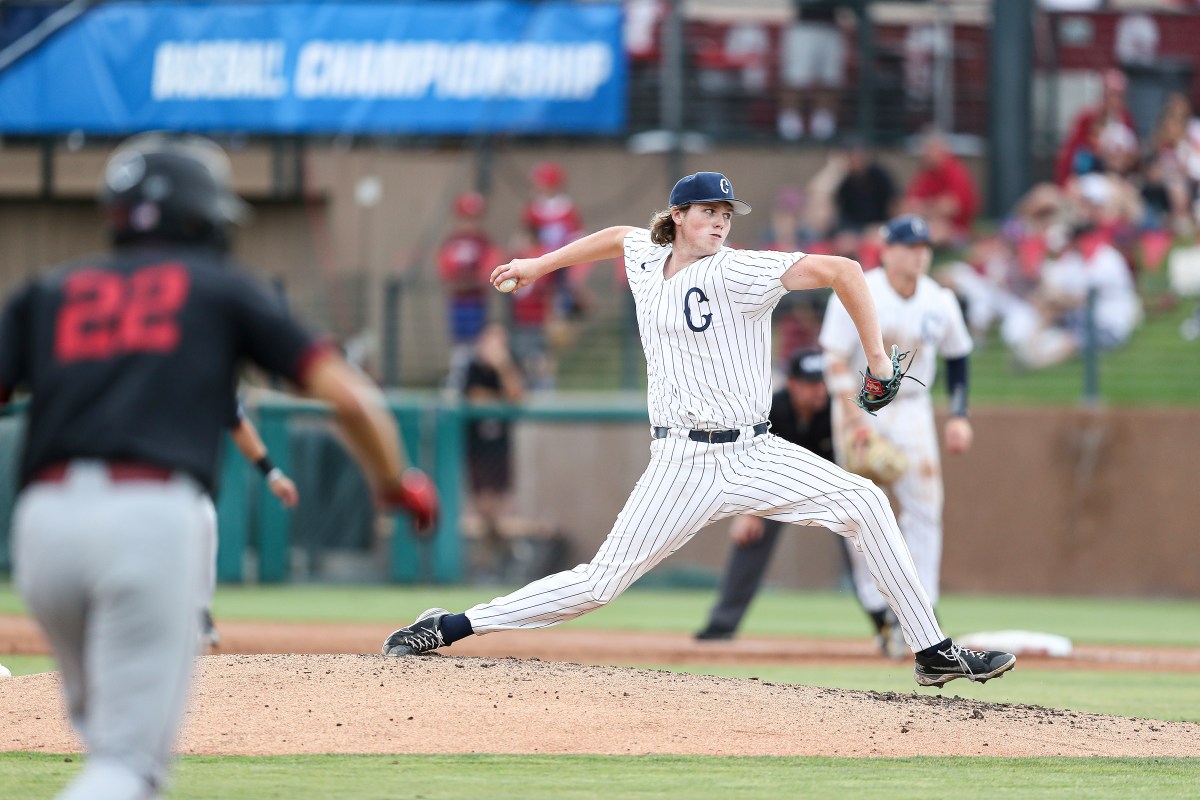
Back in March of 1962, J.O. Christian, who’d just retired after 25 years of coaching baseball at UConn, took a spring training junket down to Florida.
As he spoke with The Courant’s Bill Lee, one of my most illustrious predecessors in this job, the manager of the Mets, aged 71, Casey Stengel, limped toward them. Casey wanted to pick the UConn coach’s brain about college coaching and college pitching talent, since a former Husky, Rollie Sheldon, had a big rookie season for the Yankees in ’61. Later, Stengel was back, “where’s that feller from Connecticut,” he asked Lee. “Tell him to come back here, I want to talk to him.”
Stengel and Christian spoke another half hour, Lee reported. I relate that story here because, A, I think it’s pretty neat and B, it has some relevance now that the current UConn pitching coach, Josh MacDonald, has been making good use of his MLB streaming package to watch five — count ’em, five — of his former pitchers in the big leagues in 2026.
“Well, (big league managers) haven’t called me yet,” MacDonald said, with a laugh.
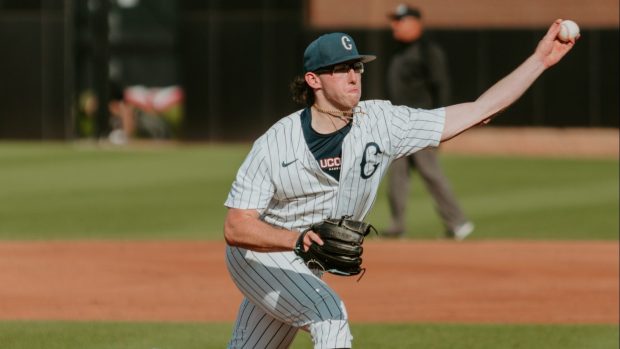 UConn’s Andrew Sears has been called up yp the majors by the Tigers. (Photo courtesy: UConn Athletics)
Austin Peterson, called up by the Guardians, is the latest, breaking in with two scoreless innings, one hit and three strikeouts on Saturday against the Tigers, a day after ex-Husky Andrew Sears threw 5 2/3 strong innings for the Tigers in the same series. Ben Casparius of the Dodgers, who came up in 2024, PJ Poulin of the Nationals, who broke through last year, and Anthony Kay of the White Sox, who has returned to the MLB after two years in Japan, are the other Mac strike-zone attackers in the big leagues.
“Maybe the coolest byproduct of these guys all being in the big leagues is that even though I’m a gigantic Red Sox fan, I’ve become more of an MLB fan this year,” MacDonald said. “I’m flipping through games, then earlier in the year at 10 o’clock, I’m flipping over to Dodger games. With Kay starting, I’m able to schedule my day around that.”
The other thing that’s just as cool: “The competitiveness oozing through the screen,” he said. “When I watch all five of these guys, I think that’s pretty apparent.”
Peterson, 26, from Indiana, didn’t get the chance to be a front line starter at Purdue, so he went to a JuCo in Illinois, where MacDonald spotted him. At UConn, he became a No.1 starter and led the Huskies to the Super Regional in 2022.
“What coach Mac does best,” Peterson said Sunday, “is find out what you’re good at and make you realize how good you are at that. For me, it was being a good overall pitcher, being able to move the ball around and use different pitches to get guys off balance, not be too predictable. I think my overall competitiveness matches Coach Mac.”
MacDonald, from Milford and Notre Dame-West Haven, pitched for UConn and was, in fact, the winning pitcher in the first of Jim Penders’ more than 800 wins in 2004. He has been the Huskies’ pitching coach for 15 seasons. Over the course of his career, analytics has become a bigger and bigger part of evaluating and coaching pitchers, but he has balanced the analytics and the modern emphasis on velocity and spin rate with old-school intangibles.
“It’s really a good testament to his eye overall,” Peterson said. “It’s something he was really good at before analytics became a huge thing. He’s a good mix of old school and new school.”
Dom Amore: To Japan and back, this former UConn star has helped spur dramatic MLB turnaround
Peterson has been a starter throughout his minor league career, since Cleveland drafted him in the ninth round in 2022. He missed time this year with a strained muscle in his arm, but returned to strike out 102 in 95 1/3 innings. The Guardians, in a playoff race, began looking at him as a reliever. He returned to Triple-A Columbus Saturday, which is how these things go, but he left a good impression. When he first got out on the mound, he told himself “don’t look up” at the huge crowd, but eventually he took it all in.
“You just get your feet wet and have the confidence to go out there and attack the zone,” he said.
Sears, a lefty, transferred to UConn from Rhode Island College and came on strong late in his one season with MacDonald, 2023, striking out 74 in 62 innings. “He turned the corner so much the local area scouts were drooling over his 6-5 frame and his low arm slot,” MacDonald said.
Detroit took him in the 10th round in 2023. Two weeks ago, Sears called MacDonald to say, ‘hey, don’t tell anybody yet, but I’m going to the show.” Two days later, he pitched vs. Kansas City. His first outing was rough, but he pitched well in his last two appearances against the Dodgers and Cleveland before being sent back to Triple A Sunday. He’s earned the nickname “Psycho” in pro ball.
MacDonald is still coaching him, too. He was happy to see Sears paying attention to runners at second base. “When he first came to UConn, they stole third a lot on him,” MacDonald said.
Kay, originally a late first-round pick by the Mets in 2016, is still the old bulldog type. With nine wins he has helped the resurgent White Sox rise to first place in the AL Central, and he’ll still get texts with reminders from his college coach. MacDonald loves watching Poulin, who is currently on the injured list, finesse the best hitters in the game with modest velocity. Casparius, an infielder before transferring from North Carolina to UConn during the pandemic, is also hurt, but he has been a big part of the two-time champion Dodgers bullpen at times. MacDonald’s first big leaguer was Scott Oberg, pitched five productive seasons with the Rockies before injuries shortened his career in 2019.
“I think it has a lot more to do with the way Jim Penders runs his program,” MacDonald said. “One thing you know, when you get one of our guys, they know how to act. You’ve got a guy who acts like a professional and takes baseball seriously.”
And there are quite a few more of Mac’s guys working their way up in pro baseball. If there’s a secret sauce that old Casey Stengel would’ve picked from Josh MacDonald’s brain, it’s polishing the finer points of pitching, while stoking the competitive fire it takes to get hitters out.
“I would say the thing that maybe separates me from a lot of coaches is that, although everything right now leans toward analytics and pitch selection and chasing all these metrics, I try to marry that with owning the strike zone,” MacDonald said. “Owning the counts, focusing on what the runners are doing. They’re all bigger and stronger and faster than when I played, and when I first started coaching, but I think you can marry those two skills and let them enjoy competing. And if they’re not competing at that level, we need to correct it in my very old-fashioned way.”