
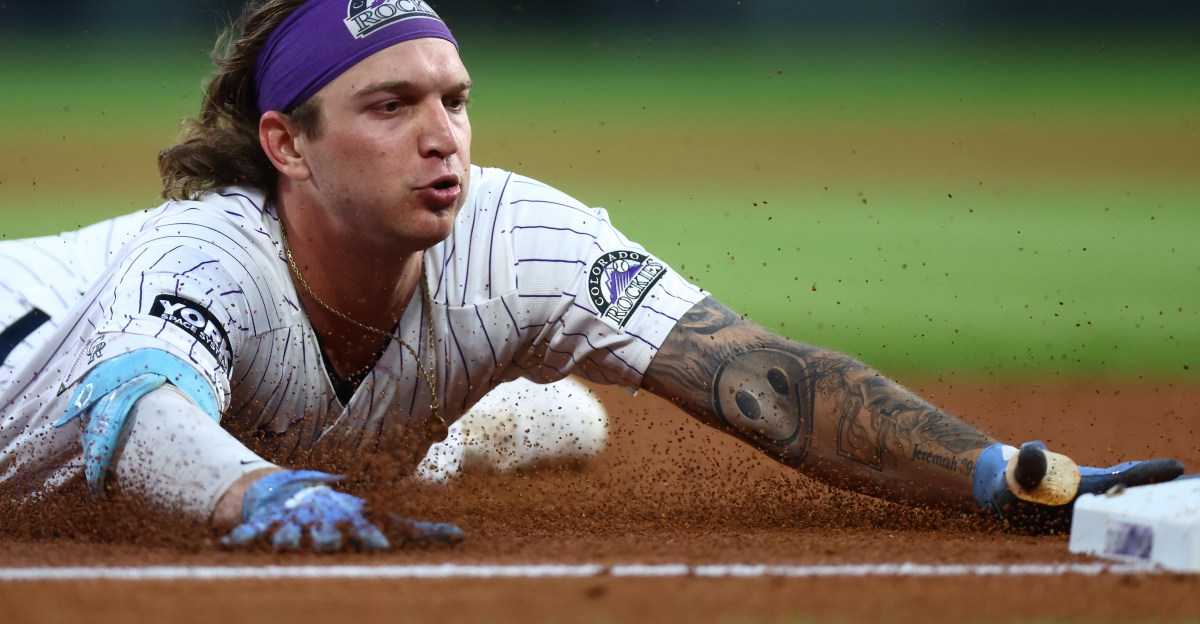
It has been nearly a month since Zac Veen was recalled for his second big-league stint with the Colorado Rockies. After a phenomenal season in Triple-A Albuquerque, Veen was finally handed the opportunity to see if his offseason personal changes and in-game adjustments were legitimate enough to help the Rockies.
After 21 games into this cup of coffee, Veen has shown promising development. He still plays with the energy that defined him in his minor-league career, and his at-bats have looked better than they did during his brief 12-game cameo in 2025. He’s shown obvious maturity, and that’s an important stepping stone for him.
However, fans have noticed that Veen is not necessarily being used on an everyday basis in the way they hoped. Over his 21 appearances, Veen has made a start in 11 of them and has played a full game just three times.
This has led me to ponder: Is this an instance of manager malpractice or simply a signal that Veen still has some hurdles to jump as a big-league player?
I won’t dive into every single statistic and season progression for Veen today, as that can be saved for our Ranking the Rockies series coming in the offseason. However, we can get a basic overview of where things stand.
Entering Tuesday’s series against the New York Yankees, Veen is batting a respectable .263/.349/.526 over 45 plate appearances with a 126 wRC+. He is 10-for-38 with two doubles, a triple, and two home runs. He is still striking out at an extremely high clip of 37.8%, the same as in 2025, but has drawn four walks for an 8.9% walk rate. Additionally, he’s hitting more line drives (17.4%) and fly balls (39.1%) while hitting fewer ground balls (30.4%).
Veen has also played serviceable outfield defense, although advanced metrics rate him with -2 Outs Above Average and Fielding Run Value, along with -3 Defensive Runs Saved. He’s still developing as an outfielder but has shown to have a strong arm that can make a huge difference in the outfield.
On the surface, Veen is fine. It’s obvious he is still trying to adjust to the big leagues as a young player, but there is enough there to like that warrants more opportunities. However, what lies beneath the surface could be reason enough to manage his playing time in the way the Rockies have done thus far.
Let’s look at one of the more apparent factors: platoon splits.
Veen is a left-handed hitter and has seen the majority of his opportunities come against right-handed pitching. Every start he has made has come against a right-handed starting pitcher. Seven of his other 10 appearances where he appeared as a pinch-hitter have been started with a left-hander on the mound.
He’s done well against right-handed pitching overall, slashing .294/.385/.588 in 39 plate appearances. Meanwhile, he’s 0-for-4 in six plate appearances against left-handed pitching. It makes sense to limit his exposure to big-league lefties, as the Rockies in general have struggled in that department of the platoon game.
However, Veen has struggled a little bit more against right-handed starters, batting .241/.353/.517. The numbers aren’t horrible, but it does speak to the reality that he could use some more seasoning and development in that area at the big league level. After all, he punished righties to the tune of a .338/.419/.696 with 20 home runs in the Pacific Coast League and had an impressive .284/.347/.470 slash against lefties. We know he is capable of doing great things to disregard the platoon, but the jump in competition from Triple-A to the big leagues is a tough one.
Still, the Rockies could be better served feeding him some more opportunities against same-sided pitching even if they prefer the match-ups for Jordan Beck and other right-handed hitters.
There is no question that Veen is energetic and eager at the plate. Remember that one spring training where he was basically swinging at the first pitch every single time?
Veen is still an aggressive hitter, although he has shown some restraint at times during his big-league return. What’s fascinating is that even though there is some restraint, the plate discipline metrics are nearly identical to what he did during his brief time in 2025.
He is seeing 3.62 pitches per plate appearance and has a 66.3% strike percentage of pitches he has seen. Veen’s slight restraint at the plate has seen his called strike percentage rise to 6.7%. Unfortunately, he has also swung at the first pitch 53.3% of the time, which has aided a first-pitch strike rate of 66.7%, the highest mark of his professional career by a good margin.
Basically, Veen is swinging as much as he did in 2025 at the big-league level; it has just moved around in terms of foul ball swings and types of contact. He’s making contact 66.3% of the time, but is making much more contact on pitches outside of the zone (48.7%), which is still less than what he did in Triple-A, but more than he did with the Rockies last season.
Being aggressive is good, but being overly aggressive to the point that you swing at bad pitches and constantly have to work from behind in the count isn’t a great method for success. Attacking pitchers has helped Veen in pitch-hit situations where he’s batting .375/.444/.500, but he’s still looking for that balance in approach when seeing three at-bats a game.
Trouble with the Fastball
Perhaps the toughest thing hindering Veen is the fastball.
So far, he has proven more than capable of handling offspeed and breaking pitches. The fastball, however, has limited Veen to a .143 AVG with a 51.9% whiff rate. He has seen a fastball 54% of the time, and it has been the putaway pitch 38.5% of the time with 10 strikeouts. The four-seam fastball has proven especially difficult with a 52.9% strikeout rate and a 57.6% whiff rate, limiting him to a .133 AVG.
Location of pitches is the key thing to focus on here. Consider this chart displaying the whiff rate compared to where pitches of any kind are located.

Baseball Savant
Now, look at where the majority of four-seam fastballs are being thrown to Veen. Can you see the similarity?

Baseball Savant
Opposing pitchers are attacking Veen’s weakness up in the zone while also working away from him. Despite a quick bat, Veen has produced an ideal attack angle just 33.3% of the time due to his steeper 33-degree swing path and 14-degree attack angle.
For Veen to take the next step as a hitter, he has to figure out how to hit big-league fastballs, or learn to lay off the high ones at the very least to begin with.
Ultimately, I wouldn’t say it’s manager malpractice with how Veen is being utilized. While it would be easy and beneficial to throw Veen out there every single day to work through his issues and learn on the job, that’s just not how the Rockies have operated this season. Platoon match-ups have reigned supreme, trying to win every single battle in the hopes of winning games. Veen is still learning and developing, and as much as I would love to see him playing every day, I understand that he has a lot of work to do, and the platoon may be his best bet down the stretch. He’s learning to embrace the role of doing anything to help the team win a game, and that’s an important step in any young player’s journey.
Triple-A: Albuquerque Isotopes 3, Reno Aces 2
It was a strong night of pitching for the Albuquerque Isotopes as they managed to hold on for a 3-2 victory despite some drama in the bottom of the ninth. Jake Brooks delivered a spectacular start, firing six shutout innings and allowing just two hits. He also had just one strikeout against two walks, utilizing eight groundouts and five flyouts.
The following two relievers fired scoreless innings before TJ Shook entered to collect the save. Shook battled his command, issuing three walks to load the bases with one out to bring in Reno’s first run. A sacrifice fly scored the second run but Shook closed things out with a ground ball to end the game. Offensively, Bryant Betancourt drove in two runs with a double in the second inning. Ryan Ritter had an RBI single in the fourth as part of a two-hit night to drive in Edouard Julien, who also had two hits.
Double-A: Somerset Patriots 7, Hartford Yard Goats 2
The Hartford Yard Goats were stunned early as Somerset scored five runs in the bottom of the first, cruising to a 7-2 victory. Bryson Hammer started on the mound for Hartford and gave up three doubles in the first inning, including a bases-loaded double, to fall behind 5-0 in the first. He ended up going 3.2 innings, giving up six total runs on five hits, but only one was earned after an error in the first inning. He did tally four strikeouts against one walk.
Offensively, the Yard Goats had five hits, with Jared Thomas and Jacob Humphrey scoring the only two runs for Hartford late in the game. Andy Perez hit his 30th double of the season, but the team struck out 11 times against three walks.
Rockies Reacts Survey: Will Hunter Goodman hit 40+ home runs in 2026?
Affected by Altitude Episode 224: Well, We’re Sold… on TJ Rumfield | Rocky Mountain Rooftop
This week, Evan Lang and I talk about Connor Norby, Zac Veen, Charlie Condon, and the potential of a new Rockies owner in the future. We also hand out our August Players of the Month!
NL ROY candidate Rumfield excited to face former Yanks Minor League teammates | MLB.com
As the Rockies face off against the New York Yankees, it’s a full-circle moment for TJ Rumfield, who was traded away by the Yankees during the offseason.
Fewer adsCreate community postsComment on articles, community postsRec comments, community postsNew, improved notifications system!
Please keep in mind our Purple Row Community Guidelines when you’re commenting. Thanks!