
On the night before everything came to an end, a cold front dumped about an inch-and-a-half of rain on New York City. We’d gone up to the Stadium to watch Roger Clemens try and win his 20th game of the season and to basically just catch up over some baseball. As the rain further diluted our already watery beers and the lightning played across the façade of the Bronx County Courthouse, it became clear that this wasn’t going to be a wait-it-out thunderstorm.
When you’re still young, you don’t let a little washout get in the way of your evening out, and in turn-of-the-century NYC, the evenings tended to go long. Rather than taking the dry way out and heading home on the 4 train, we all got caught up in a more southerly impulse and trekked down to our friends’ new place down in Battery Park City. We joked about the consumption of “TUDs,” or Totally Unnecessary Drinks until, goddamn, it’s 3:30 already? So we crashed on the couch and on the love seat and on the floor in the baby’s room, which was unoccupied because said baby was still inside his mother.
The blue of the sky that morning was eternal. You know the rest.
* * * * *
Twenty-five years on, and there’s a case to be made for the notion that we never fully recovered from the attacks, although sports—and baseball, especially—did their damnedest to usher us all into a sort of New Normal. If it can be argued that those 17 minutes between the tower strikes marked the last gasp of a fading reality—despite the endless visibility, from a street-level view you could almost convince yourself that the first plane was an accident, a self-delusion that would be brusquely erased by United Airlines Flight 175—the quarter-century since has been an exercise in distracting ourselves from the metanarrative. Sports still do a lot of heavy lifting, although as a cultural phenomenon, they’ve never been more efficacious than they were in the weeks directly afterward.
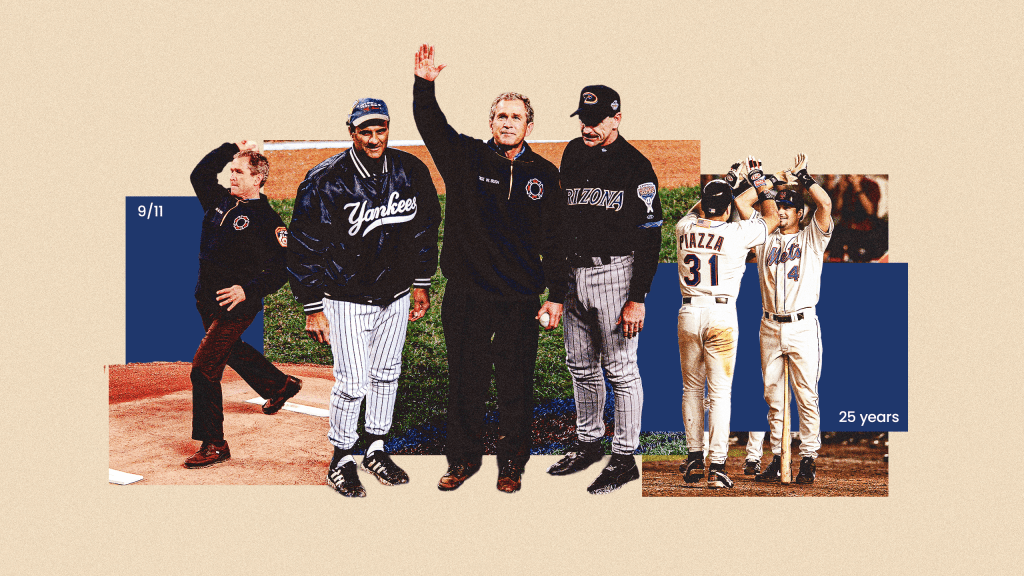
The Mets and Braves got the ball rolling on Sept. 21 at Shea Stadium, as the two rivals came together to put on a show for 41,235 New Yorkers who were greatly in need of something to help take their minds off the horrors of that Tuesday morning. Just a few days prior to MLB’s NYC restart, the venue had served as a staging area for rescue and recovery teams, and the Mets wore caps emblazoned with the logos of the police and fire departments. Mike Piazza went the extra mile, crafting a custom fit with a pair of scissors, an NYPD logo hat and a couple dabs of glue; the stylized catcher’s helmet he wore that night is on display at the 9/11 Memorial Museum.
Trailing 2-1 in the bottom of the eighth, Piazza came through like a champ, taking Steve Karsay yard for the go-ahead (and winning) two-run blast. Catharsis. A Queens native who grew up in the shadow of Shea, Karsay would later say that he felt grateful to “give the fans in the stadium and the city of New York a small amount of time to take their mind away from the outside world.”
The Yankees would also have their turn at bat, and while Clemens would collect that deferred 20th victory in Chicago, the Bombers went on a postseason tear that was overstuffed with such moments. The most momentous of these was reserved for Game 3 of the 2001 World Series, which saw Clemens take the hill with the Yanks down two games to none to the Arizona Diamondbacks. While the right-handed hurler pitched a gem of a game on Oct. 30, New York’s much-needed 2-1 win is best remembered for a wholly separate performance on the mound.
As Bernie Williams would recall in an April 2019 appearance at the 9/11 Museum, a visibly calm, cool and collected George W. Bush was getting ready to throw out the first pitch ahead of Game 3 when Derek Jeter dropped by to give the president a little pep talk. “Derek says, ‘Hey, you know, don’t bounce it, because they’ll boo you,’” Williams said. “To the president of the United States! I was, like, ‘Dude, you’re crazy!’” (Bush would confirm the story, adding that Jeter’s advice only served to stir up the dormant butterflies.)
Despite the shortstop’s inadvertent trespassing into Bush’s headspace, the president sidestepped the ceremonial mark at the front of the mound and toed the rubber like a pro. Despite being burdened by a bulletproof vest, W fired in a strike that disappeared into the pocket of Todd Greene’s glove with a thwock. Bedlam.
Bush’s toss arguably marked the last time Americans ever agreed on anything that smacked of the political, but as Williams recalled, divisiveness was clearly not on the menu that night.
“We were playing for something bigger than us,” Williams said. “We were playing for something bigger than baseball. And we had a responsibility to do whatever we could to play our part to assist in the healing of this nation. If we were there to be a distraction, that’s what we were going to be.”
The idea of serving as a distraction has been taken up by multiple Yankees ever since. Torre acknowledged that when play first resumed up in the Bronx on Sept. 25, “the last thing on your mind was baseball.” But once he’d made his way to the ballpark, Torre “realized there was something for us to do and it was to try to, you know, distract the best we could.”
The Yankees would lose the World Series to Arizona on a Game 7 walk-off, denying fans the Hollywood movie ending in favor of a Kelly-Leak-gets-thrown-out-at-home finale. But like The Bad News Bears’ rangy little dirtbag on the dirtbike, there was no dishonor in the loss, even if the fans would’ve found even greater consolation in a title. While the last upright section of the World Trade Center façade stood sentinel over Ground Zero and the fires still burned under the rubble, baseball did its level best to help New York and the nation at large think of other, far less weighty matters, if only for a few hours every night in the long fall that followed.
Let’s just hope we’ll never again have to require so much diversion from a simple pastime.
“I remember making a lot more eye contact with the fans at that time, looking people in the eyes, saying, ‘Yeah, man,’” Williams remembered. “And, I mean, I never do that. As a matter of fact, I try to block everything out. That’s the only way I know how to play and stay focused. But I allowed myself to interact with the crowd more because I knew that … I was playing for them.”