
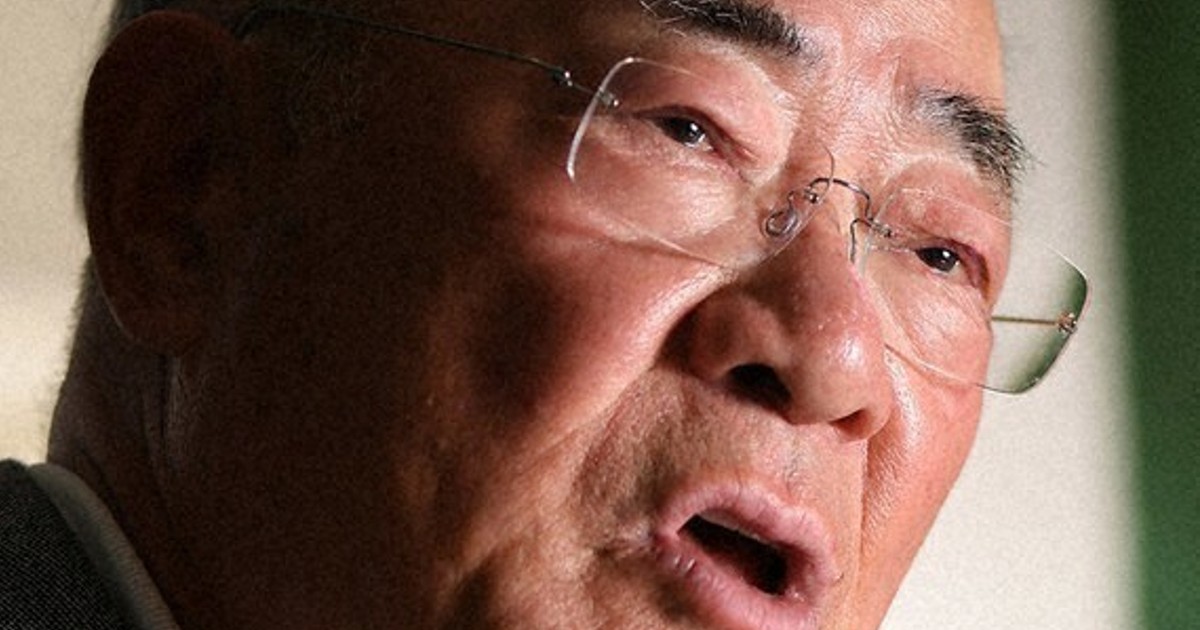
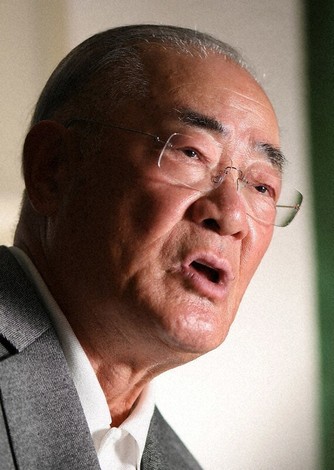
Isao Harimoto is seen in Tokyo’s Setagaya Ward on Jan. 13, 2020. (Mainichi)
OSAKA — Former professional baseball player Isao Harimoto, who passed away on Sept. 9 at age 86, called for nuclear abolition during a telephone interview with the Mainichi Shimbun just four days before his death.
“Nuclear weapons must be eliminated throughout the world. Wars in which people kill each other with weapons must absolutely never be fought,” Harimoto reiterated in the same passionate tone as always.
After retiring as a player, Harimoto became a familiar face on television as a commentator with a stern but warm way of speaking. But in his later years, he kept pressing a message that went beyond his role as a sports community “opinion leader”: the abolition of nuclear weapons. After staying silent for many years about his experience of the atomic bombing in Hiroshima, he began speaking about it after turning 60 out of a single wish that Hiroshima and Nagasaki will be the last places to suffer atomic attack in warfare.
On Aug. 6, 1945, when he was 5, Harimoto was exposed to the flash of the atomic bomb at his home in Hiroshima, 2.3 kilometers east of the hypocenter. The blast leveled his family’s house. His eldest sister, Tenko, then 12, was exposed to heat rays from the bomb while mobilized for wartime student labor. She repeatedly murmured, “It’s hot, it’s hot,” and died several days later.
Harimoto’s parents had arrived in Japan from the Korean Peninsula, then under Japanese rule, during World War II. His father died of illness during the war. After the war, his mother raised Harimoto and two other children by running a grilled offal stall from a barracks building, among other work. Even after entering professional baseball at 18, Harimoto did not speak about the bombing for many years. “I was absorbed in baseball, and I had put a lid on that jar of memories,” he recounted.
He began sharing his experience with the media around 2005, 60 years after the bombing. It was after he saw a young person say in a TV street interview, “War has nothing to do with me,” which alarmed Harimoto. “We are the last generation who can speak up about the atomic bombing experience. I thought I had to pass it on,” he repeatedly said in interviews.
The first installment of the “Hibakusha” interview series, published in the Mainichi Shimbun’s Kyushu Head Office edition on Oct. 11, 2006, featured Harimoto. The series has since continued for 20 years, interviewing survivors of the Hiroshima and Nagasaki atomic bombings. The first article appeared two days after North Korea conducted its first nuclear test. Harimoto said emphatically, “It is outrageous. What on earth are they trying to do to the world?” After recounting the difficult days his family endured after the 1945 bombing, he also said, “I hate Aug. 6. I wish they would get rid of it by law.”
After those words were reported, a letter arrived from a sixth-grade girl in Oita Prefecture saying, “Please do not forget Aug. 6,” which moved Harimoto. In spring 2007, he visited the Hiroshima Peace Memorial Museum for the first time, a place he had avoided out of fear that “the memories of that time might come back.”
In the July 2007 “Hibakusha” installment, Harimoto said he would “never forget” that day. He stopped at every exhibit and said he cried out in his heart, “Why did they drop it (the atomic bomb)?” He also revealed that when he saw the tattered clothes worn by a boy about his age, he felt like speaking with him and saying, “You must have seen hell. It must have been painful.”
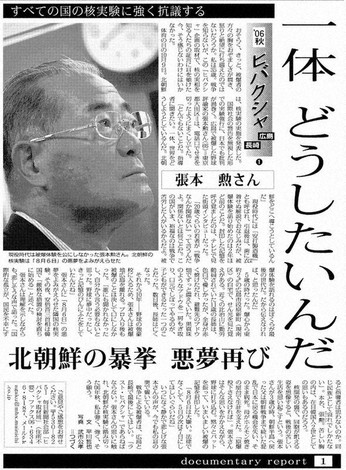
The first installment of the “Hibakusha” interview series appeared in the Mainichi Shimbun’s Kyushu Head Office edition on Oct. 11, 2006, featuring Isao Harimoto as the first interviewee. The series has since continued for 20 years. (Mainichi)
Harimoto later said in an October 2011 Hibakusha series article that the letter he received from the girl at that time “created my starting point as a ‘messenger’ for nuclear abolition.” Peace groups across the country began asking him for messages for their activities, and he wrote such words as, “Nuclear abolition for all humanity.”
When Harimoto signed a contract in 1958 with the Toei Flyers pro baseball team and received a 2 million yen cash signing bonus, he took a night train to Hiroshima. Without breaking the seal on the package of bills, he handed it to his mother and said, “Please build a house with this.” He said in a February 2016 Hibakusha series article that a single thought sustained him through his playing career: “I want to let my mother eat her fill.”
As he spoke about his turbulent life, he also expressed his candid feelings about nuclear-related developments in the world at each moment. He revealed his frustrations over the lack of progress toward nuclear abolition. Lamenting that he felt no one was responding even after speaking about his atomic bombing experience in newspapers and on television, he once said in an October 2011 Hibakusha series article, “I want to breathe my last after hearing the words, ‘Nuclear weapons have disappeared from the Earth.'”
In what became his final interview on Sept. 5, he was also asked about the unceasing war gripping our world. “Killing or being killed is the one thing we absolutely must avoid. Human beings have wisdom. Even if it takes time, we have to resolve things through dialogue,” he said, his words becoming even more passionate.
Asked about talk under Prime Minister Sanae Takaichi’s administration of reviewing Japan’s three non-nuclear principles of not possessing, producing or permitting the introduction of nuclear weapons into the country, Harimoto said with emphasis, “I don’t know the details, but what we must not possess, we must not possess. Not only Japan — the whole world.”
(Japanese original by Mio Matsumoto and Hiroko Tanaka, Osaka City News Department)