

Jase Bowen walked into the San Diego Padres’ clubhouse at Citizens Bank Park in Philadelphia one afternoon in early June with the heightened awareness that comes from doing something for the first time. A 26-year-old outfielder, Bowen had been promoted from the Padres’ top minor league affiliate. He would play in his first major league game that night.
Bowen didn’t know if he would be with the Padres for a week, a month or the rest of the season. But now that he was a major leaguer, he had major league concerns. When Nick Pivetta, the Padres’ MLBPA player rep, walked past his locker, Bowen buttonholed him. “Hey, Nick,” he said. “Can I ask you a question?”
The previous week, baseball’s owners had made their initial proposal for the next collective-bargaining agreement, which would take effect in December. According to the terms, each club could spend no more than $245.3 million a year on players’ salaries. Bowen had heard that if no agreement was reached by the deadline, the owners would declare a lockout. He admitted he didn’t know what that entailed. “A lot of the stuff, the salary cap and the lockout — what they’re really fighting for, I have no idea,” Bowen said. “I’m getting my information from Twitter. This will be my first big-league offseason, and I don’t know what to expect.” Now that he had the Padres’ player rep in front of him, he figured he should ask.
MLB’s owners and players negotiate a new deal every three or four years. Each time, all but a few teams have the same owner as they did during the previous negotiations. In fact, the majority of teams haven’t changed hands since before 2005, five negotiating cycles ago. “It’s the same people sitting across the table,” says Jake Cronenworth, a Padres infielder and one of eight players on the union’s executive subcommittee.
By contrast, nearly half of MLB’s players have made their debut since the last agreement was signed in April 2022. Such extreme turnover in the labor force doesn’t happen with steelworkers or flight attendants.
That makes educating its members far more important for the MLBPA than for other unions. “Some players come from a union background or love the history of the game and want to be involved from the beginning,” said Andrew Miller, who pitched for 16 seasons and now works for the MLBPA as its special assistant for strategic initiatives. “Others say, ‘Look, I don’t care, I just want to play the game.’ There’s a whole spectrum of where players are coming from. Our job is to educate them, give them a cohesive message, make sure they have access to us and that all their questions are answered.”
Over the past few months, some 60 players from teams in large and small markets were asked about a salary cap for this story. Not one was willing to even entertain the idea. But as of this week, 244 more players have made MLB debuts this season, comprising nearly a quarter of the MLBPA’s current membership. Most of them arrive as Bowen did, knowing little about the issues under consideration. And while nominally supporting the union is easy enough at this point, if no deal has been reached by April, missed paychecks will start accumulating, adding to the motivation for the players to settle. “What MLB does,” Pivetta says, “is try to pressure-cook it all the way to the end.”
 Former pitcher Andrew Miller has become a key link between the MLBPA and its players. Getty Images
Pivetta’s answer to Bowen’s curiosity about a salary cap was simple: It’s a way for owners to make costs predictable, increase profits and grow franchise valuations. “It’s just suppressing market values for younger generations for the rest of their lives,” Pivetta explained. He reminded Bowen that a small-market team, the Milwaukee Brewers, won more games than any other last season, and seems likely to do that again. “Teams have all these revenues,” he told Bowen. “They all have money. Their valuations are going through the roof. They can spend a lot more, but they just choose not to.”
In the young outfielder, Pivetta saw an opportunity. A few days later, he urged Bowen to become one of several Padres alternate representatives, which is essentially an apprenticeship to becoming a union leader. The Padres are a veteran team, and Pivetta figured Bowen could be a link to the future. “It’s the way most of us started,” he said.
Later that month, outfielder Samad Taylor was recalled from Class AAA El Paso. Pivetta urged Bowen to give Taylor his version of the MLBPA’s talking points. It went well enough that Taylor said he felt comfortable with the union’s position. That pleased Pivetta. “The simple approach is the best way to keep people engaged. And at this stage, with nothing really happening yet, keeping them engaged is all we want,” he said.
The Cost of a Crack
The MLBPA is different from America’s other unions, which tend to have members that come from similar backgrounds, get paid around the same amount and spend decades doing similar jobs. “We have players from here and players from all over the world,” Miller said. “We have young players who are superstars, role players, players who are only going to get a cup of coffee in the majors.”
In 1981, a player strike canceled a third of the season’s games, and a shortened season was played in two halves. At the time, Steve Rogers was one of the best pitchers in the National League and part of the MLBPA negotiating team. Now 76, he still works for the union, helping to calculate player service time. He insists that a deal was almost done before the strike deadline that June. “And then,” he said, “three guys made comments to reporters: ‘I don’t know what’s going on with any of this. I just want to play.’ I mean, everybody thought that, but they said it.”
Those were three players out of around 1,000, yet the comments made headlines. Emboldened by what they thought was an increasingly fractured union, the owners dug in and the season shattered. When a deal was signed seven weeks later, it was essentially what had been on the table in June.
“You do worry about something being taken out of context that kind of hurts our position,” Miller said. “One or two guys is not ideal, but it’s not the end of the world. It’s when they can break off a chunk of players that there’s trouble.”
Miller’s role is to try to prevent that from happening. “That’s why we spend so much time making sure these guys understand where we’re coming from, why we’re doing things, why their peers want this or that,” he said. During the last negotiations in 2021, he was a free agent with a wipeout slider who hadn’t yet retired. He didn’t pitch again, as it turned out, but he was an important member of the players’ bargaining team. “I faced him, and I think a lot of the guys in this clubhouse did,” Trea Turner, the Phillies’ All-Star shortstop, said. “And I remember being on the phone calls and listening to him talk and just how smart and passionate he was. Over the years, he’s earned my respect.”
For much of the past two years, Miller has traveled the country visiting clubhouses. The biggest danger, he tells players, whose average salary is $5.34 million, is apathy. He believes that players who have positive interactions with the MLBPA will be less likely to break ranks, even if games eventually get canceled and pay is lost. “We need as many touchpoints as we can get to make us as strong as we can possibly be,” Miller said, “and there’s a million ways to do that.”
 Bruce Meyer was named MLBPA executive director as it works to educate and unify
players ahead of a potential labor showdown. Getty Images
When Joey Bart, then with Pittsburgh, saw Miller in the Pirates’ clubhouse, he asked a question about investment opportunities and ended up understanding the union’s positions on several issues at a depth he never had. When Tyler Rogers, now with the Blue Jays, was wondering why he couldn’t get his unique uniform number — 71 — for Team USA, he asked Miller and the union for help. “It can be something as small as field conditions after a rain delay,” Miller said. “I always tell players, we’re here to work on your behalf in whatever situation.”
When the Blue Jays were playing the Rays in 2025, Miller set up a round of golf with outfielder Davis Schneider in Tampa. In Schneider, Miller perceived a potential activist who hadn’t found a reason to become involved. “I get him on the golf course for four hours,” Miller said. “Half the time, we’re talking about completely unrelated stuff. But half the time, we’re talking about union stuff.” Miller was persuasive. “He knows what he’s talking about,” Schneider said. “And he’s just a really good guy.” After Chris Bassitt, Toronto’s player representative, left the team last winter, Schneider agreed to succeed him.
Inside clubhouses, Miller has a strategy for engaging with players. “You kind of linger, you talk to guys you know and if a group of guys are sitting down having breakfast, you wander over,” he said. “I can talk to them about whatever rule changes have been made since last season. I can talk about my slider.” He might ask a hitter how he has been seeing the ball lately, or a pitcher how the ball feels leaving his hand; standard player chatter. “And maybe that lasts for 20 seconds before somebody says, ‘Oh, look, I’ve got this contract issue.’ Or it may be 10 minutes of telling funny stories about guys I played with. And maybe that small conversation then goes, ‘Hey, actually, what about this?’” Whatever the issue, Miller will attempt to solve it, in the process reminding the player that the union works on his behalf.
The Cap Comes Back
The owners last proposed a cap in 1994, when the players went on strike and the rest of the season was canceled. For two decades, the idea wasn’t even on the bargaining table. But in large measure because of the Dodgers — who have won the last two World Series, signed the most coveted free agents and have a player payroll more than five times that of some other teams — fans in many markets now feel like a cap is needed to give their favorite team a chance. “There are fan bases that are disillusioned,” said Brent Suter, a veteran pitcher now with the Atlanta Braves. “I get the frustrations.” Some players admit that even their family members believe the current system isn’t working.
Owners agree. More MLB teams have won championships this century than teams in the NFL, NBA and NHL, but baseball hasn’t had a low-budget World Series winner for more than a decade, since the Royals did it in 2015. The goal of a cap, coupled with a spending floor, would be to mitigate the difference between market size and baseball-related revenue, giving teams like the Royals — as well as the Brewers, Rays and Guardians, who have found ways to be successful on smaller budgets — a better chance to survive the sport’s recently extended playoffs. They point to the NBA’s San Antonio Spurs, the NHL’s Carolina Hurricanes and the NFL’s Kansas City Chiefs, who have won three Super Bowls since 2019, as evidence that a cap works.
They have made the case so persuasively, on MLB.com and elsewhere, that disgruntled fans are calling for a salary cap across sports websites and social media. “It’s the lowest-hanging fruit for the casual fan to grab onto,” said Pete Fairbanks, who pitches for the Marlins. “All those faceless people arguing on the internet to prove their point, because all the other leagues have it. But the desire to cap the cost of labor isn’t rooted in competitive balance. Every business in the history of businesses has wanted a static labor cost.”
Still, in a poll of fans The Athletic conducted on its website in February, 68% of respondents agreed that a salary cap would be beneficial, and these days the number would likely be even higher. That sentiment seems to have emboldened the owners to push for one. “The owners smell blood in the water,” one agent said. That makes educating the players more important than ever, Miller believes. “It’s not a lot of fun when you’re a player in your hometown and you go to a restaurant or the YMCA and you hear it from fans, ‘Why won’t you guys do this or that?’” he said. “Knowing the big picture can help make them feel stronger in their positions. And that’s what keeps them unified.”
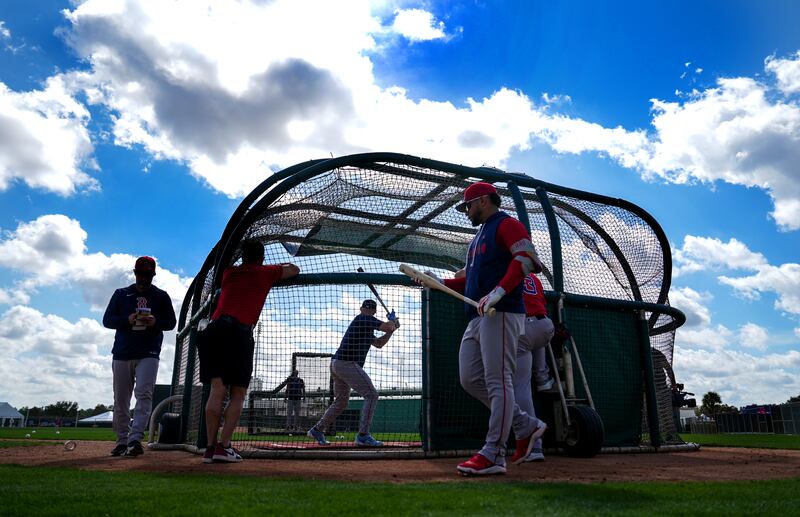 An emergency players’ meeting at Red Sox spring training underscored the uncertainty surrounding the MLBPA. Boston Globe via Getty Images An Unexpected Assist
Every year, the MLBPA visits all 30 teams at their spring training sites. Those visits are often perfunctory — there just isn’t much to talk about. This year was different. Everyone knew the owners would demand a salary cap. And then, the day before the tour was scheduled to begin, ESPN reported that Tony Clark, the executive director, was romantically involved with his wife’s sister, who also worked for the organization. The Padres were one of the first clubs on the schedule, so the news of Clark’s transgressions was fresh. At the club’s facility in Arizona that morning, players seemed more interested in getting details of the scandal and its aftermath than discussing lockouts or salary caps.
Before the meeting, Miller ambled over to a table of Padres. Five of them were young pitchers he hadn’t met. But Michael King is involved in the MLBPA Players Trust, the union’s nonprofit arm, and happens to be Miller’s neighbor in Tampa. That gave Miller an opening. Soon he was chatting with Alek Jacob, Ty Adcock and Ron Marinaccio, none of whom were major leaguers during the last lockout. It wasn’t long before one of them had a question. In April, the Padres were scheduled to play the Arizona Diamondbacks in Mexico City. News accounts of a government raid on the leader of a drug cartel that led to more than 70 deaths were making them uneasy. They wondered if the trip would be safe. “Is something like that,” someone asked, “a union thing?”
It was. If a similar concern came up during the season, when Miller attends an average of a game a week, he would text the union officials involved with international trips, then relay their response to the player. In this case, those officials were standing across the room. “The answer was, it was a fluid situation,” Miller said. He told the players that the union was monitoring it and would include them in the process. “And if the situation gets worse,” he said, “we will make sure the trip doesn’t happen.”
That interaction might have been the first direct connection those players ever had with the MLBPA. “And now,” Miller said, “they have someone they feel good about calling for whatever comes up.”
Once the meeting started, though, the Clark scandal dominated the discourse. And a balky heater was whining, making it easy for anyone who wasn’t already engaged to tune out. “I was thinking, ‘You’re going to have to shout if you want us to hear you,’” Bowen recalled. That’s about all he remembers from those two hours. “We had like 10 other meetings that day,” he said. “I was just worried where I had to be next.”
Afterward, support for the MLBPA still felt … provisional. A former player, Clark had been a popular and inspirational leader. Bruce Meyer was a veteran negotiator with a propensity for bluntness that was perceived by some players as arrogance. It was far from certain that he would have been elected if Clark hadn’t resigned so abruptly. Combined with the sense of betrayal from Clark’s duplicity, it led several of the players to express support for the union positions but without much enthusiasm.
That seemed to be the case in most clubhouses I visited. “I don’t think they have the people in place who will make the decisions that need to be made,” I heard from one American Leaguer, who didn’t want to hurt the union’s cause by giving his name. He had been heavily involved in the 2022 negotiation, but he wanted no part of this one. Cronenworth, the Padres infielder, acknowledged that many players remained uninvolved. “The eight of us on the subcommittee have been talking so much about how we can make this the most tight-knit unit that we possibly can,” he said. “But, I mean, we have almost 1,200 players. It’s not an easy thing to do.”
Help came from an unexpected source. The owners’ initial proposal on May 28 caught the attention of many union members who hadn’t previously engaged. Perhaps some players might have been open to at least discussing a cap, but it was unlikely any would support one that limited teams to a spending level that eight clubs were already exceeding. “A lot of people were like, ‘If this is what they’re going to hold firm on, there’s definitely going to be a lockout,’” said King.
“Some of the trouble we’ve gotten into in the past is when there’s a bit of complacency,” Miller added. “The whole deal is truly a negotiation about leverage, and who is willing to fight harder.” In that sense, he said, “the league did us a favor.”
Around baseball, the figure was perceived as an insult. “I think if you want to even remotely persuade us on a salary cap, or even try to persuade players at all, this was very, very far from it,” said Bassitt, now an Oriole. Added Paul Skenes of the Pirates, last year’s National League Cy Young Award winner, “Their offer was very, very bad.” All at once, it seemed, players clamored to know what the union was planning. Xander Bogaerts, the Padres’ four-time All-Star who previously had shown little interest, was “asking me a ton of questions,” Cronenworth said. Bogaerts has a stature that gives him a presence in the Padres clubhouse. So does Manny Machado, the third baseman whose $32 million salary is the team’s highest. “All these young guys are suddenly asking me stuff,” Machado said recently. “What do I tell them? That a cap is not going to fix anything.”
“It has been the spark,” Cronenworth says now. “Guys are finally realizing how important this is.”
Historically, the owners’ strategy has been to drag out negotiations as long as possible, with the theory being that they all have the means to mitigate missed income, while a majority of the players are making the major league minimum. “They think we’re stupid,” Pivetta said. Nevertheless, he’d been prepared for the league to propose a far higher cap and, with it, a higher spending floor, an offer that probably would have provoked a barrage of commentary about how only greed and a disdain for fans could lead the union to refuse.
His message to players would have been that, though the numbers look enticing now, they would change with each new agreement — and once a league gets a salary cap, it never goes away. Instead, his talking point became simple. “I just go up to them,” he said, “and tell them, ‘It’s nonsense, it’s nonsense, it’s nonsense.’”
When Unity Gets Expensive
Perhaps no union in America has a winning streak as long as the MLBPA. But keeping the players united is getting harder and harder. “It’s much easier to unify a group that feels like their health and safety and welfare and comfort is being ignored,” said agent Barry Meister.
In the early days of the union, salaries were so low that many players had to take offseason jobs. “Back in the day, players felt they were being denied a living wage,” Meister said. “That isn’t happening now.”
Somehow, though, the players still usually manage to outlast the owners. During the 2022 negotiations, following the pandemic, the owners’ lockout seemed almost half-hearted. By mid-March, much of spring training had been lost, and both sides were eager for a settlement. Still, the MLBPA negotiators, including star pitchers Gerrit Cole and Max Scherzer, who already had long-term deals, were willing to stay out unless minimum salaries were raised.
Of all the success that the MLBPA has had, perhaps the most crucial has been cultural: the tacit understanding among players that ceding previous gains would be a betrayal of those who had sacrificed parts of their careers during negotiations. Not so long ago, football, basketball and hockey players also didn’t have salary caps, but they were prevailed upon — in some cases because franchises were actually going bankrupt — to accept one. In each league, the curve reflecting player compensation has flattened. “We don’t need to try it out,” Scott Boras, baseball’s leading agent, said recently. “We have all the evidence from the NBA and the NFL that it doesn’t work.”
Cronenworth’s wife, Brooke Fletcher, is a television reporter in Chicago whose father, Scott, played 15 years in the majors. Scott Fletcher was there for the 1981 strike, and he was still around in 1994 when that season was aborted in August. He was 35 by then, so losing those games was especially painful; he knew there wouldn’t be many more. Whenever the families gather, Fletcher has a message for his son-in-law. “He always tells me, ‘Remember what we fought for in ’94,’” Cronenworth said. “He won’t let me forget it. I hear it at every holiday.”
Cronenworth will be hearing it again in his head next year as the prospect of losing paychecks looms, but he’s only one of eight players on the subcommittee and one of 1,200 in the MLBPA. How well Miller and the union have educated the Jase Bowens and Samad Taylors will go a long way toward deciding how unified those players remain, and what baseball will look like going forward.
Bruce Schoenfeld is a writer based in Colorado.