

It was late August, amid a tough series against the Arizona Diamondbacks, when Pete Crow-Armstrong found assistant hitting coach John Mallee to sit together on the bench in the visitors’ dugout at Chase Field.
The Chicago Cubs were on the verge of losing a second consecutive close game, and Crow-Armstrong had, to that point, an 0-fer series. Crow-Armstrong needed to talk out his frustrations. Mallee listened, as always. It’s become a common sight during each half-inning the Cubs are batting: Crow-Armstrong posted up next to Mallee along the dugout railing, chatting while watching the game.
Their bond dates to 2023, when Mallee served as hitting coach at Triple-A Iowa during Crow-Armstrong’s first time reaching that level. They worked together there in 2024 when the center fielder spent the first three weeks of the season in Iowa and again for a week that May. Reunited at the big-league level last year, Chicago native Mallee has been a constant in Crow-Armstrong’s quest to be his best.
“That’s my baseball dad in a sense, somebody knowing you when it comes to this kind of thing, I mean, you really need it,” Crow-Armstrong told the Tribune. “I think we speak the same language. I’m lucky that I don’t have to get to know him again or anything. He knows what he’s getting into when it’s a game like that, and he knows that I always feel like there’s something we’ve got to f−−−−−− figure out. We’ve got to do it now, and he’s always down for the challenge.
“There really is no ego with him, and he’s got a lot to give, and he loves this s−−− so much. And I think, yeah, we both kind of share the same craziness sometimes when it comes to learning the game and continuously just trying to figure this s−−− out.”
Mallee knows what makes Crow-Armstrong tick, the moments to lend an ear to his frustrations and the times to get a little stern with him.
 Chicago Cubs center fielder Pete Crow-Armstrong (center) stands beside assistant hitting coach John Mallee (left) atop the Cubs dugout in the second inning of a game against the Milwaukee Brewers at Wrigley Field in Chicago on Sept. 3, 2026. (Chris Sweda/Chicago Tribune)
Their post-plate-appearance conversations at the dugout railing have become a staple of how Crow-Armstrong reflects and breaks down what went right or wrong. Mallee always stands in the same spot for any player who wants to get an opinion or discuss their approach ahead of their next at-bat. With Crow-Armstrong, he wants to help accelerate the development of his at-bats. Rather than focusing on whether he got a hit or not, it centers on: What was the process? Was it the right one? Do we need to change it for the next at-bat? What was the approach? Do we need to adjust?
“It allows him to process it back, go through it, and pay attention to it because the game will teach you how to play if you pay attention to it,” Mallee said to the Tribune. “Most guys will make an out and go, ‘I struck out’ or ‘I swung at a bad pitch.’ But what led into that? It’s a deeper thing for him to get a good approach and a plan, whether good or bad, rehearsing what just happened.
“The more we can put pitchers in buckets, like certain left-handed pitchers with sinkers and sweepers, then we have a general plan of how we want to approach this type of guy with this type of stuff.”
Mallee has had a front-row seat to Crow-Armstrong’s evolution over the last four years — and has helped lay the foundation for his superstardom.
“It is a special relationship,” president of baseball operations Jed Hoyer said to the Tribune. “He has a way of getting through to Pete from a hitting standpoint. He also has a way of getting through to Pete from an emotional standpoint, and I think that both of those help him immensely. You have to learn to deal with the failure of the game, and the hitting coach, a lot of their job is knowing the player and knowing what they respond to emotionally.”
 Chicago Cubs assistant hitting coach John Mallee, center, hangs out during the 13th annual barbecue that longtime season ticket holders and bleacher fans Bob Krause and Ken Keefer, right, throw for Cubs fans and workers at the corner of Waveland and Kenmore Avenues outside of Wrigley Field on Saturday, July 18, 2026. (Eileen T. Meslar/Chicago Tribune)
When he thinks back to their time in Triple A together, the moment that stands out the most to Crow-Armstrong has nothing to do with hitting.
The day Crow-Armstrong got the call for his first big-league promotion on Sept. 11, 2023, Mallee came to Principal Park in Des Moines to say goodbye and wish him well. Pete’s mom, Ashley Crow, happened to be there too. As Crow-Armstrong headed to the airport to join the Cubs in Denver, where he debuted later that night as a pinch runner, Mallee drove his mother back to the hotel. They sat getting to know each other for an hour before Ashley Crow went to Denver.
Mallee had already left a strong impression on Crow-Armstrong during their five-plus months grinding together in Iowa, but “that kind of sold me on who I was working with.”
The coach remembers that day clearly. He went to the ballpark knowing Crow-Armstrong was getting called up and wanted to give him advice on what to expect in the majors: how to act when he arrives in the clubhouse, what his role would be, making sure he knew to go talk to then-manager David Ross right away, to listen and ask questions.
“To be honest with you, I don’t think he was ready — he was needed, but he wasn’t ready,” Mallee told the Tribune. “Talent-wise, of course, but performance-wise, there were so many different things he still needed to work on.”
But that time chatting with Ashley Crow proved pivotal in helping Mallee understand her son outside of baseball and who he is away from the field. He learned a lot about Crow-Armstrong through his mother’s eyes. He loves to win. He cares. He is genuine. He doesn’t play for the money. The team’s performance matters more than his own numbers. Mallee’s experience coaching in the minors taught him that knowing the person can be as important as helping refine a hitter’s approach or swing at that level.
“We’re all in this together, like, the mom and dad, we’ve all got to be pulling from the same side of the rope,” Mallee explained. “So if there’s things that I think at home they should talk with him about, or things to leave him alone about that really bother him and try to get the whole group because it takes a lot of people, man. It takes a lot of love and people around you that care about you and knowing they’re going to tell you the truth.
“He likes to be coached, he likes to be disciplined, he wants to be held accountable. And accepting failure is not an option. We have to somehow accept it somewhat, but never be content.”
 Chicago Cubs’ Pete Crow-Armstrong heads up the first-base line after putting down a sacrifice bunt in his first major league at-bat, against Colorado Rockies relief pitcher Tyler Kinley in the ninth inning of a baseball game Monday, Sept. 11, 2023, in Denver. (AP Photo/David Zalubowski)
Mallee, 57, is in his 31st season as a professional baseball coach and in his second stint with the Cubs. A graduate of Mount Carmel, Mallee was drafted out of UIC in 1991 by the Philadelphia Phillies in the 12th round and played two seasons of minor-league ball. He started his coaching career in 1996 as the Low-A Beloit hitting coach in the Milwaukee Brewers organization, a journey that took him to the Marlins, Blue Jays, Astros, Cubs, Phillies, Angels and back to Chicago.
Mallee has worked most notably with Miguel Cabrera, Jose Altuve, Kyle Schwarber, Kris Bryant, Bryce Harper, Mike Trout and Shohei Ohtani. How he describes his years working with multiple future Hall of Famers isn’t lost on Crow-Armstrong and other Cubs hitters. It’s always framed as what he took away from working with them and not “here’s what I taught them.”
“He’s just got a tremendous library of working with some of the best to ever do it,” manager Craig Counsell told the Tribune. “You’re talking about Ohtani and Trout and Harper, right? And I think John’s at a place in his career where he’s the best coach he’s ever been. I really believe that, and I think Pete benefits from that. Their personalities match each other. They’re both kind of fiery individuals, and that means the conversations are interesting and not without emotion, and I think it works for both of them.”
Coaching staff turnover is part of sports, and hitting coaches tend to get a lot of blame when things aren’t going well — and not much credit when they play an important role behind the scenes. Trust is imperative.
“Pete is going to be a good major leaguer no matter what, but I think his time with (Mallee) has really pushed him not only to be good but to be great,” second baseman Nico Hoerner told the Tribune. “(Mallee) has held him to a really high standard, and not just to be a center fielder that is going to play great defense and then maybe he’s OK with the bat or something. It’s amazing the different directions Pete’s career could have gone, and I think he’d have been great no matter what. But (Mallee) has really held him to the highest standard to be great, and I think that matches up with Pete’s mindset too.
“You need that ability to both lift people up and then also be honest and accountable,” Hoerner continued. “I think for all of us, hitting is definitely an emotional thing from the highest of highs and lowest lows, and just getting to the best version of yourself every day for 162. So to have someone in your corner like that, who knows both where you want to go, but also where you’re coming from and the background that you have, and off-the-field things that you can be open with, all of that plays into being the best version of yourself for four or five at-bats a day.”
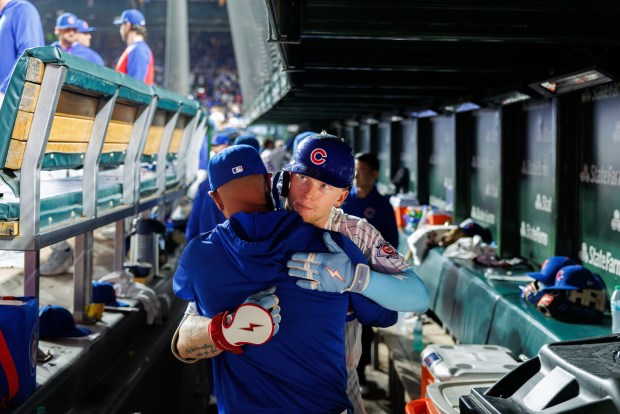 Cubs center fielder Pete Crow-Armstrong (4) celebrates in the dugout after hitting a solo-homer during the seventh inning against the Braves at Wrigley Field Sept. 16, 2026 in Chicago. (Armando L. Sanchez/Chicago Tribune)
From their first interaction in spring training 2023, Mallee saw something special in Crow-Armstrong.
He also recognized the anger and frustration whenever the budding star experienced failure; he was the same way as a player. Making an out or falling short at something was not an option for Mallee and when he did, he didn’t know how to handle it, “so I would explode with anger.”
“He is more intense and fiery than any player I have coached,” Mallee said of Crow-Armstrong. “He had what I call the ‘It’ factor like some of the great players I was fortunate enough to coach. His instincts on the field and in the box are exceptional. He has grown so much over the years and I have been blessed to be part of this journey with him.”
That understanding and relatability have been invaluable.
“I don’t think that there’s anything he’s afraid to say to me, or he’s not afraid of how to say anything to me, and there’s no tiptoeing around, nothing like that,” Crow-Armstrong said. “If anything, sometimes I feel like we cancel each other out, like, in a good way. I mean, he’s also a f−−−−−− pro and an adult, like, he’s not gonna match my energy level. He’s just gonna hopefully try and cut the fuse.”
The connection between Mallee and Crow-Armstrong speaks to the dynamic the Cubs have cultivated at the big-league level. Hitting coach Dustin Kelly has emphasized since he was hired before the 2023 season that the focus is always on the players.
“The players have egos, you have an ego, but you can’t let it come through, you have to always be there for the player, and the player is the most important. We have to be egoless,” Kelly said. “Everybody’s going to have players that they mesh with better and that they work with better. You have to delegate in this position, and if you can’t delegate, one, you’re not going to sleep, and, two, you’re just not going to give the players what they really need and deserve.”
 Cubs center fielder Pete Crow-Armstrong (4) stands at the plate during the first inning against the Braves at Wrigley Field Sept. 16, 2026 in Chicago. (Armando L. Sanchez/Chicago Tribune)
The first six weeks of this season didn’t exactly quell concerns about Crow-Armstrong’s struggles to end last year.
Through the first 54 games, Crow-Armstrong owned a .223/.311/.363 slash line with six home runs. The 24-year-old was getting caught in between with his timing on fastballs and offspeed pitches. His plate discipline again featured too much chase. In the spring, Mallee had told Crow-Armstrong that after cutting out his leg kick in favor of a toe tap during 2025, he might end up reincorporating it this year because he developed a cleaner, more adjustable swing. Eventually the leg kick was added back, but smaller and more controlled. Crow-Armstrong’s stride timing remained inconsistent but adjustable.
“What he lacks in timing he can make up in bat speed,” Mallee said. “What the leg kick did was allow him to start very early and move towards the pitcher in a slow and controlled linear move. … It is no longer a violent crash forward but a smooth flow. Then when his eyes tell him it’s time to swing, his foot goes into the ground. His adjustability is incredible and now he can be on a 100 mph fastball and downshift to offspeed. This is when he took off.”
Those tweaks, combined with a move to the leadoff spot, put Crow-Armstrong on a tear and led to his second All-Star selection. In his last 102 games, dating to May 26, he’s posted a .307/.398/.679 line with 25 doubles, 39 home runs, 84 RBIs and a 1.077 OPS.
“I think this year showed me how long the season really is,” Crow-Armstrong said. “Last year, the struggle was a couple weeks at the beginning of the year. This was over a month. And now it feels we’ve been on this good run for a long, long time. So I think I’ve just understood how long the season actually is.”
His 2025 second-half decline highlighted what he needed to do to become more consistent in his mechanical work and game planning. Mallee recalls when first working with Crow-Armstrong at Triple A he had a “see-ball, hit-ball” approach and didn’t really use the scouting reports. Now Crow-Armstrong studiously looks at how lefties pitch to left-handed hitters and the way he’s been attacked in the past. He regularly talks about approaches with his teammates and goes up to the plate with a plan. Experience matters, too. Getting to see pitchers more frequently over the course of his career gives Crow-Armstrong a better understanding of what to look for.
“When we first started, he couldn’t even evaluate his misses,” Mallee said. “Now he’s got the pitchers in the buckets. He knows how to read the scouting reports. He knows how to anticipate, and he’s very good instinctively. Sometimes he can feel and sense. And I said, honor your gut, man. You have these instincts, buddy. They’re given to you. If you feel like something’s going to happen, then honor it and stay with it and then trust it. And if it doesn’t come out that way, it’s OK because you had a plan.”
Although he will likely always be on the higher side of swing rates, Crow-Armstrong made a change in May to not go out of the zone just because he’s capable of getting to those pitches. By July 27, he had tallied more walks this season than the previous three big-league years combined.
“I am a lot more repeatable this year, I can go into the cage and I can know that I’m going to do the same three things before I swing,” Crow-Armstrong said. “Whereas last year, there was something new every day. Other than that, though, yeah, it’s all mental.”
The power production started to emerge in abundance last year, surprising some around the league that the speedy, elite defender put up 31 home runs. That didn’t surprise Cubs assistant general manager Jared Banner. He got his first in-person look at Crow-Armstrong shortly after the New York Mets drafted him at No. 19 in 2020. Banner, the Mets’ executive director of player development at that time, had only seen some video of Crow-Armstrong play because the COVID-19 pandemic cut short his high school senior season. During a camp scrimmage at the Mets’ complex in Port St. Lucie, Fla., Crow-Armstrong slugged a home run with a 107 mph exit velocity.
It immediately grabbed Banner’s attention.
“That’s just not something you see very often from a high school kid who’s not a huge monster, just freakish power for someone of that size,” Banner said to the Tribune. “It gave me a sense that he had a ton of capacity to impact the baseball. He was already strong and had bat speed, but as he continues to grow up and mature then he’s going to hit the ball even harder. And once you’re up in that territory, it’s a leap.”
A torn labrum in his right shoulder six games into his pro career ended his 2021 season with surgery and, by keeping him under the radar with the lack of game action, helped the Cubs acquire Crow-Armstrong at the trade deadline that year.
“I think Pete always knew he was a superstar, it was the rest of us that had to catch up,” Banner said. “Superstars know how to handle the attention. They know how to handle the pressure. Heavy is the head that wears a crown, and he wears it really well.”
Crow-Armstrong has already broken multiple franchise records. One more remains in play for the final six games of the regular season. With two more stolen bases, he will become just the seventh player in MLB history to record a 40-home-run, 40-steal season.
“Stats-wise, where I’m at now, I frame it as if I keep playing well, then we’re probably gonna be in pretty good shape. But I can appreciate the persistence I’ve had and kind of the calm that I found. I guess I always know that I’m going to turn it on at some point, but I’m proud of how I did this year. I think it was a very honest showing all year of everything.”
 Cubs center fielder Pete Crow-Armstrong gestures to teammates while rounding the bases after hitting his third home run of the day, a three-run shot in the seventh inning against the Reds at Wrigley Field on Aug. 29, 2026, in Chicago. (John J. Kim/Chicago Tribune)
Crow-Armstrong’s frustrations from that late August series in Arizona didn’t last long.
Back at Wrigley Field after an off day, he collected two singles against the Cincinnati Reds and then went off: a three-home-run game Aug. 29 and two more home runs the following game. Crow-Armstrong experienced a newfound satisfaction that even though he endured a tough West Coast trip not long after a 3-for-28 stretch earlier in August, he kept things in perspective.
Two tough weeks don’t have to define a season.
“One thing that I’ve talked about with people is the best players really minimize how long their poor periods are,” Crow-Armstrong said. “And I’ve started to kind of notice that where if I’m feeling really s−−−−− for a couple days, I’m making sure, and I don’t know how I do it, but I’m making sure that it’s only a couple days, and I salvaged that third day, or that fourth day, or that fifth day. I let s−−− snowball last year, and that’s not going to happen to me. I’m not willing to do that.”
His incredible performance this year has reached the point of shifting the question from whether Crow-Armstrong is the NL MVP to whether he will be unanimously chosen by the 30 Baseball Writers’ Association of America voters, something that has happened only 10 times in the National League since this iteration of the award started in 1931. The individual honor awaiting him in November is something he’s still grappling with and trying not to think about, let alone wanting to discuss, even with the regular season nearly complete.
“Someone’s gonna have to teach me what an individual season really means if stuff doesn’t really roll our way (in the playoffs),” Crow-Armstrong said. “I think that’s probably the hardest part about a win or a loss is, regardless, I’m going to focus on one of the two and probably take away from the individual stuff. But as long as I gave people something to look forward to going to the park, then that’s a big enough win for me, I think, with all the individual season stuff.”
Nearly four years before Crow-Armstrong was born, Sammy Sosa played a big role in creating the next generation of Cubs fans during his electric 66-home-run 1998 season that culminated in the NL MVP award. For him to do something at that level this year, for such a historic franchise, must feel surreal, right?
“I don’t want to believe it just yet,” Crow-Armstrong said. “So when we get there, you can ask me.”