
Baseball highlight’s are most commonly filled with a mixture of home runs and defensive plays in which the fielder must do something particularly spectacular in order to make up for a mistake earlier in the play. The skill required for those is both easily visible in the confines of television camera frame. Efficient outfield catches, however, are difficult to appreciate unless you happen to be at the ballpark and able to see the whole field.
So, as the 2026 Colorado Rockies season comes to a close, let’s take a moment to marvel at the most highlight-worthy plays for each Rockies outfielder as estimated by Catch Probability from Statcast.
Catch Probability is a simple concept at its heart that simply attempts to explain how difficult it would be for an outfielder to arrive where the ball is landing before it does. It does this with two primary inputs,
How far an outfielder needs to run.How long they have to run that far.
Those factors are combined, and a resulting percentage of the time that the ball is caught in the Major Leagues is calculated. There’s some extra nuance, but the basic premise is incredibly simple.
To make it even simpler, comparing plays can be done by dividing their Catch Percentages into the following categories:
0 to 25 percent: Five Stars26 to 50 percent: Four Stars51 to 75 percent: Three Stars76 to 90 percent: Two Stars91 to 95 percent: One Star
With this decently objective measuring stick, we can categorize the best catches by each Rockies outfielder.
Technically both Braxton Fulford and Willi Castro have seen time in the outfield for the Rockies this season. Fulford has a total of two appearances on the outfield grass, and Castro has played parts of nine games out there despite having only started in the outfield twice.
While they both have played the outfield, neither has had enough opportunities to have made any catches that qualify for “stars” using Catch Probability. In fact, the only opportunity that either player has had that would have qualified if it had been caught was a play at the left field wall on June 7, which Castro wisely played on the bounce. If he had managed to make a miraculous grab, it would have been considered a five-star catch according to Catch Probability.
That, however, is the only chance either Fulford or Castro has had to qualify for this list, so the only fair thing to do is take them out of the running.
Sterlin Thompson only had a few more games in a big league outfield this year than Fulford or Castro but he made the most of them.
In the 15 Major League games that Thompson took the field, he made two separate plays at the wall that qualified as two-star catches. The most visually impressive was one from June 3 that would have meant extra bases for Mike Trout had Thompson not been able to effectively backpedal and leap against the left field wall to make the grab.
Zac Veen’s most difficult catch of the season is similar to Thompson’s in that it required him to backpedal and judge a play against the wall. The difference between the plays is subtle, but Veen needed to cover four more feet with less time than Thompson did.
Mickey Moniak’s hardest catch of the season nearly resulted in a collision.
Moniak was making chase towards a ball deep in the right-center gap when center fielder Jake McCarthy slid in front of him in what could have been an ugly result if McCarthy had been just a step slower.
While Catch Probability doesn’t account for the nuances of needing to coordinate with and/or avoid fellow outfielders, the 93 feet of distance Moniak needed to cover in just over five seconds was enough to qualify this catch as only 60% likely.
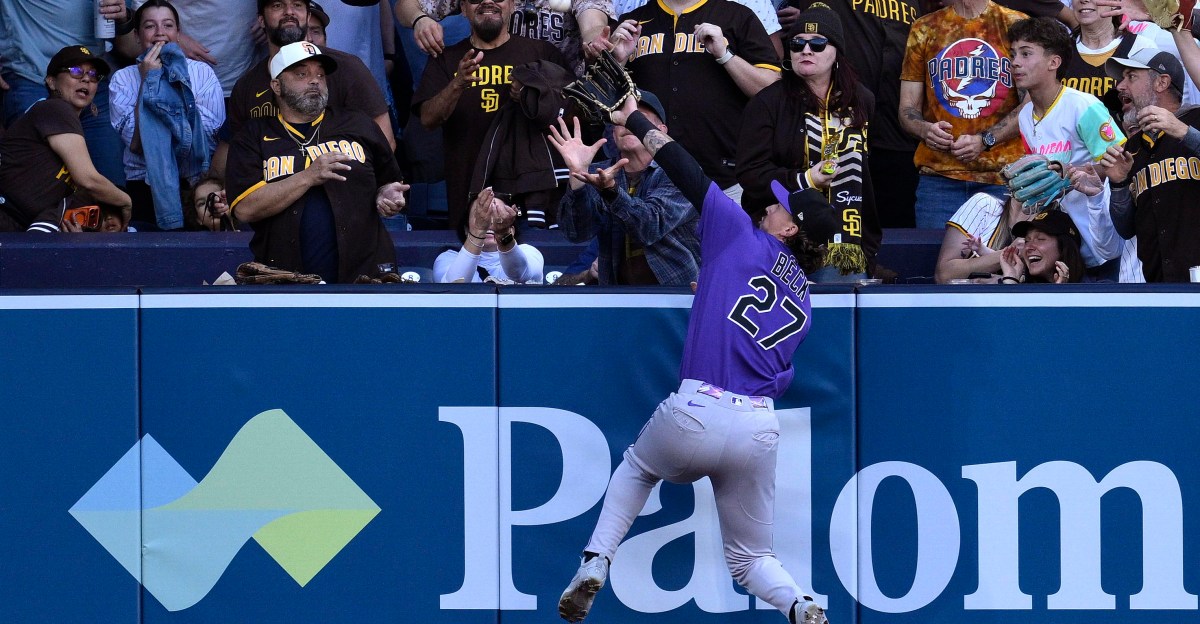
Where Moniak’s best catch qualified primarily based on the distance he needed to cover, Jordan Beck’s most difficult was primarily due to how little time he had to react. In just under three seconds from the moment Brett Sullivan released his 57 MPH “fastball,” Beck needed to assess where the hit from Steven Kwan would land, run 31 feet, and slide to be at the correct height to be able to scoop the ball as it was landing.
Given that lack of available reaction time, it’s understandable why that August 21 catch from Beck is qualified as his most difficult on the season. That being said, Beck’s other three-star catch (which only has five percent lower Catch Probability than his most difficult catch) was far more impactful. I’d be remiss if I didn’t remind everyone of this early-season home run robbery against Nick Castellanos.
While Brenton Doyle has made a four-star catch in the Major League’s this season, it came after his trade to the Chicago White Sox. Doyle is, however, a two-time Gold Glove award winner, so of course he made great plays for the Rockies this season regardless of how limited his time was with the team.
His best catch of the season wearing a Rockies uniform came on April 5 against the Philadelphia Phillies. Much like Beck’s home run robbery, Doyle needed both to cover a large distance (93 feet) and time a jump just perfectly in order to make the following beautiful play possible.
As we all know, Doyle Rules!
Troy Johnston isn’t exactly known for his defensive prowess, but he has managed a surprising number of memorable defensive plays in his first season with the Rockies. Johnston actually has two catches that are rated four-stars, but his least likely one came on April 23 on a line drive to shallow right field.
This dive forward towards short liners may be Johnston’s signature move as he had made a very similar play to end a game just four days earlier. While that catch obviously had a larger impact on the specific game than the first, it didn’t quite qualify as a four-star catch.
Cole Carrigg provides an illustration of a couple factors that Catch Probability does not take into account: sightlines and angles.
The following is Carrigg’s singular four-star catch per Catch Probability:
That is, for sure, an impressive catch that showcases Carrigg’s speed and range as he had to cover 46 feet in just over three seconds. What it isn’t, in my estimation, is Carrigg’s most difficult catch of the season.
Just this past weekend Carrigg made a spectacular running catch near the wall to end a scoring threat.
This ball was in the air for nearly a full five seconds which limits its catch probability to two-stars, Carrigg needed to be sprinting towards the wall while looking over his right shoulder to reach his left arm forward at the right angle in order to make it.
Catch Probability attempts to account for needing to run backwards in terms of how doing so slows the fielder down and decreases the chance to reach the ball in time. What it doesn’t account for is how much more difficult it is to catch a ball a player can’t properly view. This Carrigg catch shows off a combination of coordination and dexterity in addition to the range that Catch Probability does a good job of assessing.
What Jake McCarthy lacks in arm strength, he more than makes up for in sprint speed. He has limitations as a fielder, but his range in the outfield is obviously great. He often gets to balls with enough time to spare to make routine looking catches that would have required desperate diving plays by outfielders with average speed.
Given that, it should come as no surprise that McCarthy’s most difficult catch of the season doesn’t actually look particularly difficult.
In that July 20 play McCarthy had to cover 60 feet with just 3.7 seconds of reaction time from the moment the ball left Kyle Freeland’s hand.
This is a great example of an incredible catch that would be difficult to assess as such via the television broadcast. At the ballpark a scout may be able to pay attention to McCarthy’s starting point, his reaction time, and his route efficiency in order to appreciate how hard that really was. From home, being locked into the camera view that shows the pitcher and batter for the first few moments of the play, it’s implausible to recognize that that was McCarthy’s best catch of the year.
The same can not be said for Tyler Freeman’s best catch of the season.
Like Johnston in the four-star catches section, Freeman is not particularly well known for his fielding prowess. His range, in particular, grades out very poorly as only in the sixth percentile in MLB this season according to Baseball Savant.
His usually poor range makes what he was able to do on June 12 against the Chicago Cubs that much more unexpected and impressive.
This diving catch in which the tip of Freeman’s glove just barely manages to reach underneath the ball as it lands is a perfect counterpoint to the visual ease of McCarthy’s five-star catch above. Freeman needed to cover slightly less distance (53 feet) in slightly less time (3.5 seconds) than McCarthy did which equates to a roughly equal 15% Catch Probability score.
McCarthy made a 15% catch look easy. Against those same odds, Freeman clearly needed to use every inch of his range in order to match McCarthy’s success.
The end result of both plays was the same. The most difficult outfield catches of the 2026 Rockies season… so far.
There aren’t many Rockies games left, but we should all be sure to be on the lookout for a more spectacular catch and ready to give it the recognition it deserves regardless of whether the player is able to make it look easy.
Fewer adsCreate community postsComment on articles, community postsRec comments, community postsNew, improved notifications system!
Please keep in mind our Purple Row Community Guidelines when you’re commenting. Thanks!