
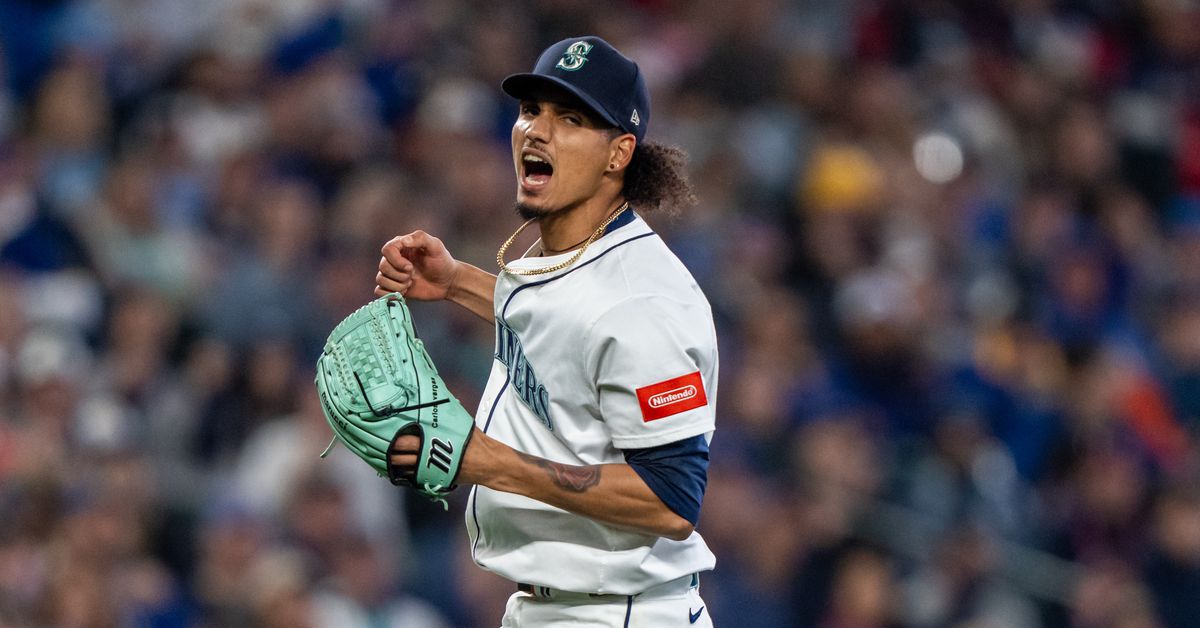
Confidence in a bullpen is only as good as their last blown lead. After a pair of one-run wins to take a series from the Minnesota Twins, the Seattle Mariners ceded another winnable game late last night. It was another disappointment in a week and a half of frustrating frailty that the Mariners have made pleasantly uncommon in recent years. Some of the blame lies with the personnel, and simple variations in fortune, but the M’s are also taxing the more volatile members of their pen at a rate well beyond past years, and the cracks have shown.
Seattle’s bullpen is on pace for just shy of 613 innings pitched. That’d be the third-highest total under Jerry Dipoto’s stewardship, trailing just the “First Step Back” 2019 club and the COVID-influenced 2021 season which saw elevated bullpen usage across the league. A season ago, Seattle’s bullpen threw just 490.1 IP, the only club under 500 frames in a season nearly half the league eclipsed 600 IP.
I don’t expect this to continue apace. Seattle’s immense relief workload is a consequence of the UNO Reverse they’ve experienced from the past few seasons in their rotation. Even aided by T-Mobile Park’s abyssal scoring tendencies, the injuries and struggles of George Kirby, Bryce Miller, and Logan Gilbert map easily onto the larger issues at hand. A dip in innings pitched per start from a league-leading 5.8 IP in 2024 to a league-average 5.3 IP is, essentially, an extra half inning a night or an inning every other night for the pen to pick up. Framed another way, Seattle’s quality start rate (6+ IP, <=3 ER) has fallen from best in the sport at 58% in 2024 to barely over 1/3rd of their outings this year.
Those extra half innings and innings add up in several ways. Collin Snider hit the IL after heavy usage in the past week, being stretched in multi-inning appearances frequently and seeing his velocity and efficacy dwindle. Even in good starts, like Emerson Hancock’s excellent 5.2 frames of one run ball, the M’s were stretched one spot too deep. The entire “A-Pen” as it seems is nearly back to its 2023 self, with Andrés Muñoz, Gabe Speier, and Matt Brash all looking and performing their _ responsibilidades Bombero_ with aplomb-ero. But Carlos Vargas – perhaps erroneously – had to be called on with Speier heavily taxed. While Vargas has flashed encouraging tools, he’s not consistently executed. The same can be said of Snider, Trent Thornton, Troy Taylor, Casey Legumina, Eduard Bazardo, Gregory Santos, and Jackson Kowar. Seattle’s exceptional rotation allowed them to largely weather the absence of Brash and Santos a season ago, but without similar starting strength, much as with the bottom of the lineup, the M’s are at the mercy of their depth’s many coin flips. Where the 2023 unit also had Paul Sewald and Justin Topa excelling, 2025 is still searching for its safety net.
One of these issues should resolve itself in the coming weeks. Kirby and Miller are back already, and should manage to work deeper into games as their workload builds up to full in the next start or two. Gilbert’s return will hopefully not be too far on their heels, and with Kirby, Miller, Castillo, and Woo all fully built out, the M’s will have cause to believe they can get 6+ innings each night again. That stabilization is one of the better hopes for offering an emergence from the listed names above, in lieu of de facto setup man duties for a grab bag of bullpenners without much big league track record to speak of, much less in high leverage. Even if the offense continues a trick or treat trajectory, that is a pathway to seeing Seattle convert a few more victories they’ll need to outlast the dogfight the AL West and Wild Card races are shaping up to be.