
The world according to Jim:
• As the winter of baseball’s existence approaches – one that could be longer, chillier and conceivably more damaging than ever unless the sides come to their senses – let’s be honest. Anyone who is not already a Dodgers fan is going to be rooting against a three-peat, the first ever by a National League team, beginning with Saturday afternoon’s Division Series opener against Atlanta.
Well, almost anyone. See below. …
• But that’s fine. As Jason Bateman’s voiceover on the Dodger Stadium pregame hype video put it, “What’s wrong with being the bad guy? If being the best makes you bad, so be it. … If we’re being honest, sometimes it’s fun to root for the bad guy.” …
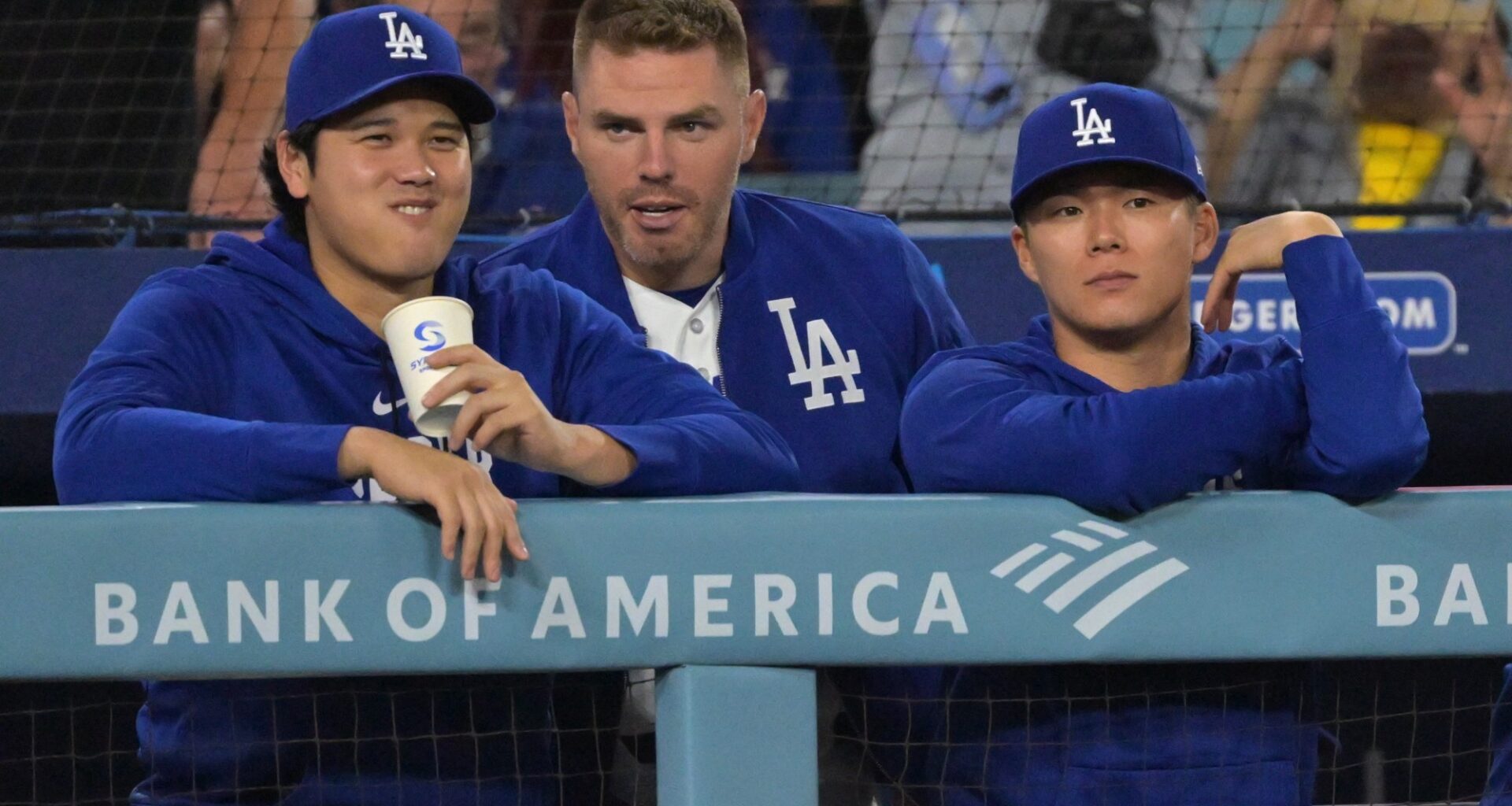
• Payroll, stars, expectations, blah, blah, blah. At this point, the nucleus that by now should be familiar throughout baseball – Ohtani, Betts, Freeman, Smith, Muncy, etc. – is playing for history, and for individual and team legacies. And it’s clear, with the collective age of this group, that there’s no sense holding anything back now, never mind the question of whether there will be a next year in this sport, never mind how long we’ll be waiting or what form the game’s economics will have when things are eventually settled. …
• Which leads to the question: Are Rob Manfred and those in MLB’s offices who stump for a salary cap actually rooting for the Dodgers to snag another Commissioner’s Trophy and somehow prove their point?
Those would be strange bedfellows, indeed. …
• And wouldn’t it be hilarious if Kyle Tucker, whose regular season was far below what you would expect from a $60 million average annual value player, turns out to be a postseason hero?
It could happen. He has a 1.072 OPS since Sept. 9. Then again, 14 of those 17 games were against the Cincinnati Reds, Miami Marlins and San Francisco Giants pitching staffs. …
• By the way, what’s the more eye-popping number? The expected game-time temperature Saturday is 103 – and it’s not going to cool down much for the next week – while the get-in price for Game 1 is $56 according to the TickPick ticketing platform, the lowest price not only for any of Saturday’s four series openers but for any of the eight participating teams’ first home game.
Yeah, playing at 1 p.m. local time amid a heat wave isn’t such a great idea. And you know where this is going to go: People staying home to watch on TV, and the social media mob from the rest of the country declaring that L.A. is a bad baseball town. …
• Meanwhile, the Milwaukee Brewers and Tampa Bay Rays will be defending the honor of small market baseball in these playoffs, and they’ll be leaning into it as hard as they can.
But their performance is the arguing point that directly contradicts the main stance of management, which is that payroll limitations automatically would improve competitive balance. (As we’ve noted here previously, the actual motivation is mostly about team valuations, and the idea that teams in salary cap leagues sell for greater amounts than they do in baseball.) …
• By the way, does San Diego even count as a small market anymore? The Padres have drawn more than 3 million fans in four straight seasons, and their 40-man roster payroll for luxury tax purposes ($265.3 million) is eighth in baseball according to Cot’s Contracts. You suppose they’ll be portrayed as Goliath when they face the little ol’ Brewers in this round? …
• And it’s no wonder that José E. Feliciano and Kwanza Jones, the husband and wife who purchased the Padres for $3.9 million earlier this summer, seem to be having so much fun. …
• There doesn’t seem to be much conversation about baseball’s playoff brackets – which are not re-seeded by record after the wild card round – except in New York. The Yankees have to play Tampa Bay, so suddenly it’s bad for baseball and needs to be changed. Right. …
• Here’s why such a change isn’t so simple: The winning teams have two days max to get to their next destination. In the case of the Braves, they knocked off Philadelphia on Thursday night in Game 3 at home and had to get to L.A. for a Friday workout. Logistics and the everyday nature of the sport provide a variable many people don’t consider. …
• It is bad enough that professional sports organizations have commercial ties with traditional gambling entities, but the embrace of “prediction markets” Polymarket and Kalshi seems even more unsavory. Maybe it’s a tipoff that in their TV ads, those companies don’t even attempt to explain what their business entails. …
• And, along with the potential to corrupt the games themselves (via prop bets) and the social media harassment of players and their families by those who lose, reports by ProPublica and the New York Times detail how these betting services – specifically DraftKings, in the case of those stories, but likely the others as well – prod the gamblers most likely to lose to keep playing. …
• When a questioner on the papal plane asked Pope Leo XIV last week if he had anything to do with the success of his Chicago White Sox, he first declined comment, and then said: “Great things happen in Chicago.”
On the South Side, anyway. I’m not going to suggest divine intervention, yet, but stay tuned. …
• Maybe things have died down around USC football since last Saturday’s embarrassment against Oregon. But I’m looking at their schedule from here on, beginning Saturday against Washington, and I still see them finishing 5-7 – and losing big to UCLA at the Rose Bowl. …
• And if Athletic Director Jennifer Cohen finds she needs to hire a football coach and start over, let’s start the speculation now. Readers, who might you have in mind as a replacement? I’ll print the best responses, and yes, I’m expecting some snarky suggestions from Bruins fans. …
• Do you get the impression that one major component of the not-yet-passed Protect College Sports Act – besides giving the NCAA and college athletic departments a free pass from antitrust laws – is a desire among coaches and administrators to make sure the athletes aren’t outearning them?
Really, the only positive part of that legislation that I see is the requirement that agents for college players be regulated, just as they are on the professional level. The college athletes need it more.
jalexander@scng.com