
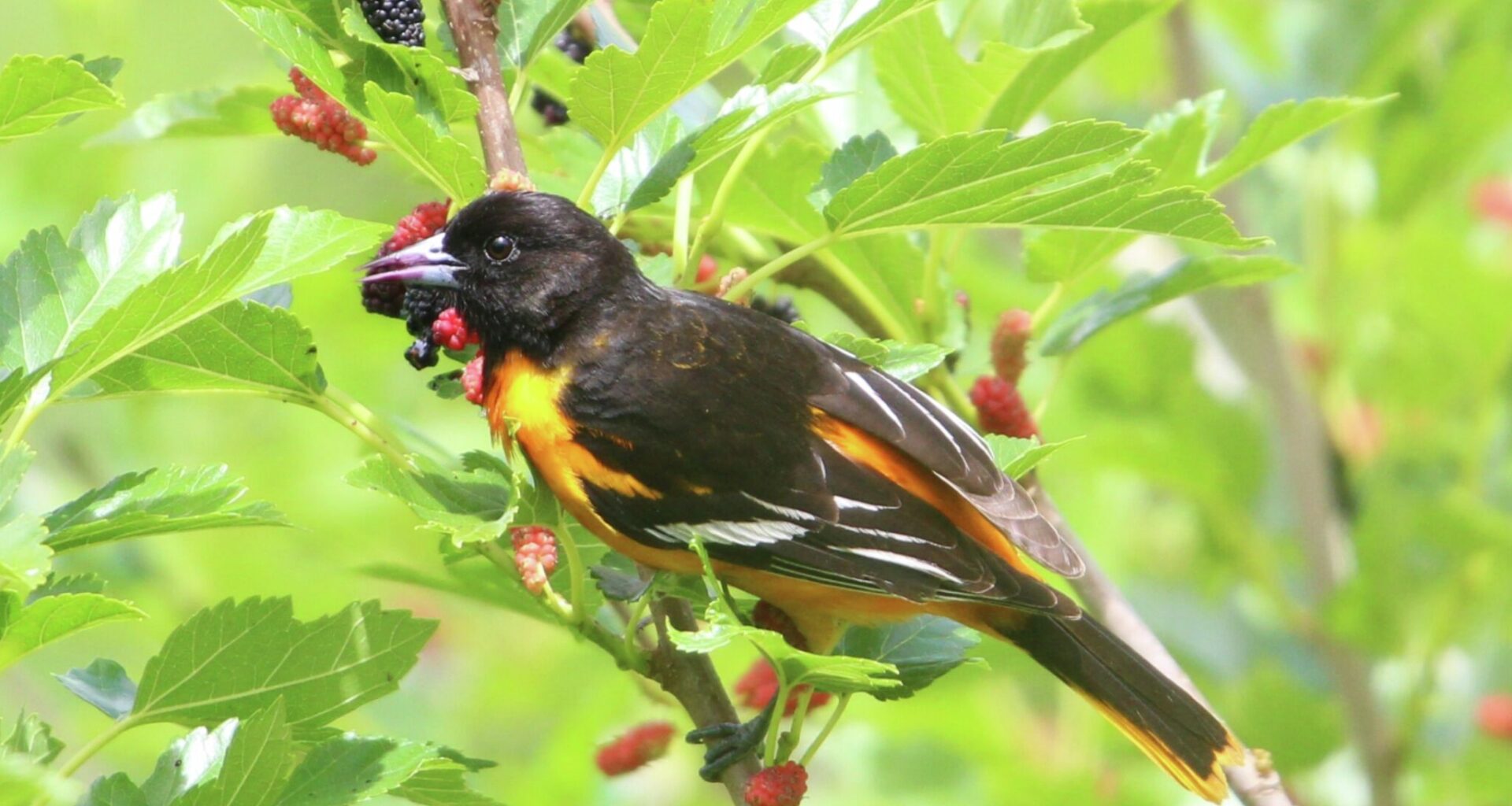
Fall migration is bringing a changing cast of birds through Houston, from a colorful cousin of one of Texas’ most notorious parking lot dwellers to tiny travelers with jewel-like throats and hawks that can fill the sky by the hundreds.

Some are only passing through on their way much farther south. Others are arriving in Houston to settle in for the winter. Here are four birds Houstonians can expect to see more often this fall.
Baltimore oriole
Baltimore orioles pass through the Houston area on their way south during fall migration.
Getty Images
One of fall’s flashiest migrants is related to the bird that patrols seemingly every grocery store parking lot in Texas.
Article continues below this ad
“Believe it or not, they’re related to our noisy great-tailed grackles,” Kelsey Low, adult programs manager at the Houston Arboretum and Nature Center, told Chron. “Like grackles, they are quite social, often foraging in flocks of five or more birds. Unlike grackles, orioles are migratory.”
Baltimore orioles are now heading south toward wintering grounds in southern Mexico, Central America and northern South America. Males are jet black and brilliant orange, while females are a warm amber color.
The birds use their sharply pointed bills to pluck insects from leaves, eat berries and sip nectar from flowers.
“At the Arboretum, we see them at the native Trumpet Creeper flowers gathering nectar and insects,” Low said.
Article continues below this ad
Houstonians can also tempt orioles into their yards with native plants such as crossvine and coral honeysuckle, hummingbird feeders or even sliced oranges wedged between tree branches.
Ruby-throated hummingbird
Ruby-throated hummingbirds are moving through Houston in large numbers this fall.
Kelsey Low
Millions of hummingbirds move through Texas during fall migration, and ruby-throated hummingbirds make up much of that traffic.
Article continues below this ad
“Almost every Ruby-throated hummingbird in the U.S. and Canada passes through Texas in the fall,” Low said. “They’re all flying along the Gulf Coast to spend the winter in southern Mexico and Central America.”
Males are emerald green with gleaming ruby throats and black tails. Females are a softer green, with pale throats and white spots on their tails.
Female ruby-throated hummingbirds are among the small but noticeable migrants passing through Houston this fall. Feeders can help fuel the tiny travelers.
Albany Times Union/Hearst Newspa/Albany Times Union via Getty Ima
Some of the biggest concentrations occur along the coast between Galveston and Corpus Christi, but Low said plenty can still be spotted at the Arboretum.
Article continues below this ad
Native plants, including Turk’s cap, red sage and coral honeysuckle, can provide fuel for the journey. Hummingbird feeders can also help, as long as they’re filled with the right mixture: one part white sugar to four parts water, with no red dye or other sweeteners.
Broad-winged hawk
Broad-winged hawks can be spotted soaring over Houston during fall migration.
Kelsey Low
Not every fall migrant passing over Houston is tiny.
Article continues below this ad
Broad-winged hawks move down the Texas Gulf Coast in huge numbers each fall on their way to wintering grounds in South America, some traveling as far as Bolivia. Although they’re usually solitary, migration can bring hundreds together in swirling groups known as “kettles.”
“These small soaring hawks migrate in massive numbers along the Texas Gulf Coast in the fall,” Low said.
Broad-winged hawks migrate along the Texas Gulf Coast each fall, sometimes gathering in large swirling groups known as kettles.
Albany Times Union/Hearst Newspa/Albany Times Union via Getty Ima
The largest concentrations tend to appear at Smith Point southeast of Houston and farther south around Corpus Christi, she said, but Houstonians can still catch large flocks overhead.
Article continues below this ad
Adults have brown barring across their chests, dark trailing edges on their wings and bold black-and-white striped tails. Juveniles are paler and streakier.
Low recommends looking up in the late morning, after the sun has heated the ground enough to create the rising columns of warm air the hawks use to soar.
“They often form mixed groups with other hawks and vultures,” she said.
Eastern phoebe
Eastern phoebes are beginning to arrive in Houston, where the small flycatchers will spend the winter.
Joe Liggio
While the other birds on this list are headed farther south, Eastern phoebes are coming to Houston to stick around.
Article continues below this ad
The small flycatchers have already begun arriving and should become much more common throughout October. They spend the summer as far north as northern Canada before heading to Houston and other parts of the Gulf Coast for winter.
Smart, funny and sometimes unhinged look at the week that was.
By signing up, you agree to our Terms Of Use and acknowledge that your information will be used as described in our Privacy Policy.
Phoebes are dark gray above and pale below, with a faint gray “vest” and an upright stance. They may lack the bright colors of an oriole or hummingbird, but they have other giveaways.
“Phoebes may not be showy birds, but they are easy to identify thanks to their frequent ‘fee-BEE… FREE-bee’ calls and their habit of pumping their tails up and down,” Low said.
Article continues below this ad
Look for them perched around grassy areas near water as they scan for flying insects. Low said they’re common at the Arboretum, city parks and neighborhood retention ponds.