

Growing up down the street from Fenway Park, I vividly recall the night when my father brought home Major League Baseball’s official 2004 World Series film on DVD.
I watched it over and over until the disc became too scratched to carry on, savoring the swing from the agony of almost-certain defeat, to a comeback the likes of which baseball had never seen, and has yet to see again since.
Literally, the swing. David Ortiz’s walk-off home run in Game 4 of the American League Championship Series brought the Red Sox back from the brink. It brought them back to life.
The 2026 Red Sox had several moments like that during the regular season, as they drastically turned what looked like a 100-loss year into a playoff ticket. None in such intimidating settings as old Yankee Stadium, in the throes of an 86-year drought, but thrilling moments nonetheless.
But nearly all of those heroics came between late June and the end of August. None came at the end of September, as the Red Sox were outscored 18-2 in a two-game sweep by the Yankees at the new Yankee Stadium.
And as I sat in the Bronx ballpark’s press box watching a Boston massacre unfold this week, words from that 2004 DVD echoed in my head on a constant loop.
“I can’t do anything if we don’t score runs. I can only pitch, do whatever’s possible to keep my team in the game. From there on, it’s up to them.”
Pedro Martinez spoke those words after his Red Sox lost Game 2 of the ’04 ALCS by a score of 3-1.
It is, in my opinion, one of the most evergreen, basic baseball truths.
And baffling as this may be, it seems to be something the Red Sox either no longer believe, or inexplicably think can be circumvented somehow.
The 18-2 cumulative score of this week’s wild-card round begs to differ.
Pitching and defense, the two pillars on which chief baseball officer Craig Breslow constructed the 2026 Red Sox, are crucial, too. But they will only ever be preventative measures, keeping the opponent off the bases and scoreboard. A team with the most lockdown pitching and defense of all time could maintain a scoreless game through 100 innings, and lose in the 101st because their own offense never managed to bring home a run.
Again, this all sounds quite simple and logical, doesn’t it?
That New York’s pitching was stronger and manager Aaron Boone did not pull starters Cam Schlittler and Max Fried after 4 2/3 innings because he did not want them to face the Boston lineup a third time are secondary.
The Yankees are going to the ALDS because they scored more runs. End of story. End of Red Sox season.
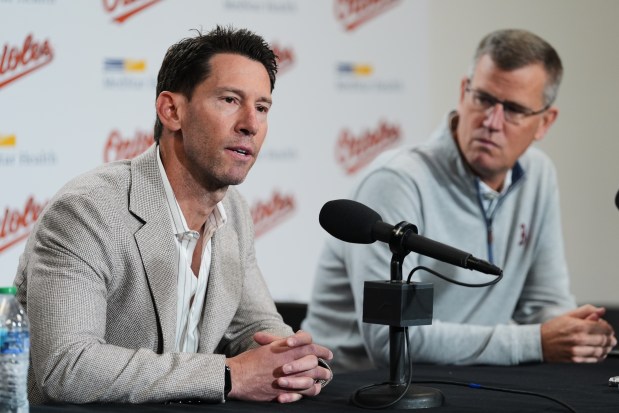 Boston Red Sox chief baseball officer Craig Breslow, left, speaks during a press conference alongside team president and CEO Sam Kennedy, Sunday, April 26, 2026, in Baltimore. (AP Photo/Stephanie Scarbrough)
The 2026 Red Sox scored 689 runs in the regular season, their lowest total in a full 162-game slate since 2014 (634). They plated 97 fewer runs than in 2025 (786), their largest year-over-year drop by far since 2021-22 (94). Last year, the Red Sox scored the third-most runs in the American League.
Judging by the clubhouse reactions following Wednesday night’s elimination, several Red Sox players would prefer a simplified approach. They acknowledged they did not hit, and either hinted or outright lamented the abundance of analytics.
“I would have liked to live-or-die with me in that moment,” Game 2 starter Sonny Gray said of being pulled with two outs in the fifth inning despite a pitch count of 70 and only one run allowed. “I would have liked to have been trusted in that moment.”
Asked how the team felt about the early hook for Gray, first baseman Willson Contreras’ answered by twice making the lips-zipped gesture. Then, he unzipped them.
Contreras was also asked if he feels the Red Sox over-rely on analytics. “If you watch the game,” he replied.
“It’s here to help us,” Contreras said of analytics. “But at the end of the day, it’s not about data. It’s about executing the game plan.”
So, what is the game plan for this offseason? (Before it is expected for the league to lockout the players on Dec. 1, that is.)
Is it for Red Sox brass to sit at their end-of-year press conference on Monday and state that adding power to the lineup is a top offseason priority, as they did last year?
Is it for the Red Sox to inquire about and be quote-unquote interested in every possible free-agent hitter and trade candidate, and fail to close the deal, as they have done too many times to count over the last half-decade?
Or will the Red Sox finally realize that there is a Big Papi-sized hole in their lineup, and they can no longer pretend otherwise? And that the way to win games in October – or even get to October, as they lost Game 2 on Sept. 30 – is to hit hard?
Baseball has learned and come to rely upon several new metrics and analytics since Martinez spoke those frustrated words.
But ultimately, the math remains as simple as ever: To win a ballgame, a team must outscore its opponent.
The Red Sox would do well to go back to basics. And big bats.