

The Athletics still haven’t found their way out of the proverbial wilderness. This franchise is in a transient stage, both in stadium construction and lineup construction. 2026 was supposed to be a huge year for the team emotionally, as they had aspirations of being contenders in a mediocre AL West or at least Wild Card hopefuls, built around a team filled with interesting young hitters.
Last year we were bullish about this lineup, stating:
The A’s have assembled some of the best young offensive talent in baseball, and there is once again excitement around this team.
That sentiment did not come to fruition as many had hoped entering 2026. Nick Kurtz, Jacob Wilson, Tyler Soderstrom, and Lawrence Butler were supposed to take their next developmental steps and join Shea Langeliers and Brent Rooker as critical ingredients in what looked, on paper, like one of the most formidable and well-rounded lineups in baseball. Instead, all of Wilson, Kurtz, and Soderstrom all missed time with injuries, so too did Langeliers and Rooker.
It wasn’t all doom and gloom for the Athletics, however. Henry Bolte emerged as one of the most interesting young outfielders in baseball entering 2027. The former 2022 second rounder was a tremendous silver lining in what was otherwise a year to forget. The 23-year-old accumulated 3.3 bWAR in 119 games, hitting 11 HR and 21 SB with a 277/359/407 slash line. Zack Gelof also positioned himself as a potential 3B of the future despite missing a month due to a freak injury caused by a piece of unprotected fencing in the Tigers ballpark. The 26-year-old former Virginia Cavalier hit 22 homers while posting an OPS just shy of .800.
Ultimately, if health can return, the future does still look bright for this lineup. The infield looks like it’ll be incredibly fun in 2027, with Gelof, Wilson, and Kurtz forming one of the more intriguing young infield trios in the game; it could be even more tantalizing if consensus top-5 prospect Leo De Vries joins the group after his promotion to Triple-A in 2026. The ingredients are all there for this offense to rebound in a massive way in 2027.
The rotation was always going to be a concern, and run prevention will likely be an issue until the Athletics leave the confines of Sutter Health Park in the hot air of Sacramento. That will continue to be a problem until 2028, when the Athletics are reportedly scheduled to finally complete their controversial, long-criticized move to Las Vegas (though the problem may also continue there, depending on the circumstances of the new stadium and whether a humidor is utilized).
The Athletics had the second-worst pitching staff ERA in baseball, aside from the team you would expect: the Rockies. Jeffrey Springs, acquired to stabilize the rotation, threw 142 innings with a 6.18 ERA. The other veterans in the rotation, Aaron Civale and Luis Severino, weren’t much better with 5.42 and 4.16 ERAs, respectively. Some reasons for optimism, though. Highly touted rookie Gage Jump’s unsightly 5.47 ERA was actually tied to a much more palatable 4.01 FIP. J.T. Ginn twirled almost 140 innings of 3.71 ERA ball despite the incredibly hitter-friendly confines he faced.
The reinforcements to the rotation will likely need to join the Athletics in Vegas via free agency, as aside from Jamie Arnold, none of the Athletics’ top farm hands seem likely to be difference makers at the Major League level in 2027.
Things will likely trend upward in 2027 as long as the A’s can stay healthy. The lineup on paper looks like one of the most intriguing in baseball, especially from a fantasy perspective with contributors up and down. I’d keep advocating against buying most of the A’s arms until the end of 2027, when things will likely stabilize slightly after the offensive bonanza they’re currently facing. 2026 was the type of speed bump many rebuilds face, but the arrow is still pointing upwards.
2027 Dynasty Outlooks – Prospects Live
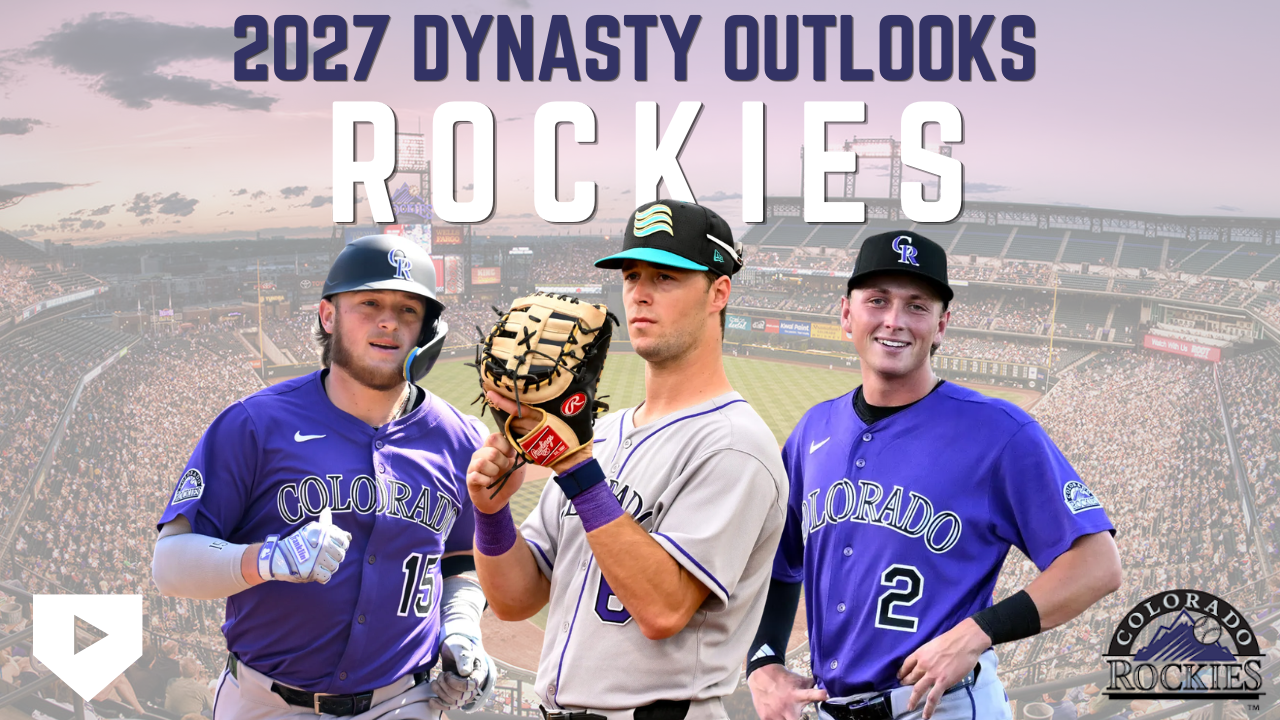 Dynasty BuysHenry Bolte
I highlighted the overslot 2022 second rounder above, but it’s hard to overstate the excitement Bolte brings. The tools that he brings to the table are absolutely top of the charts. Bolte has 100th-percentile sprint speed, 95th-percentile bat speed, and an 87th-percentile hard-hit rate. The biggest questions facing him are whether Bolte can cut down on strikeouts and whether he can improve his launch angle. The ground ball rate is too high, but the returns if he can raise his launch angle will be absolutely astronomical. There’s potential here for a legitimate 30/30 star.
Joshua Kuroda-Grauer
Across his first 21 games, “JKG” had the single highest OPS of any Athletics player with a staggering .899. He looked like a high-end, contact-oriented breakout before a freak foul-ball injury ended his season. The early returns were in line with JKG’s MILB performance as his .366/.392/.507 is demonstrative of the tools that JKG displayed over the course of his MILB career thus far where he’s slashed .308/.369/.408 across 227 games, albeit in a truncated sample size. Kuroda-Grauer seemed to tap into more power this year, with a career-high 7 HR in just 78 Triple-A games.
Dynasty SellsLawrence Butler
After a stellar 2024, Butler signed a 7-year $65.5 million extension, and he looked like he’d be the franchise’s center fielder moving forward. Unfortunately, he’s regressed the last two years, with substantially lower OPSs of .710 and .720. Butler’s sprint speed has regressed each of the past two seasons, and broadly speaking, his formerly premium athleticism has seemingly faded as time has progressed. He did trend upward toward the end of the season with a hot September, but ultimately the production isn’t worth holding onto right now. He’ll likely continue to get playing time due to prior contract commitments, but with Bolte, Soderstrom, and others fighting for playing time,, he’ll likely be a part-time player.
Hogan Harris
Hulk Hogan Harris emerged as the Athletics’ closer this year following the 2024 trade of Mason Miller to the Padres. He’s been entirely cromulent as a closer with a 3.33 ERA in 2026, and to his credit, he earned 17 saves. However, as noted, Sutter Health Park won’t do him any favors. Additionally, Harris’s walk rate has risen each of the last four years from 9.9% in 2023 up to 13.5% in 2026. He escaped most of that increased traffic unscathed in 2026, but without substantial improvements in his walk rate, he’s going to see serious regression in the ERA department, as his 4.08 FIP indicates. If you have a rebuilding roster, see if you can cash in on the 2027 Athletics’ presumed closer and net some solid prospects.
Top Fantasy Prospects
Players are in order of their fantasy prospect ranking from our PLive Rankings at time of publishing. Dynasty Rankings in parenthesis.
1. Leo De Vries #4 (#62), SS (AA)
159 PLIVE+, Peak Projection: 22 HR, 19 SB, 10.4% BB, 19.9% K, .258/.341/.449, 120 wRC+
 Photo Credit: Rick Scuteri
Injuries open up opportunities to buy. Maybe it’s not a “buy-low” opportunity, but a chance to acquire someone you might not have been able to before. I think we saw this with Sebastian Walcott this year. He is slowly slipping in our rankings due to not being on the field, and at one point, he was outside the top 10. There is always a risk players won’t return to their pre-injury form. If LDV comes back exactly the same, he is 1A or 1B in our rankings depending on who you ask. As a 19-year-old at Double-A, he hit 13 home runs, stole 34 bases at an 87% success rate, and hit .290. There doesn’t appear to be a hole in his game. This is the kind of talent you’d like to take a chance on, and so while he is on the shelf this offseason and not in the spotlight, see if you can get him on your roster. I think you’ll want a lot of pieces of the A’s lineup in the future, and he should be in the middle of it. – Tom Gates
2. Drew Burress #37 (#214), OF (A)
115 PLIVE+, Peak Projection: 15 HR, 26 SB, 9.9% BB, 28.2% K, .214/.302/.352, 84 wRC+
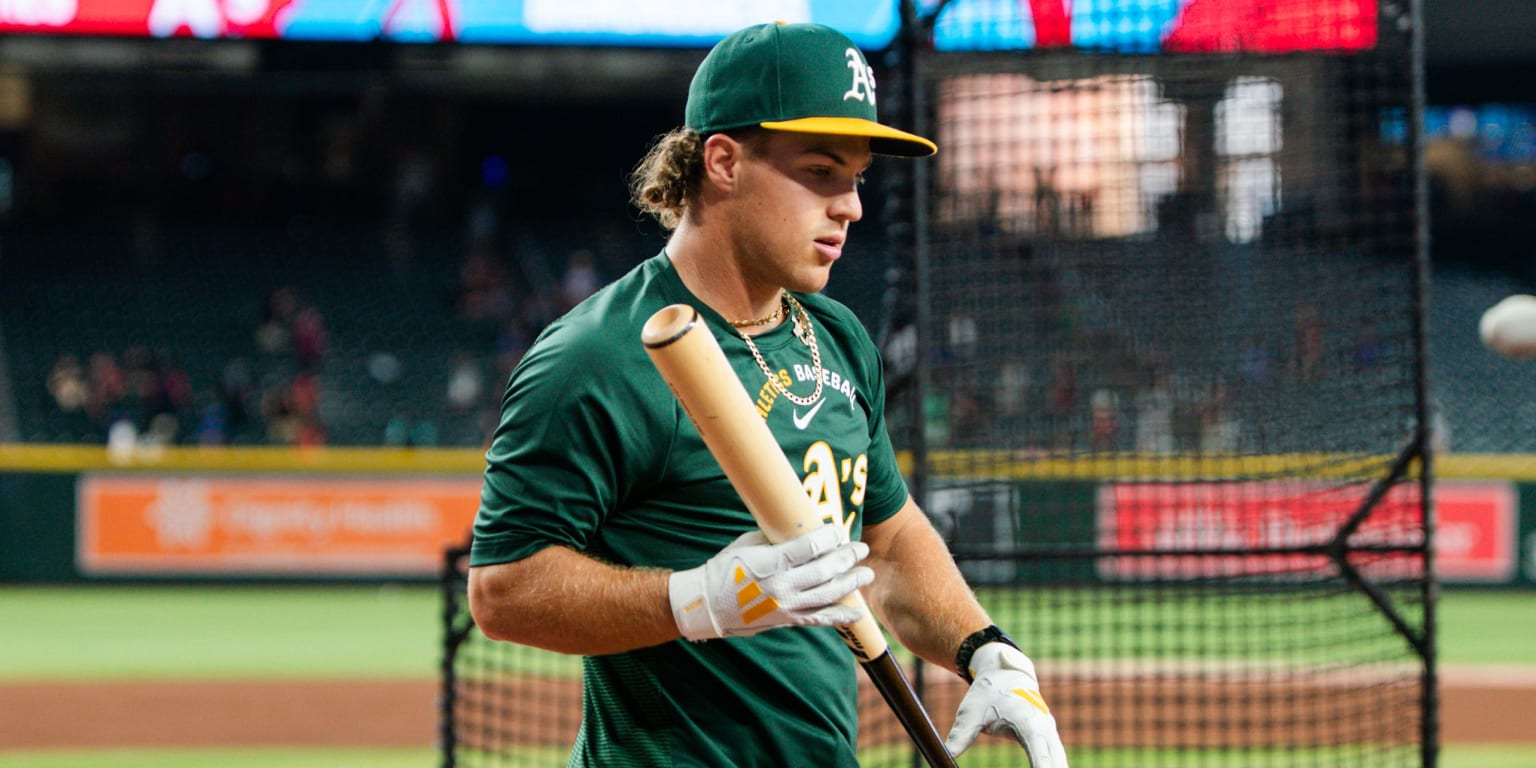 Photo Credit: mlb.com
Burress enters the Athletics system and immediately becomes one of their top prospects behind DeVries after being selected 8th overall in the 2026 draft out of Georgia Tech. He signed for an overslot $7.5 million, getting the 5th-highest bonus in a strong class. Burress showed immense production at Georgia Tech and, despite being 5’8, has the pop to be one of the top prospects in FYPD. The Athletics have generally been very aggressive with previous highly productive college bats such as Burress, so you could potentially see Burress arrive early in 2028 after a single year in the minors. He likely headlines the 2nd tier of prospect bats for FYPD after Emerson, Cholowsky, and Lackey. He provides the Athletics and dynasty owners alike a potential 5-tool player. There are some questions around how much impact will translate from the college game to the professional level. His brief debut at Single-A helped calm some of those questions: he posted a highly impressive 1.022 OPS, 7 homers, and 14 stolen bases in 21 games, though his strikeout rate nearly doubled from college at 27.2% in that small sample. The 14 stolen bases eclipsed any season he had at the college level, showcasing the speed element of his game. Burress is likely to quickly accelerate up prospect rankings and through the Athletics system. – Shawn Kohlmeier
3. Jamie Arnold #54 (#276), LHP (AAA)
82 PLIVE-, Peak Projection: 4.39 ERA, 18.3% K, 9.7% BB, 8.6% K-BB, 50.0% GB
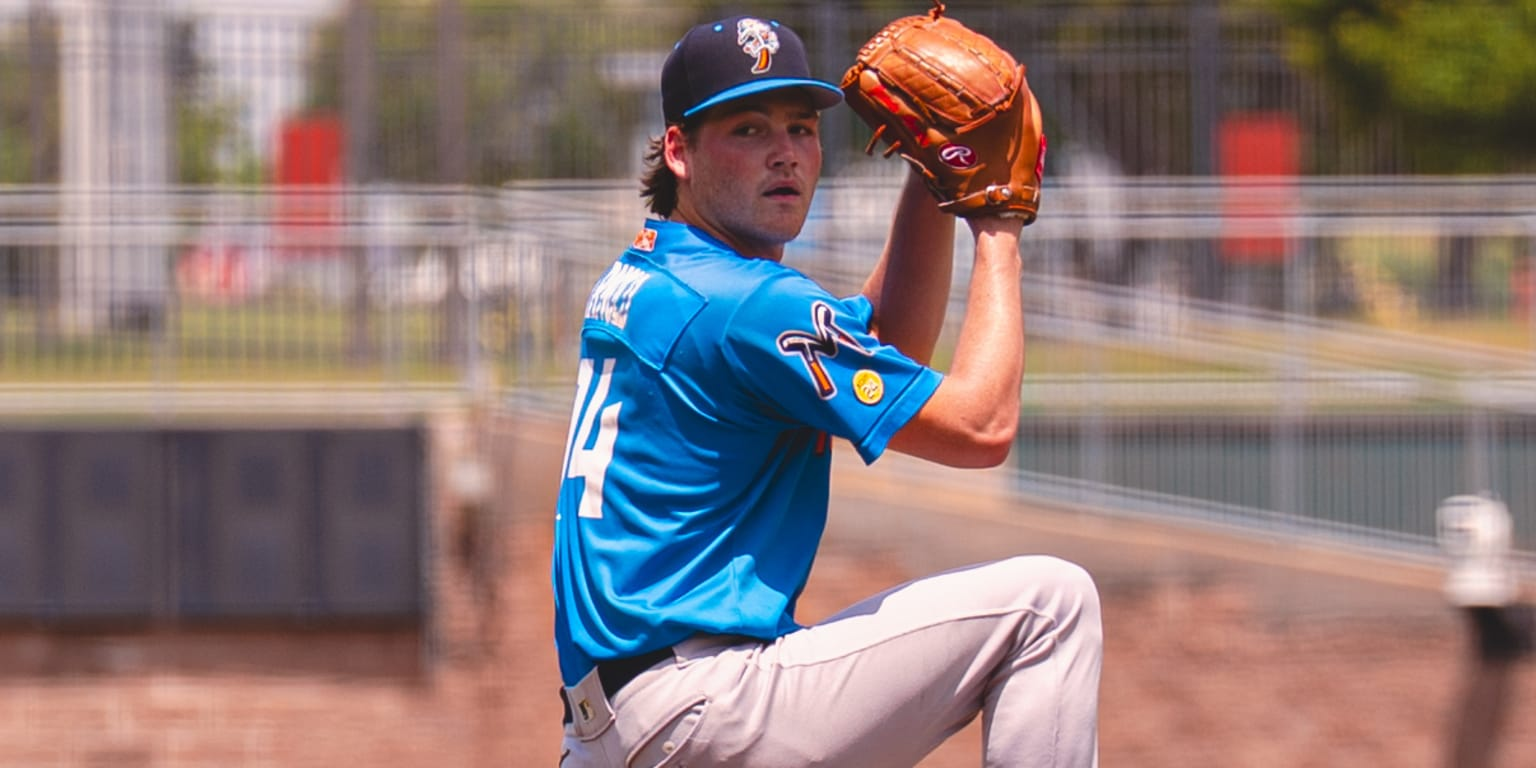 Photo Credit: mlb.com
What could have been so good ended so badly for Arnold. After 23 starts in Double-A, the 2025 first round pick was promoted to Triple-A for the last month of the season. Instead, he lasted just five innings before a line drive to the face ended his season. Surgery followed, and that’s the last we saw of one of the A’s top pitching prospects for the season. After a dominant career at Florida State, the former Seminole was equally impressive as he began his professional career. Arnold had a 3.57 ERA in 113.1 innings at Double-A while adjusting to life as a minor leaguer. He struck out 125 batters, but the southpaw also walked 49. It was the strikeouts and 53.1% ground ball rate that allowed Arnold to work out of what could have been worse trouble. Based on the elevation to Triple-A to close out the season, the A’s thought process is clear here. It wouldn’t be surprising to see Arnold in the big leagues, for better or worse, at some point in 2027, given their home field. – Ray Kuhn
4. Wei-En Lin #123 (#466), LHP (AAA)
83 PLIVE-, Peak Projection: 4.43 ERA, 20.5% K, 8.4% BB, 12.0% K-BB, 33.3% GB
 Photo Credit: mlb.com
Sign up for Prospects Live
Your one stop shop for Dynasty Fantasy Baseball, MLB Draft, Baseball Card & MiLB Baseball content. Blending Data & Scouting into our Player Evaluation
No spam. Unsubscribe anytime.
This post is for paying subscribers only
Become a subscriber now and gain access to articles, tools, and stay updated with Prospects Live.
Already have an account? Sign in