
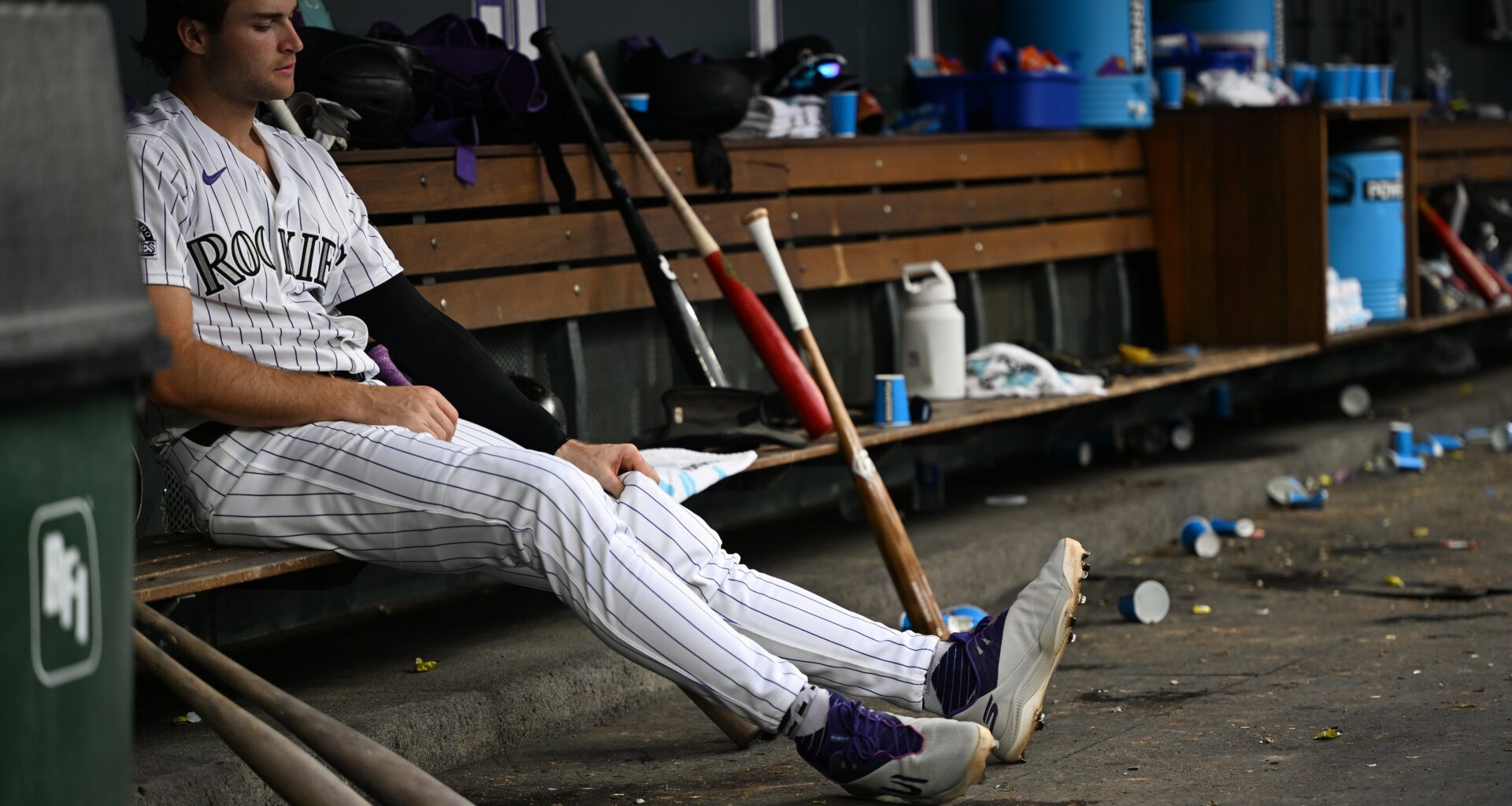
The Rockies are, unfortunately, the company they now keep.
By becoming the fifth MLB franchise to lose 100 or more games four seasons in a row, the Rockies are part of a historically inept collection of misfit teams who defined extended futility in the majors.
Here’s a breakdown of each of those other four teams, and the parallels to the Rockies’ skid of 100-plus losses each of the last four seasons. Colorado logged 30 MLB seasons before going on its historic four-season swoon, becoming the first non-expansion team to lose 100 or more games four seasons in a row since World War II.
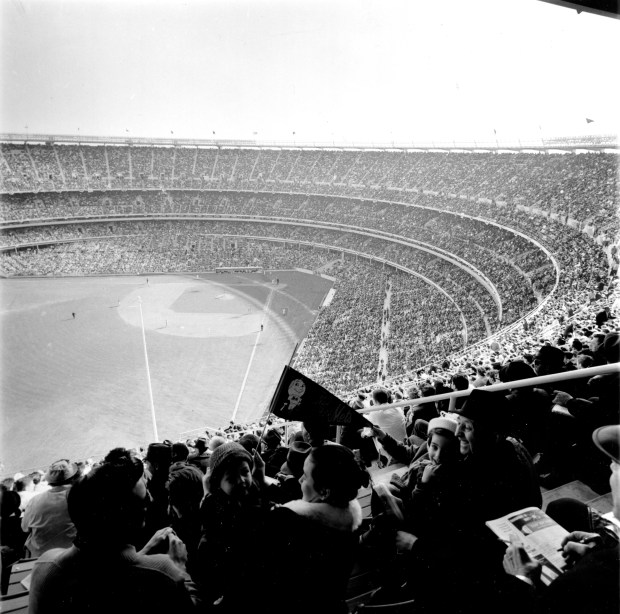 This April 17, 1964 file photo shows Shea Stadium as the New York Mets play their first game in the new ballpark against the Pittsburgh Pirates in the Queens borough of New York City. (AP Photo)
The expansion Mets
From 1962-65, the Mets finished last in the National League each season — just as the Rockies have from 2023-26. Those Mets, whose debut in ’62 filled the National League void left by the departure of the Dodgers and Giants to California following the 1957 season, set a modern record with 120 losses in their first year. (That mark was broken by the White Sox in 2024, when Chicago lost 121 games).
The major correlation between those Mets and these Rockies is the mistake of treating a baseball team like a Broadway show. Mets management had “an obsession with bringing in former Dodgers and Yankees as gate attractions,” according to a Society for American Baseball Research recap of the season. While the fellow expansion Colt .45s (current Astros) signed mid-level veterans and prospects to finish with 24 more wins than the Mets in ’62, the past-their-prime former Dodgers and Yankees quickly sank the Mets’ chances of being remotely competitive.
The Rockies did this, too, albeit on a smaller scale: Signing Kris Bryant to a seven-year, $182 million deal ahead of the 2022 season was perhaps the worst contract in Colorado sports history. Bryant has played just 170 games since inking that deal and appears to be done for good due to chronic back issues. Don’t forget why the Rockies signed him: to be a gate attraction following the trade of Nolan Arenado to St. Louis in February 2021. The Broadway approach of needing a name on the marquee had years-long implications for both the 1960s Mets and the current Rockies, who paid Bryant $27 million this season to play zero games.
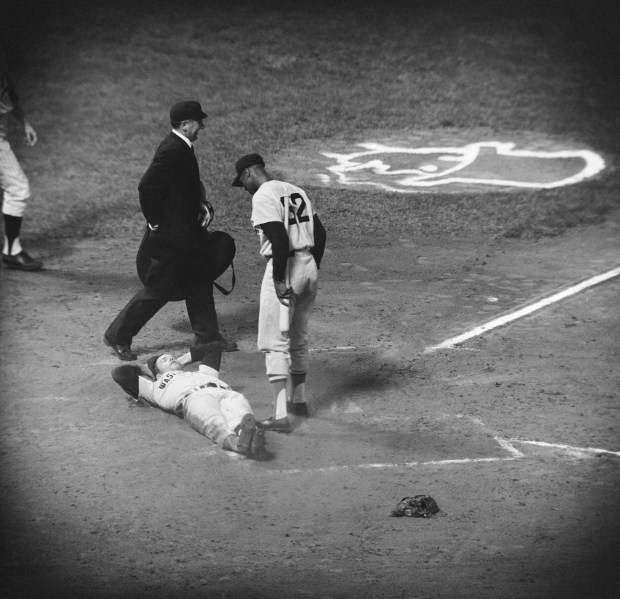 Jim Piersall, centerfielder for the Washington Senators relaxes on the ground after scoring against the Minnesota Twins, June 1, 1962. Others are unidentified. (AP Photo/Gene Herrick)
The expansion Senators
The second iteration of the Senators — the first version moved to Minnesota in 1961, prompting the second Senators — didn’t last long in Washington. After debuting in 1961, the Senators lasted just 11 seasons before relocating and becoming the Texas Rangers in 1972.
Of the other four teams in this infamous club, Washington had the fewest total losses. The Senators lost 100 games in their inaugural season in 1961, followed by 101, 106 and 100 in ’64. In ’61, the Senators showed a little promise at the beginning of the season, posting a 17-12 record in May, much like this year’s Rockies, who were a deceiving 13-14 in June. But the ’61 Senators didn’t have a winning month the rest of the season.
Despite the streak of consecutive 100-loss seasons, the Senators actually escaped sole possession of the American League basement twice during that run, finishing tied for last of 10 teams in ’61 and then ninth in ’64. The Rockies, the NL’s worst team four seasons running, haven’t been as lucky.
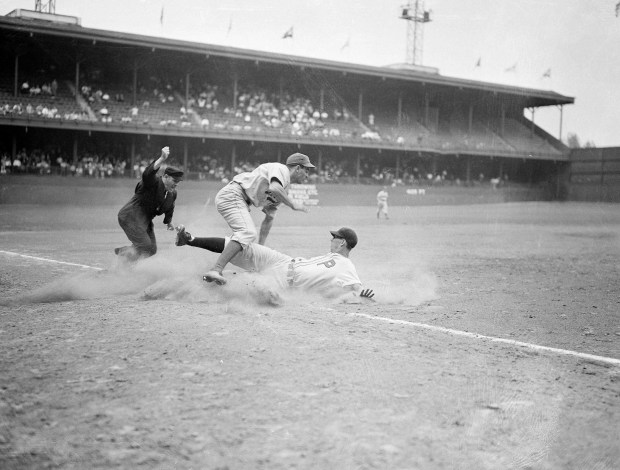 Stan Benjamin, Phillies outfielder, is out at third in the fifth inning of the nightcap game in the doubleheader between the Brooklyn Dodgers and the Phils at Philadelphia, Sept. 3, 1941. Benjamin was caught trying to stretch his drive to left field into a triple. Cookie Lavagetto, Dodgers third baseman, leaps high to avoid Benjamin’s spikes as he makes the putout and umpire Bill Stewart calls the play. The Phillies won, 4-1. (AP Photo)
The WWII-era Phillies
Philadelphia’s record run of five straight 100-loss seasons came under the direction of owner Gerald “Gerry” Nugent, a World War I veteran who ran the team with his wife from 1932 to 1943. His tenure with the Phillies coincided with the Great Depression, and Nugent was consistently forced to sell off his best players for cash to keep his team afloat.
The Phillies moved from the rundown Baker Bowl to Shibe Park in the middle of the 1938 season, the start of their triple-digit loss streak. Philadelphia went 185-534 from 1938-42, and eventually Nugent ran out of quality players to sell. The National League “helped out (with bailouts) for a few years as a way of keeping baseball alive in Philadelphia,” according to SABR, and by early 1943 Nugent sold the team.
The correlation to the Rockies’ current streak comes from this line in the SABR summary of the Phillies’ record futility: “The personnel that passed through (Nugent’s) hands would have over the course of a decade constituted a serious pennant-contending team.”
The moves that set the Rockies up for their current nadir likely wouldn’t have made them a pennant contender, but it might have averted this current tepid stretch. In the few years before this streak started, Colorado let a batting champion walk in free agency (DJ LeMahieu), traded away a likely future Hall of Famer (Arenado), and placed a southpaw starter on waivers who went on to become a two-time All-Star with two other clubs (Tyler Anderson).
Plus, the Rockies faced a money issue of their own when the franchise lost its regional sports network, AT&T SportsNet Rocky Mountain, after the 2023 season. That was an important source of revenue for the club, though it can’t be blamed for the Rockies’ array of roster missteps that led to this streak.
Boston sets the futility bar
The current Atlanta Braves were known by an array of nicknames during their streak of four straight 100-loss seasons from 1909-12, including the Doves, Nationals, Rustlers and eventually the Braves.
During this period, the franchise had two club presidents die unexpectedly in as many years. And on the field, sportswriter Harold Kaese later wrote that “a squirrel on a treadmill couldn’t have produced more action with less progress than the Boston Nationals of 1911,” when the club lost 107 games after losing 100 in 1910 and 108 in ’09. The streak was polished off by a 101-loss season in 1912.
Just two years removed from that, the “Miracle Braves” won the 1914 World Series by sweeping the Philadelphia Athletics, a feat that came despite sitting in last place in the National League on July 4.
The worst Boston team of its streak, in 1909 — like the worst Rockies team of their streak when Colorado lost a franchise-record 119 losses lost year — had a horrible offense. In 1909, only two Boston position players had a WAR greater than 1.0 — outfielders Johnny Bates and Roy Thomas. Similarly, in 2025, only two Colorado position players had a WAR greater than 1.0 — catcher Hunter Goodman and third baseman Ryan McMahon.
The parallels end there. There will be no “Miracle Rockies” winning the World Series in 2028.
Want more Rockies news? Sign up for the Rockies Insider to get all our MLB analysis.