
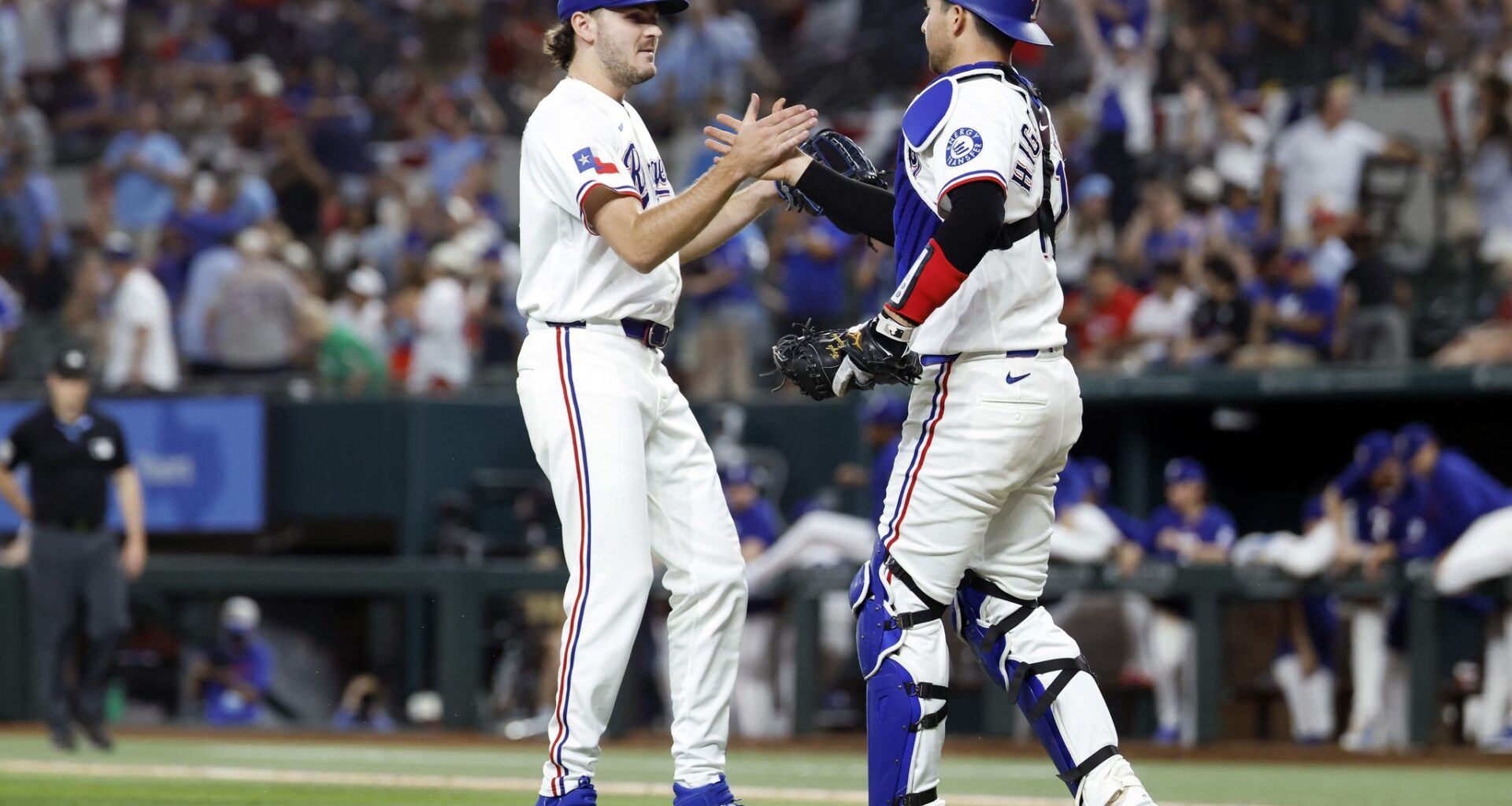
Texas Rangers relief pitcher Jacob Latz (right) and catcher Elias Diaz slap hands after finishing off the top the ninth inning against the Seattle Mariners at Globe Life Field in Arlington, July 27, 2026.
Tom Fox/The Dallas Morning News
We can’t say for certain when, exactly, the Rangers will play baseball again. We can say for certain, though, that much of their roster needs to be evaluated between now and whenever that is.

That’s where we come in.
Texas Rangers catcher Kyle Higashioka (right) is congratulated by relief pitcher Gavin Collyer after he made the final out of the game, a pop up by Detroit Tigers Matt Vierling at Globe Life Field in Arlington, July 2, 2026.
Tom Fox/The Dallas Morning News
Texas Rangers catcher Danny Jansen (9) heads to home plate after talking with pitcher Nathan Eovaldi (17) during the sixth inning of a baseball game against the Boston Red Sox at Globe Life Field on Wednesday, Sept. 16, 2026, in Arlington.
Elías Valverde II/The Dallas Morning News
It’s time to review the Rangers position group-by-position group after a third consecutive postseason-less season. Today, we’ll begin with the catchers, a unit that’s been lost in the wilderness for three years now.
Article continues below this ad
Primary cast: Kyle Higashioka, Danny Jansen, Elías Díaz
What went right: The Rangers’ professional scouting department saved what could’ve been a potentially disastrous season from the team’s catcher position when it signed Díaz to a big league contract in the first half. He led Rangers backstops in games played (77) and fWAR (0.4) despite the fact that he joined the team June 6. If he wasn’t signed, or if the club chose a different in-season option that backfired, the Rangers might’ve been in deep trouble with Higashioka and Jansen on the injured list for a combined 126 games.
What went wrong: Health and defense. Higashioka, their expected starter, missed the final 62 games of the regular season because of a right flexor strain that limited his ability to throw. Jansen, their biggest offseason position player addition, missed 64 games in the middle of the year because of a right forearm strain. Higashioka (94 wRC+) and Jansen (92 wRC+) were close to league-average hitters when available, but in the field, each was a net negative defender according to defensive runs saved and defensive value metrics. The Rangers graded out as an average defensive team behind the plate in large part because of Díaz’ stability. It’s not great when your break-in-case-of-emergency plan proves to be your best option.
What needs answering: Can they find a suitable partner to play alongside (or start over) Jansen next season? Jansen will be in the second season of a two-year contract, and although his first half left much to be desired offensively, he slashed .314/.397/.529 after he returned from his arm injury and was named the team’s September player of the month. That plus his career track record suggest he is still a viable option to start for the Rangers next year, but even still, he’s caught more than just 90 games once in the last seven seasons.
Higashioka, a free agent, is well-liked in the clubhouse, but at 36-years-old with consecutive injury-riddled campaigns, he should not be considered a top option to return in a meaningful role. Could Díaz fill that spot? He gave the Ranger a fine half-of-a-season, and posted a .735 OPS in the final month, but he was available in the middle of the year for a reason. How comfortable would they be with Logan O’Hoppe behind the plate? They acquired the former starting catcher from the Los Angeles Angels at the trade deadline but used him exclusively at designated hitter when in the big leagues as they attempted to rework his defense in the minor leagues. The Rangers view the 26-year-old as a potential long term play given the team control, but he’s been among the league’s worst defensive catchers for the last two seasons, and they’d need to feel especially confident about the state and growth of his play behind the plate to view him as a safe option.
Article continues below this ad
This answer will be determined by how much the Rangers are willing or able to spend — either in free agency or on the trade market — to solidify the position. The free agent pool, headlined by Ryan Jeffers and former Ranger Carson Kelly, is relatively top-heavy. Want a big name on the trade market? Try Athletics catcher Shea Langeliers. The 28-year-old is a Keller native and was an All-Star last season. He wouldn’t be cheap, though, and that kind of acquisition may ultimately not be aligned with the club’s offseason direction.
One number says it all: 1.2. That’s the collective fWAR that the Rangers have gotten out of the catcher position over the course of the last three seasons. It ranks 27th league wide. That’s weighed down by bottom-10 defensive metrics and bottom-five offensive metrics. Either way you slice it, it’s been bad since Jonah Heim’s All-Star campaign three years ago, and the Rangers may need to take a larger swing to dig themselves out of a perpetual rut.
Prospects: Former first-round draft choice Malcolm Moore had a breakout campaign in his second full professional season. The 23-year-old slashed .260/.352/.480 with 18 home runs and reached Double-A Frisco mid season. He showed significant improvement behind the plate before his promotion and still posted a .746 OPS in a “down” second half of the year at a more advanced level. The Stanford alum is the closest thing to a big-league ready catching prospect that the Rangers have, and while he may not be an immediate option for the major league club next season, he could play his way into that conversation if he continues to show progress at the plate and in the field. Moore is the club’s No. 6 prospect per MLB Pipeline. The issue? He’s the only catcher listed on the top 30.
Summary: The Rangers have gone three consecutive seasons with well-below-league-average play from the catcher position and it took a June signee to avoid potential disaster this year. Higashioka and Jansen’s injuries might’ve held this position group back from an average-to-below-average season. That still can’t be ignored come evaluation time.
Grade: C-minus. We gave this position group a straight ‘D’ last season and it managed to improve from 0.5 fWAR to 1.1 fWAR. That was still a bottom-five metric league wide. They technically got better, sure, but how much credit should be given for going from “bad” to “slightly less bad”?
Article continues below this ad
Find more Rangers coverage from The Dallas Morning News here.
Click or tap here to sign up for our Rangers newsletter.