
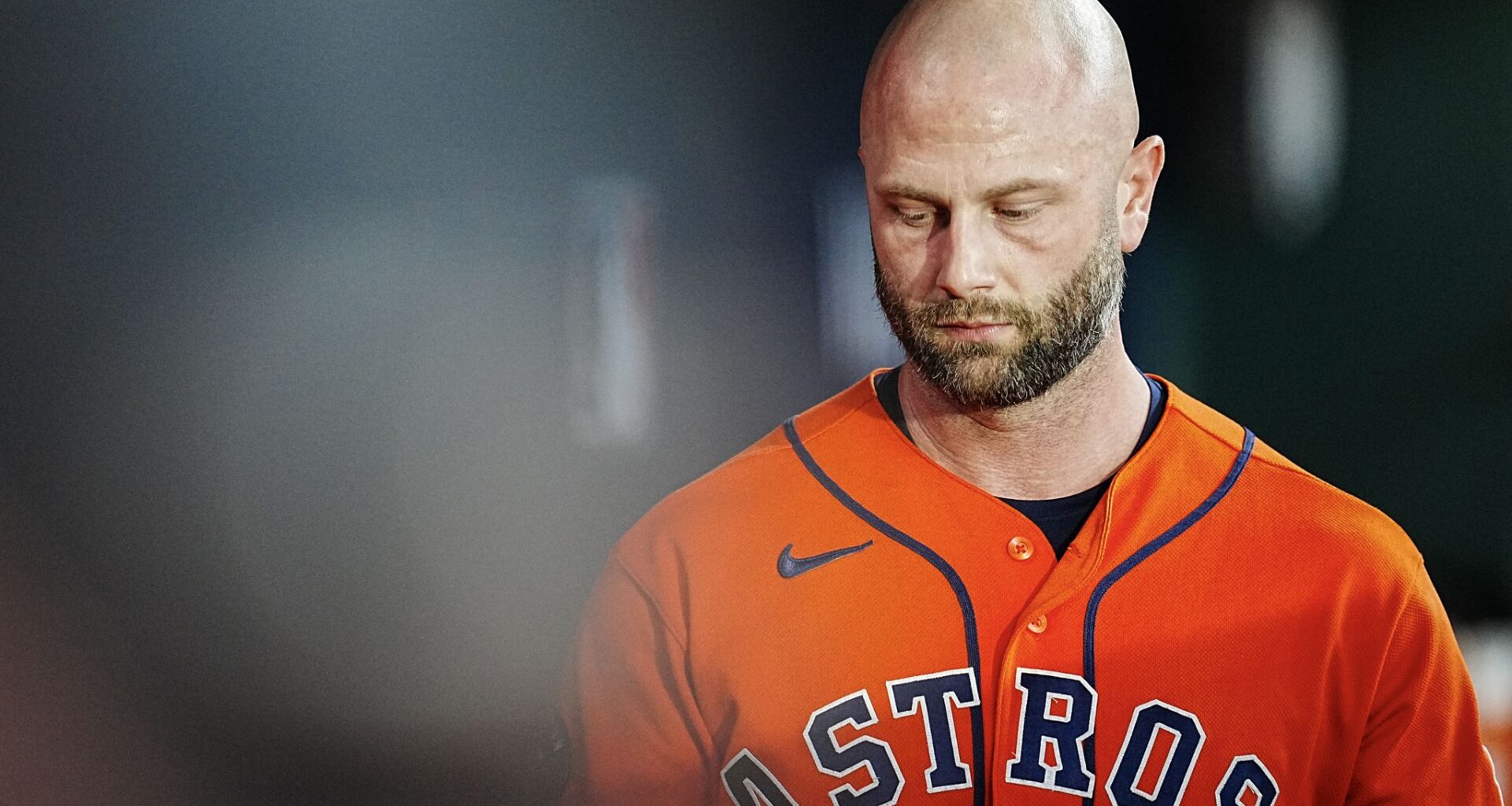
Houston Astros Christian Walker (8) walks through the dugout after striking out to end the sixth inning during Game 2 of an American League Wild Card Series in Houston, Wednesday, Sept. 30, 2026.
Jason Fochtman/Houston Chronicle
Second in a series on the Houston Astros‘ 2026 season, which ended with an AL West title but a sweep in the opening round of the playoffs
First base
Houston Astros Christian Walker hits a solo home run off Athletics starting pitcher Jacob Lopez during the fourth inning of an MLB baseball game at Sutter Health Park in Sacramento, California, Friday, Sept. 25, 2026.
Jason Fochtman/Houston Chronicle
Inverse seasons led Christian Walker to a similar conclusion. A frigid start ceded to a second-half upswing in his first year with the Houston Astros. This year, the first baseman cooled after a strong first two months.
Article continues below this ad
“I’d like to be more consistent throughout the season,” Walker said after the Astros’ wild-card defeat, echoing a self-assessment from late 2025.
Ironically, both paths produced similar seasons. Walker hit 29 home runs in the second year of his three-year, $60 million deal, two more than in 2025. He finished with one fewer RBI (87) and an OPS that was 10 points higher (.727), while starting 150 games at first base, the same number as last year.
Isaac Paredes and LaMonte Wade Jr. combined for the other 12 starts. Together, they accrued 2.3 wins above replacement at first base, per Baseball Reference, ranking 15th of 30 teams at the position. That middling number marked a step up from last year, when Houston accrued 0.3 bWAR at first base.
Houston Astros Christian Walker tosses his bat after hitting a solo home run off Athletics starting pitcher Jacob Lopez during the fourth inning of an MLB baseball game at Sutter Health Park in Sacramento, California, Friday, Sept. 25, 2026.
Jason Fochtman/Houston Chronicle
What went right
For the season’s first two months, Walker resembled the impact middle-of-the-order bat Houston sought when it signed him. He totaled 16 home runs and 43 RBIs across his first 60 games, with an .835 OPS. Among qualified AL hitters, Walker ranked sixth in homers and tied for second in RBIs at the end of May.
Article continues below this ad
To say Walker and Yordan Alvarez carried the Astros offense early is not a stretch. It made what followed with Walker more glaring. Across his next 90 games, Walker posted a .611 OPS with nine homers and 37 RBIs. He had the sixth-lowest OPS among qualified AL hitters in that span.
Despite the dropoff, some metrics gauged Walker’s second season with Houston a modest improvement. He accrued 2.0 bWAR, up from 0.3 last year. Sports Info Solutions assessed him 10 additional runs saved at first base. He pared his strikeout rate by 4.6 percent and raised his walk rate by 1.7 percent.
A closing week in which he went 8-for-23 with four home runs helped push Houston into the postseason. Walker finished ninth in the AL in home runs and tied for 13th in RBIs.
What went wrong
The Astros needed Walker to be a run producer, given the traffic created by the top of their lineup. Only Isaac Paredes came up more often with men on base or in scoring position than Walker among Houston hitters. Walker’s struggles in those situations prevented his season from being more productive.
Article continues below this ad
Just 18 major-league hitters took more plate appearances than Walker with runners in scoring position. He batted .197 with a .263 on-base percentage in those situations. League-wide, players hit .252 with a .335 OBP in them. Walker drove in 56 runs in his 175 plate appearances with a man in scoring position.
Walker’s second-half decline resulted in his dropping to sixth or seventh in Houston’s lineup at times. His home-road splits also remained stark. Walker posted a .797 OPS on the road, compared to a .652 OPS at home, hitting 19 of 29 home runs away from Daikin Park. He went 0-for-6 in the wild-card series.
Overall, Walker’s .226 batting average was his lowest in a qualified season and his .299 OBP his second-lowest. He finished with a 103 OPS-plus, three percent above MLB average.
Number to note
Minus-6: Walker’s batter run value against four-seam fastballs in 2026, according to Baseball Savant.
Article continues below this ad
Walker feasted on four-seam fastballs with Arizona. From 2022-24, he slugged .557 with a plus-31 run value against four-seamers, per Baseball Savant. Just 14 hitters in the majors posted a higher run value against four-seamers in that span.
Those numbers have declined in two straight seasons. This year, Walker batted .172 and slugged .344 against four-seamers. Among the 254 hitters who had at least 100 plate appearances ending on four-seamers, Walker’s average ranked 10th-lowest, while just 28 hitters compiled a lower run value.
Walker’s average bat speed remained in the 77th percentile in the majors. Yet his 27.7% whiff rate and 30.8% strikeout rate against four-seamers were up from marks of 24.6% and 25.1% from 2022-24, not ideal for a hitter who will be 36 next season.
Contract status
Walker is entering the final season of a three-year, $60 million contract. He will make $20 million next year. Should the Astros explore a trade this offseason, Walker’s deal includes a limited no-trade clause that would allow him to block a trade to six teams.
Article continues below this ad
In the minors
Houston had no first-base prospects knocking down the door this year. Logging the most games at first for Triple-A Sugar Land were Cavan Biggio (age 31), Trenton Brooks (31) and CJ Alexander (30). All have some major-league time and represented upper-level depth.
Worth noting is Jason Schiavone, the Astros’ minor-league player of the year, who has primarily caught but played some first base in Houston’s system. Schiavone compiled a 30-home run, 30-steal season across three levels that ended with a nine-game stint at Triple-A.
That practice of position flexibility is not uncommon in Houston’s system. Will Bush, after a non-roster invite to major-league camp, also split time between catcher and first base at Double-A Corpus Christi. So did Collin Price, who debuted in June and remains on the Astros’ 40-man roster.
Logan Hughes, the Astros’ first-round pick in this year’s draft, played corner outfield and first base in his initial 21-game stint at Single-A Fayetteville. Hughes made a good first impression with a .333/.433/.605 slash line in his first 97 minor-league plate appearances.
Key question
Will there be a trade market for Walker and will the Astros explore it?
Houston has an infield surplus again with Carlos Correa expected back healthy next spring from his ankle surgery. Trading from the group again seems a logical way to resolve it. Three of the five players involved are entering their final seasons under team control, with shortstop Jeremy Peña and third baseman Isaac Paredes arbitration-eligible for the last time this winter.
Paredes and Peña ranked second and third among Astros hitters in OPS-plus this season. If the priority were creating an infield that can accommodate both, it could make Walker expendable. Correa played third base before his injury and, ostensibly, will return there. Paredes, displaced from third, could shift over to first base if Walker were moved.
It is unlikely to be that straightforward, however. Peña is probably the Astros’ most attractive trade chip, and if they don’t extend him, leveraging that value – similar to Kyle Tucker two winters ago – must become a consideration for a club in Houston’s position. Paredes, coming off a 4.0-bWAR season and with a $13.35 million team option for 2027, could also generate trade value.
Walker’s market, if the Astros explore it, could be suppressed by his contract, age and inconsistency the past two seasons. His numbers this year might boost his trade value to teams seeking more thump at first base. Yet even if the Astros were to cover some of his $20 million salary, Walker might not generate the same kind of return as Peña or Paredes.
Then again, moving him could create some payroll flexibility. Projecting the Astros’ approach is difficult with their general manager job still vacant and little clarity on who will be running baseball operations this winter. Discussions about the infielders seem interrelated, but maybe not, depending on the scope of changes Houston intends to explore.
Summary
In two seasons as Houston’s first baseman, Walker has proven a durable and veteran presence who will pop home runs and is prone to slumps. The Astros this season ranked 22nd in the majors in OPS at first base and 23rd in weighted runs created-plus. Defensively, they rated sixth in runs saved, per Sports Info Solutions, and fourth in Statcast fielding run value at the position. After their playoff exit, Walker said of his own season that “the roller coaster of everything gets exhausting, so a goal for myself is to improve consistency and be the best version of I can for this team.”
Previous