

Here’s a look back at what happened in the Chicago area on Oct. 14, according to the Tribune’s archives.
Is an important event missing from this date? Email us.
Front page flashback: Oct. 15, 1912
 Former President Theodore Roosevelt was brought to Mercy Hospital in Chicago for treatment after an assassination attempt Oct. 14, 1912 in Milwaukee. (Chicago Tribune)
1912: As he departed from the Hotel Gilpatrick in Milwaukee to deliver a speech, former President Theodore Roosevelt was shot by Bavarian immigrant John Flammang Schrank. Miraculously, a variety of items in Roosevelt’s jacket pocket — a metal case for his glasses, a 60-page manuscript of his speech and a package of letters — may have saved his life.
“The bullet passed through these various objects, they absorbing its dangerous force and velocity, deflecting its course and preventing a much more dangerous wound,” the Tribune reported.
A crowd gathered and seized Schrank with the intention of killing him, but Roosevelt pleaded for the man to be handed over to the police. Schrank was taken into custody. Scribblings found in his pockets said Schrank was told in a dream by McKinley to kill Roosevelt. Schrank spent the rest of his life in an asylum and died in 1943 at Central State Mental Hospital in Wisconsin.
Vintage Chicago Tribune: How a stack of speech notes saved Theodore Roosevelt’s life 114 years ago
Almost unfazed, Roosevelt chose to deliver his speech at the Milwaukee Auditorium, now known as the Miller High Life Theatre. He told the audience what happened and pointed at the perforated manuscript.
“I do not care a rap about being shot, not a rap,” he said. “Friends, I shall have to ask you to be as quiet as possible. I do not know whether you fully understand that I have just been shot, but it takes more than that to kill a Bull Moose. … The bullet is in me now, so that I cannot make a very long speech. But I will try my best.”
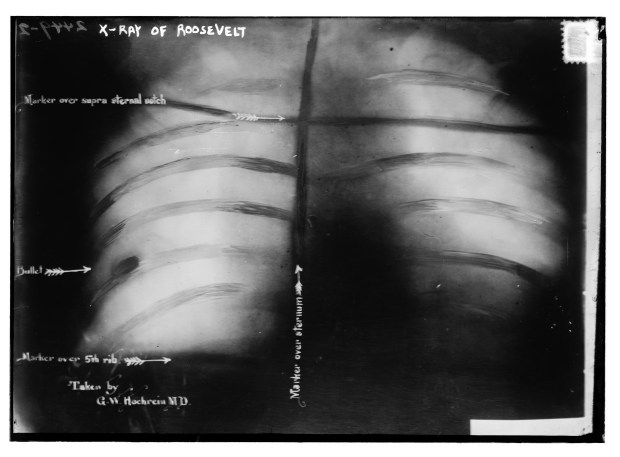 The X-ray of former President Theodore Roosevelt was taken shortly after he was shot Oct. 14, 1912, by Bavarian immigrant John Schrank in Milwaukee. The bullet remained lodged in Roosevelt’s body for the rest of his life. (Library of Congress)
Roosevelt was rushed to Mercy Hospital in Chicago via train. The Tribune provided daily updates on his temperature, pulse and respiration numbers. He departed after six days, but the bullet remained lodged in Roosevelt’s chest for the rest of his life.
Flashback: Mercy Hospital’s major milestones
Weather records (from the National Weather Service, Chicago)
High temperature: 89 degrees (1975)
Low temperature: 27 degrees (1872)
Precipitation: 4.19 inches (2017)
Snowfall: Trace (1992)
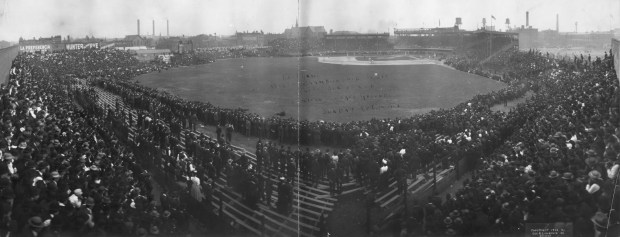 The last game of the World Championship Series between the White Sox and Cubs is played on the American League Grounds on Oct. 14, 1906. (George R. Lawrence Co./Library of Congress)
1906: The Chicago White Sox — nicknamed the “Hitless Wonders” (manager Fielder Jones‘ team hit .230, the worst in the American League during the 1906 season with only seven home runs) — faced the Chicago Cubs in Game 6 of the World Series.
Almost 20,000 fans jammed South Side Park III, and thousands waited in the streets. With Cubs ace Mordecai “Three Finger” Brown on the mound, a seventh game seemed certain.
The Cubs scored a run in the first inning, but the Sox scored three, then exploded with four in the second. In the Cubs’ ninth, with the score 8-3 and two out, Frank Schulte hit a weak ground ball to the mound. Doc White tossed to first, then ran for his life as Sox fans swarmed onto the field and into the streets. That night, bonfires were set for a party that lasted into the morning.
 The Chicago Cubs beat the Detroit Tigers 2-0 on Oct. 14, 1908, to win the team’s second consecutive World Series. The illustration by Clare Briggs was publish in the Tribune the next day. (Chicago Tribune)
1908: The Cubs won four games to one to reign as world champs for the second consecutive year.
Only 6,210 fans showed up for Game 5, despite ideal conditions in Detroit. (The series is still considered one of the worst in attendance.) Orval Overall dominated in the 2-0 Cubs win, which gave the club its second consecutive World Series title.
Vintage Chicago Tribune: How the Cubs and White Sox have fared in the postseason since 1906
“Not in the memory of this generation of fans has any team ever won its honors with greater credit than that which belongs to Frank Chance’s warriors,” the Tribune’s I.E. Sanborn wrote. “Not in a thousand years has a team been compelled to fight as hard for its titles as the Chicago team, which won the National league pennant twice inside of five days under the most trying circumstances.”
Sanborn was referring to an incident that happened on Sept. 23, 1908. With the Cubs and New York Giants knotted in the standings, a Giants batter appeared to drive in the winning run from third. But Merkle, on first base, went to the clubhouse without touching second base, and the Cubs recovered the ball and got a belated force-out at second. Because of “Merkle’s boner,” the game ended in a tie and was replayed later, leading to a Cubs victory that gave them the pennant — and made their World Series victory possible.
 After 29 consecutive losses, the Chicago Cardinals finally had a win. They beat the Chicago Bears 16-7 on Oct. 14, 1945, at Wrigley Field. The Cardinals moved to St. Louis in 1960. (Chicago Tribune)
1945: The Chicago Cardinals (the oldest pro football franchise in the NFL) broke a 29-game losing streak — extending back to the 1942 season — by defeating the Chicago Bears 16-7 at Wrigley Field.
Vintage Chicago Tribune: Meet Violet Bidwill, the NFL’s first female owner of the Cardinals
Violet Bidwill was entrusted with the leadership of the Cardinals after her first husband and team owner Charles died unexpectedly in 1947. And though she, too, later died suddenly, the Bidwill family still retains ownership of the team due to her efforts.
 Milton Friedman, a University of Chicago economics professor, started Oct. 15, 1976, like any other day in his life. The day before he was named a Nobel Prize winner while he was a speaker in Michigan. When he returned, it was a day of honors and congratulations. He was constantly interrupted by phone calls, the glare of television lights and accepted his good wishes of his friends across the country. (Hardy Wieting/Chicago Tribune)
1976: University of Chicago economist Milton Friedman, the founder of the “Chicago school” of free-market economics, was awarded the Nobel Prize in economics.
Vintage Chicago Tribune: Nobel Prize winners with Chicago connections
Friedman died in 2006. The Milton Friedman Institute for Research in Economics was established at the University of Chicago in his honor in 2008.
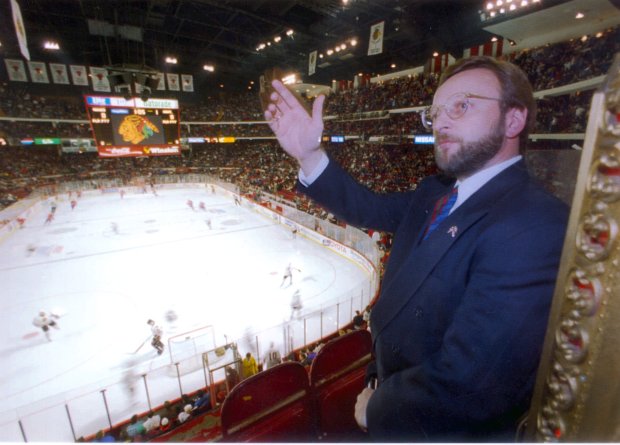 Wayne Messmer sings the national anthem before a Chicago Blackhawks-St. Louis Blues matchup April 8, 1994, at Chicago Stadium. Hours later, he became a gunshot victim. (Charles Cherney/Chicago Tribune)
1994: After national anthem singer Wayne Messmer was shot in the neck on April 9, 1994, in Chicago, doctors were worried if he would recover his voice. He was joined by his wife, Kathleen, to once again sing “The Star-Spangled Banner” at the debut of the Chicago Wolves hockey team. Messmer, the team’s executive vice president said, “No one can imagine how I felt.”
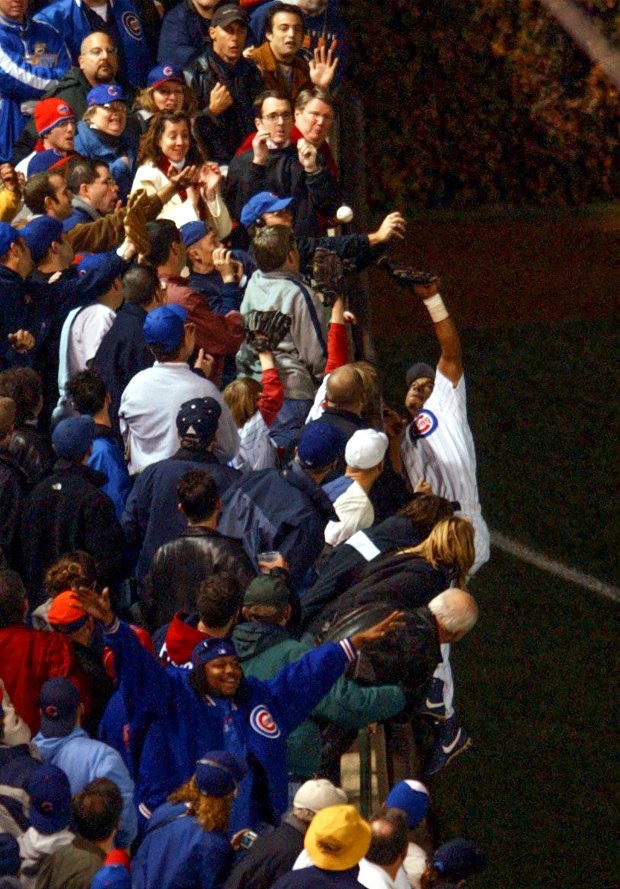 Fan Steve Bartman deflects a foul ball that Chicago Cubs outfielder Moises Alou might — or might not — have caught in the infamous 2003 NLCS at Wrigley Field on Oct. 14, 2003. Bartman has remained in virtual hiding since the incident. (Charles Cherney/Chicago Tribune)
2003: The Cubs appeared to have the NLCS locked up — along with their first World Series berth in 58 years — leading 3-2 in the series with a lead in the eighth inning of Game 6 and Mark Prior on the mound at Wrigley Field. But trouble lurked in a left-field box seat — and at shortstop. With one out, the Florida Marlins’ Luis Castillo hit a foul ball down the left-field line. Several spectators reached for the ball along the railing as Moises Alou lunged to try to make the catch.
One fan, Steve Bartman, deflected the ball as he reached for it, and Alou was unable to make the grab. Alou reacted demonstrably, and the Marlins went on to score eight runs in the inning, sending 12 batters to the plate, as Cubs shortstop Alex Gonzalez botched a routine double-play ball.
The Marlins went on to win Game 7, then defeated the New York Yankees in the World Series. The Cubs were upset again by the Marlins in the 2020 wild-card series, losing the series in a two-game sweep.
The team gifted Bartman a championship ring after it won the 2016 World Series.
Want more vintage Chicago?
Subscribe to the free Vintage Chicago Tribune newsletter, join our Chicagoland history Facebook group, stay current with Today in Chicago History and follow us on Instagram for more from Chicago’s past.
Have an idea for Vintage Chicago Tribune? Share it with Kori Rumore and Marianne Mather at krumore@chicagotribune.com and mmather@chicagotribune.com