
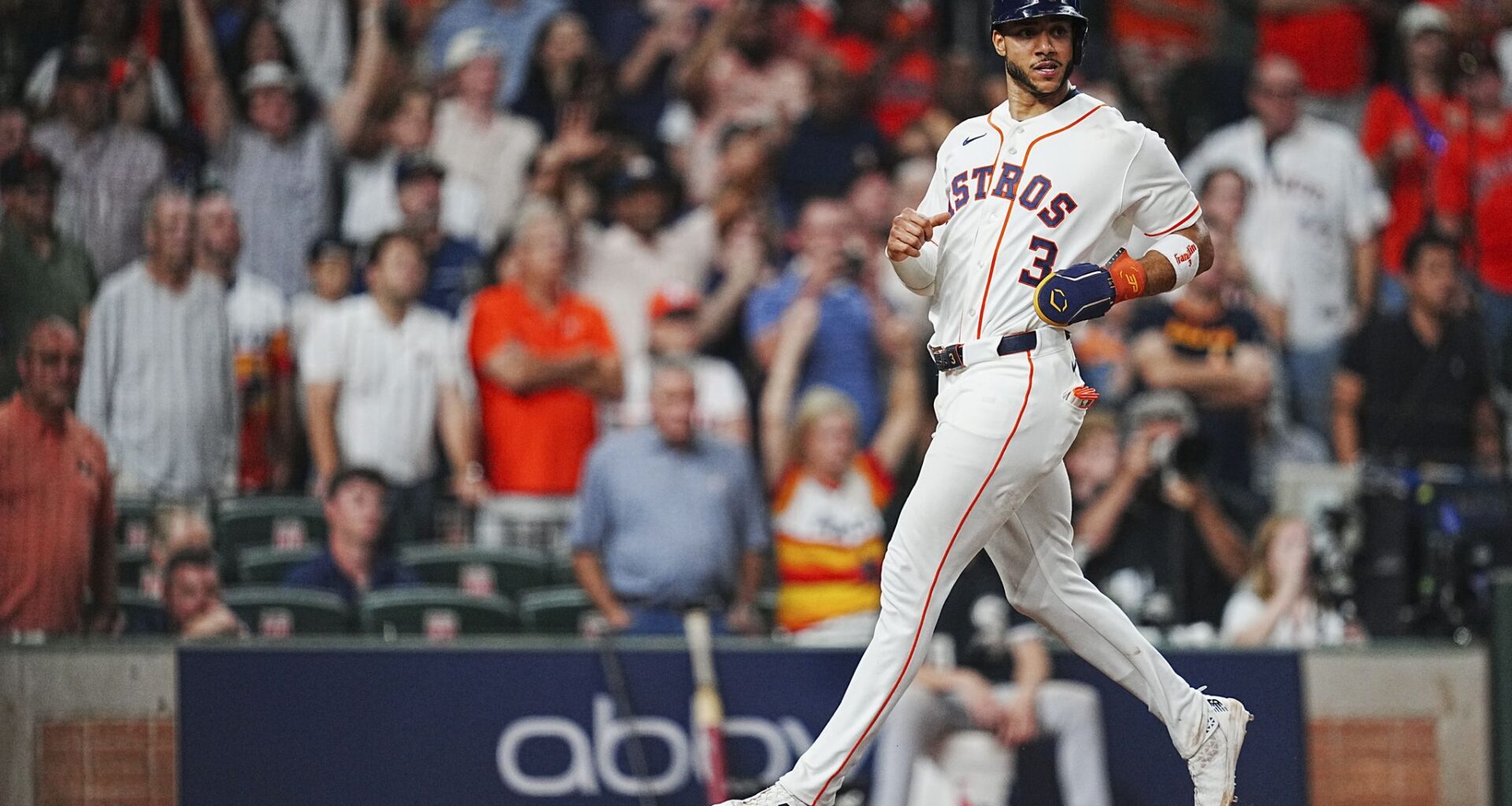
Jeremy Peña has proved to be a catalyst atop the Astros’ lineup for two straight seasons, but had an injury-marred 2026 and is heading into the last year of team control.
Jason Fochtman/Houston Chronicle
Fourth in a series on the Houston Astros‘ 2026 season, which ended with an AL West title but a sweep in the opening round of the playoffs.
Shortstop
On May 18, Jeremy Peña returned from a five-week injury absence to a Houston Astros team 10 games under .500. From that date through the end of July, just four qualified American League hitters posted a higher OPS than the shortstop. On Aug. 1, the Astros were a game above .500 and atop the AL West.
Article continues below this ad
It illustrated Peña’s impact as the Astros’ sparkplug. For a second straight season, Peña was one of Houston’s most productive hitters, albeit with injuries and a late slump hindering his opportunity to mount a full encore to last year’s All-Star campaign.
Carlos Correa, Nick Allen and Braden Shewmake were among those who filled in at shortstop in Peña’s absence. Overall, the Astros extracted 4.8 wins above replacement at shortstop, per Baseball Reference, sixth-highest in the majors and their second-highest mark at a non-pitching position after DH.
What went right
When healthy, Peña again proved a catalyst as a leadoff hitter. The Astros went 59-49 and averaged 4.8 runs per game with Peña in the starting lineup. When he was absent, they were 22-32 and averaged 4.1 runs per game.
Peña ranked third among Astros hitters in OPS-plus (124) and second in runs scored (82) while taking their sixth-most plate appearances. His average dipped 27 points and his OPS fell 38 points from last season. But he matched his 2025 slugging percentage (.477) and his career high of 22 home runs, the latter despite taking a career-low 447 at-bats.
Article continues below this ad
Led by that production, the Astros ranked fourth in the majors in offensive bWAR at shortstop and fifth in weighted runs created-plus at the position. Their shortstops ranked third in slugging, fourth in batting average and first in runs scored. Correa contributed by posting an .802 OPS in his 91 plate appearances as shortstop.
Injuries were an issue for Jeremy Peña in 2026.
Jason Fochtman/Houston Chronicle
What went wrong
Various injuries limited Peña to 112 games. He began the season building up from a fractured fingertip sustained in an exhibition with Team Dominican Republic and played in 10 games before a hamstring strain sidelined him for five weeks. He also had a 10-day IL stint for a calf strain in early July.
In the second half, Peña endured a brutal and prolonged slump. Over 35 games from Aug. 3 through Sept. 13, Peña batted .170 with a .518 OPS and a 32.7% strikeout rate. The Astros averaged 3.8 runs per game in that stretch. Peña then batted .353 with a 1.064 OPS in his final 12 games of the season.
Article continues below this ad
His defensive metrics, meanwhile, took a step backward. Peña, a Gold Glove winner in 2022, accrued a career-low minus-5 runs saved at shortstop, per Sports Info Solutions, and a minus-5 fielding run value, per Statcast. Both penalized his range. As a team, the Astros ranked 21st in runs saved at shortstop.
Number to note
43.4%: Peña’s ground-ball rate, a career low.
For a time, elevating the ball more was a project for Peña. In his first four seasons, Peña’s ground-ball rate twice topped 50% and did not dip below 47.7%. This year, Peña pared his ground-ball rate to 43.4%, while his average 13-degree launch angle on balls put into play jumped from a previous career high of 8.9, with the result being more chances to tap into his pop.
Peña matched his career high of 22 home runs in 74 fewer at-bats than it required in 2022. He paired his increased contact in the air with a career-high 48.2% pull rate for a duo conducive to power numbers.
Article continues below this ad
If deliberate, the approach may have come with some trade-off. Peña also chased out of the strike zone (39.3%) and swung-and-missed (31.8%) at career-high rates this season. His strikeout rate rose nearly 7 percent from last year to 24%. Against breaking pitches, his average (.195) dropped by 78 points and his whiff rate (44.8%) rose by 10 percent year-over-year, per Baseball Savant.
Peña also hit 10 home runs in his 159 at-bats ending on breaking pitches, meanwhile, compared to five homers in 187 such at-bats last season. Overall, he ranked in the 67th percentile of major-league hitters in expected slugging percentage — he had not finished above the 58th percentile in any previous season — perhaps indicating where he aimed to make strides.
If the Astros decide to trade Jeremy Peña to help replenish their roster, Carlos Correa could be an option at shortstop.
Elizabeth Conley/Houston Chronicle
Contract status
Peña is entering his final season of salary arbitration eligibility and projected by MLB Trade Rumors to receive $13.1 million next season. As a homegrown star going into his last season under team control, Peña is in the same situation as Kyle Tucker was when Houston traded the right fielder two winters ago, inviting the question of whether the Astros might follow a similar approach. (More on that later).
Article continues below this ad
Correa is signed through 2028, with a series of club options starting in 2029 that can vest based on plate appearances. Allen is entering his second year of arbitration eligibility and projected by MLB Trade Rumors to earn $1.8 million next season. Shewmake was designated for assignment in July, detoured to Milwaukee, then re-signed on a minor-league deal with Houston before the season ended.
Xavier Neyens, the Astros’ 2025 first-round pikc, was a high school shortstop but finished last season in the minors playing third base
Rob Tringali/MLB Photos via Getty Images
In the minors
Several of the Astros’ higher-ranked prospects are left-side infielders but still a ways off. Xavier Neyens, their 2025 first-round draft pick and a high school shortstop, notably played only at third base after a promotion to High-A Asheville this season. Albert Fermín, the headliner of their 2026 international class, played in the Dominican Summer League this year.
Pascanel Ferreras, a 20th-round pick in 2023, reached Triple-A this season and led Sugar Land in games played at shortstop. Ferreras hit .305 with an .837 OPS in 71 games at Triple-A. Max Holy, a primary shortstop who had a .638 OPS in 90 games at Double-A, was named the Astros’ minor-league defender of the year by their player development department.
Jeremy Peña and Jose Altuve have been a double-play combination for five seasons but the former is heading into his last year of team control.
Jason Fochtman/Houston Chronicle
Key question
Are the Astros willing to extend Jeremy Peña?
After the Astros’ wild-card round exit, Peña declined to discuss his future but said: “I love this city, I love everything about the Astros. Hopefully, I can be here long-term.”
To make that happen could require the Astros to break from precedent. Under owner Jim Crane, the team has not awarded a contract longer than six years or larger than $151 million. Houston allowed homegrown stars Alex Bregman, Correa and George Springer to depart in free agency rather than deviate from an aversion to long-term megadeals.
Peña, entering his final season before free agency, has positioned himself to seek one. Among qualified shortstops, Peña ranks fourth in FanGraphs WAR and tied for second in weighted runs created-plus over the past two seasons. He is entering his age-29 season, owns a top-10 MVP finish and a World Series MVP award and plays a premier position.
No two contract situations are exactly alike. But for possible context, shortstops Trevor Story and Javier Báez both signed six-year, $140 million deals in free agency before their age-29 seasons in 2022. Willy Adames landed a seven-year, $182 million deal before his age-29 season in 2025. Story had accrued 27 bWAR prior to his deal, Baéz a 23.5 bWAR and Adames a 21.5 bWAR. Peña has a 22.2 career bWAR.
Peña is represented by agent Scott Boras, who has a history of clients reaching free agency. Jose Altuve, notably, is an exception who signed two nine-figure extensions with Houston.
Are the Astros willing (or inclined) to commit to Peña long-term? If not, it would put him in a similar position to that of Tucker two winters ago. Unlikely to extend Tucker, the Astros traded the right fielder ahead of his final season of team control to the Cubs for a significant return — Isaac Paredes, Hayden Wesneski and Cam Smith — that addressed multiple areas of their roster.
If the Astros intend to let Peña go, taking a similar approach with him could be a consideration for a team coming off an 81-81 season with a flawed roster and a poorly rated farm system. Correa could provide a replacement at shortstop if willing to move back from third base. Peña’s stated desire to stay is notable, but so is Houston’s track record on this front.
Summary
Peña followed his breakthrough 2025 season with one not quite as well-rounded but that reaffirmed his importance to the Astros’ offense — as well as uncertainty of how much longer he’ll remain a part of it. How to proceed with their shortstop is perhaps the Astros’ most pressing roster question at the onset of an offseason full of them.