
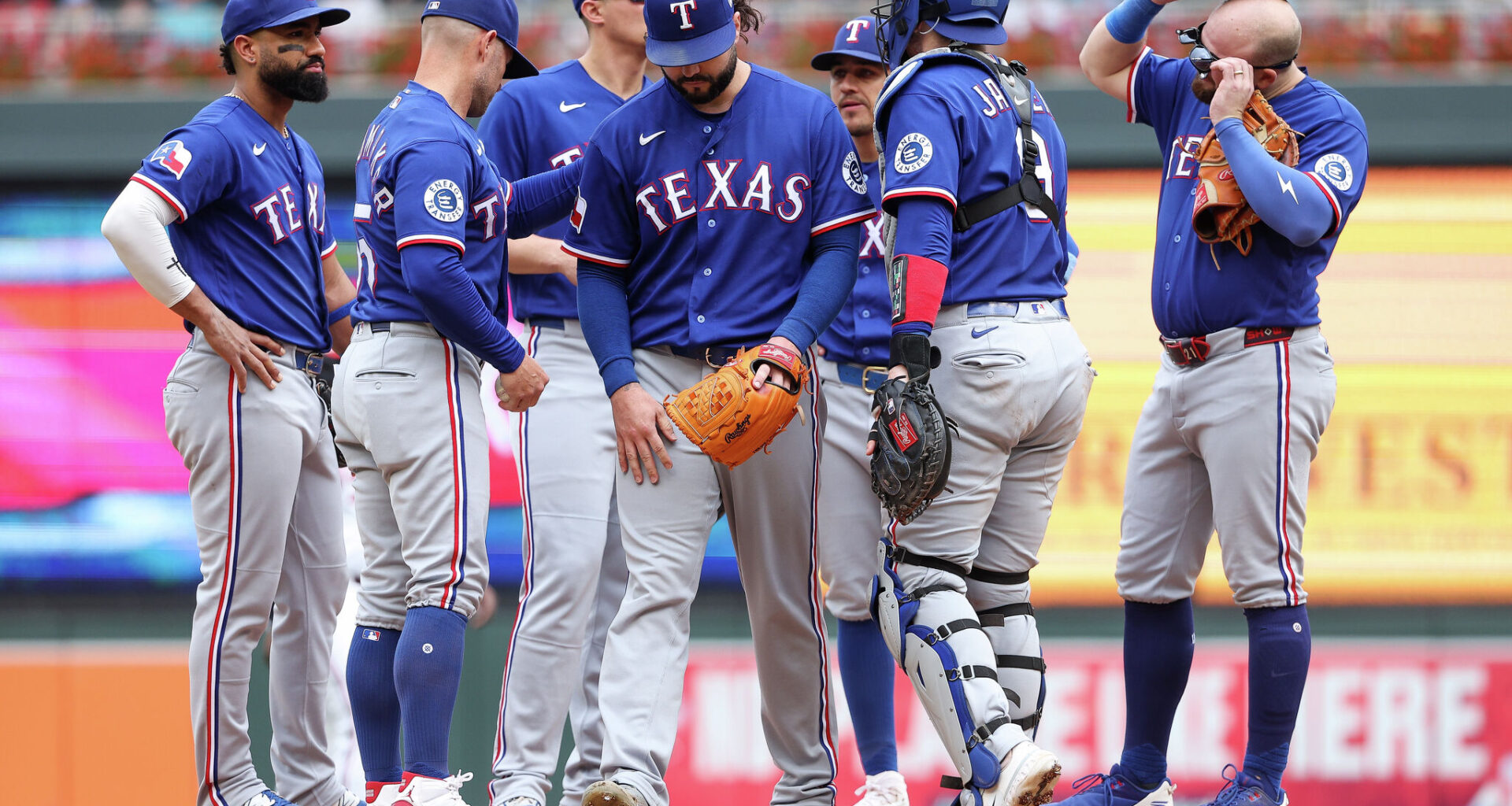
Texas Rangers pitcher Jakob Junis, center, reacts after he is taken out of the game against the Minnesota Twins during the fifth inning of a baseball game, Sunday, Sept. 27, 2026, in Minneapolis. (AP Photo/Matt Krohn)
Matt Krohn/AP Photo/Matt Krohn
The full-fledged free agency window officially begins five days after the World Series concludes, which could be as early as Nov. 1, or as late as Nov. 5. The current collective bargaining agreement will expire Dec. 1.

It could make for a hectic month of maneuvers.
Or everything you’re about to read might still be relevant after contract disputes wrap up.
Article continues below this ad
Like most things that pertain to next year’s baseball season, we don’t know for sure when free agency will hit its stride, but we do know that the Rangers have several areas of need to address. We’re going to break it down this week, and today, we’ll look at the potential pitchers they could seek out.
Overview: The rotation dropped from “best in baseball” to “in and around average” year over year. How much will the Rangers spend to steer the trajectory upwards again? They have $61 million committed to their two veterans (right-handed pitchers Jacob deGrom and Nathan Eovaldi), five prospects committed via trade to a former top prospect (left-handed pitcher MacKenzie Gore) and a pair of homegrown phenoms who’ve had turbulent starts to their big league careers (right-handed pitchers Kumar Rocker and Jack Leiter). All that said, the Rangers needed right-handed pitcher Cal Quantrill to bail their rotation out last season, so even if they plan to proceed with the quintet currently rostered, they will need another arm or two available for depth.
The bullpen might have a star in left-handed closer Jacob Latz. Beyond that? The quintet of Robert Garcia, Chase Silseth, Cole Winn, Peyton Gray and Robby Ahlstrom are all currently under contract for next season, but that group was in part responsible for a 4.88 ERA in the bullpen during the month of September. The Rangers may have a closer, their middle-relief options aren’t horrible, but another high-leverage arm or two to replace left-handed pitcher Tyler Alexander (free agent) and right-handed pitcher Jakob Junis (mutual option) should be a priority if they want to field an improved bullpen.
Tarik Skubal, abridor de los Dodgers de Los Ángeles, trabaja frente a los Bravos de Atlanta durante la primera entrada del Juego 1 de la Serie Divisional de la Liga Nacional, el sábado 3 de octubre de 2026, en Los Ángeles. (AP Foto/Mark J. Terrill)
Mark J. Terrill/AP Photo/Mark J. Terrill
The big fish: Los Angeles Dodgers left-handed pitcher Tarik Skubal will be the top available arm on this winter’s market, and although the two-time Cy Young Award winner would be a significant boost, if not an unimaginably pricey one, we’d like to direct your attention to a different southpaw. If the Rangers were interested in a high-profile, nine-figure arm, Baltimore Orioles left-handed pitcher Trevor Rogers meets the criteria that the club cares most about.
Article continues below this ad
The 28-year-old’s 69.3% strike percentage was the second-best in baseball last season. The Rangers and manager Skip Schumaker (who coached Rogers with the Miami Marlins) adore pitchers who throw strikes at a high rate. His 5.5% walk rate (the eighth-best in baseball) and 4.03 strikeout-to-walk rate (19th best in baseball) were both well above average and made his raw numbers (a 4.03 ERA in 169 2/3 innings) shine brighter. He’d be an exceptional second or third option in the rotation behind deGrom and Eovaldi, but if the Rangers did part with one of the two, he’d likely headline the staff.
Rogers will likely command a multi-year deal at north of $20 million per season. It’s a bargain compared to what Skubal may draw, but for a Rangers team in financial limbo, it might ultimately be too steep.
San Diego Padres catcher Luis Campusano, left, and pitcher Adrian Morejon, right, celebrate after their team defeated the San Francisco Giants in a baseball game Sunday, Aug. 2, 2026, in San Diego.
Denis Poroy/AP Photo/Denis Poroy
The middle men: Is this the winter that the Rangers spend (relatively) big money on their bullpen? We’ll classify that as unlikely given the club’s recent propensity for small-dollar relief builds. But, if that changes, they should look for a hard thrower who can rack up whiffs and pair with Latz at the back end of their bullpen.
Our high-end suggestion is left-handed pitcher Adrián Morejón. The former San Diego Padres reliever has a fastball that runs 99.4 mph and carries a 43.1% whiff rate. The Rangers simply do not have that kind of weapon in their bullpen, which this season threw the third-slowest average fastball league-wide, and it showed late in the year when they needed outs. Morejón fixes that, but at anywhere from $15-20 million per year, would the Rangers really swim in those waters?
Article continues below this ad
If they don’t, and if they still want to address their swing-and-miss needs, could right-handed pitcher Evan Phillips be had at a smaller cost? The former Los Angeles Dodger reliever throws a 96.8 mph fastball and both it and his sweeper generate whiffs more than a quarter of the time. At anywhere from $5-10 million per season, it would still be more than the Rangers have spent on a free-agent reliever in recent years, but it could help solve issues in the back end.
The bargain bin: The Rangers have struck relative gold here in recent years on both the rotation (see: left-handed pitcher Patrick Corbin and right-handed pitcher Cal Quantrill) and bullpen (see: right-handed pitcher Shawn Armstrong and left-handed pitcher Tyler Alexander) front in each of the last two offseasons.
They’ve found their unexpected rotation help in spring training each of the last three seasons, but could left-handed pitcher Patrick Sandoval, now two-plus years removed from elbow surgery, have anything to offer as a back-of-the-staff arm? He had a 5.12 ERA in 70 1/3 innings with the Red Sox last season in his first year post-operation.
Can right-handed pitcher Tim Hill and his 5.4% walk rate serve usefully in the bullpen? He’s 36 years old, but his 71% strike rate last season with the New York Yankees plays at any age.
Article continues below this ad