
Paul DePodesta should see this World Series as a cram session.
When the Fall Classic begins on Friday in Milwaukee, the Rockies‘ president of baseball operations will have plenty of takeaways as the Brewers and Rays clash to become a first-time champion.
After this season ends, the Rockies will be one of four MLB teams that have never won it all, joining the loser of this series, the Padres, and the Mariners. Another World Series appearance in LoDo remains a pipe dream, but Colorado can learn a lot from the 2026 World Series as the Rockies attempt to accelerate their return to contention following four straight 100-loss seasons.
Here’s how the Rockies stack up against the Brewers and Rays in a variety of ways, and what Colorado can emulate from MLB’s little engines, which have combined for 14 playoff appearances over a nine-season span from 2018-26.
Division and market size
The Rays and Rockies compete within baseball’s arguably two toughest divisions, the American League East and the National League West.
Those divisions feature a pair of heavyweights in the Yankees and Dodgers as well as teams that have shown flashes of serious, recent contention in the Red Sox, Blue Jays, Padres, Diamondbacks and Giants. And the Brewers compete in the top-heavy NL Central, where the Cubs and Cardinals are usually their primary competition.
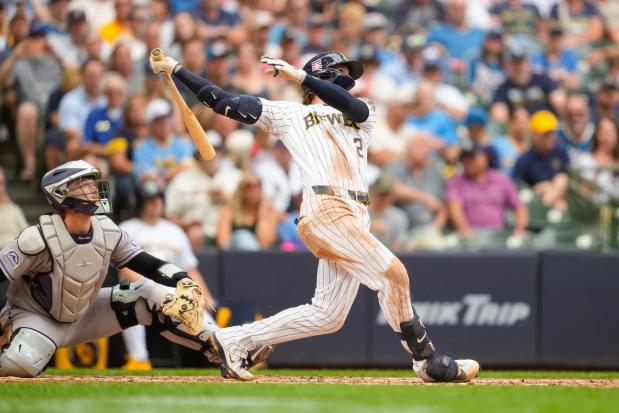 Milwaukee Brewers’ Brice Turang, right, watches his home run with Colorado Rockies catcher Hunter Goodman, left, during the sixth inning of a baseball game Friday, July 24, 2026, in Milwaukee. (AP Photo/Kayla Wolf)
Meanwhile, the Brewers are making magic with eight playoff appearances in the past nine seasons despite being MLB’s smallest market. Under the current collective bargaining agreement, the Brewers’ revenue-sharing market score is last, while the Rays are 19th and the Rockies are 21st.
The Rays are commonly categorized as a small-market team because of their payroll frugality and the fact that their local broadcast and ticket revenue streams don’t correlate with the population of Tampa Bay, which is the 17th-largest metropolitan statistical area in the U.S. So while they are technically a mid-market team based on the CBA’s distinction, the Rays operate like a small-market club.
Until a potential divisional realignment that comes with MLB expanding from 30 to 32 teams, the Rockies can’t do anything about their place in the tough NL West, just like the Rays can’t do anything about having to contend against the Yankees and Red Sox. The market-size factor will likely never change either. Colorado has to learn to out-finesse its divisional competition like the Rays and Brewers have consistently done.
The payroll factor
In terms of spending, the Brewers (19th in 2026 payroll at $146.2 million) and Rockies (21st at $121.5 million) are comparable, while the Rays ranked 28th this year at $95.6 million. By the way, fellow ALCS contender Cleveland ranked last with a $74.5 million payroll.
The Brewers are renowned for their ability to milk the most out of their payroll, and for not doling out huge contracts when their top players hit free agency. Of the four veterans (players with more than six years’ service time) on Milwaukee’s roster, only one has a significant payroll hit that was given by the Brewers — outfielder Christian Yelich, the team’s longest tenured position player who signed a seven-year, $215 million extension in 2020.
Yelich is making $26 million this year. The other two veterans making significant money, pitchers Dustin May and Antonio Senzatela, earn $12 million each and were deadline acquisitions with options on their contracts for 2027. The Rays’ highest-paid player is first baseman Yandy Diaz, who makes $12 million this year.
By comparison, the Rockies have spent money in all the wrong places over the last decade, based on production.
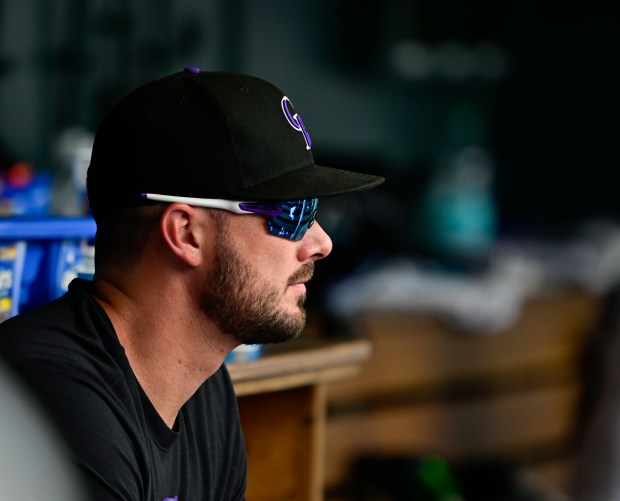 Colorado Rockies infielder/outfielder Kris Bryant watches the game against the Toronto Blue Jays at Coors Field in Denver, on Wednesday, Aug. 06, 2025. (Photo by Andy Cross/The Denver Post)
Colorado’s top six highest-paid players this year — first baseman/DH Kris Bryant ($27 million salary), pitchers Kyle Freeland ($16 million), Michael Lorenzen ($7.6 million) and Jose Quintana ($6 million), utility man Willie Castro ($5.5 million) and shortstop Ezequiel Tovar ($5.2 million) — accounted for a total of -1.0 WAR. That’s not to mention Bryant, who played zero games and looks like he might never take the diamond again due to back issues.
The contracts for Bryant, Freeland and Tovar aren’t on DePodesta. The previous GM, Bill Schmidt, signed all three.
But the point stands that Colorado has consistently whiffed on big-money deals that have contributed to the current predicament — see: Ian Desmond, Daniel Murphy, Bryant as the worst contract in Colorado sports history, and now possibly a raw deal on the struggling Tovar — and their financial decisions are light years behind the Brewers and Rays. It’s DePodesta’s job to narrow that gap.
Scouting, analytics staffs
Narrowing that gap starts with becoming smarter and more diverse in the scouting and analytics spheres, where the Rockies lag behind the 2026 World Series participants.
Tampa Bay and Milwaukee have two of MLB’s largest scouting departments, with the Rays boasting 80 scouts and the Brewers 64, according to those teams’ media guide and website. Colorado — under the direction of assistant GM Tommy Tanous, VP of Scouting Danny Montgomery and VP of International Scouting Rolando Fernandez — has 42 scouts, according to the club’s 2026 media guide.
In the analytics realm, the Brewers rank second in baseball with an analytics staff of 46, and the Rays are sixth at 39, according to Four Rings Consulting. Those rankings have the Rockies tied for last in baseball with the Athletics with an analytics staff of 11, though a club source says that number is actually 17.
 The Colorado Rockies host an end-of-season press conference with club President Walker Monfort, left, and President of Baseball Operations Paul DePodesta at Coors Field on Tuesday, October 06, 2026, in Denver, Colorado. (Photo by RJ Sangosti/The Denver Post)
That latter count would still put the Rockies well below the league average of about 29, but DePodesta signaled at the team’s end-of-season presser earlier this month that more hires are coming. That’s good news, because to get out of the abyss the club currently sits in, the Rockies need a lot more manpower.
“Some of (the improvements we are seeking) requires real investment, both in people and technology,” DePodesta said. “We’ve been given the green light to pursue each and every one of those things.”
Track record in draft, trades
One player encapsulates how much better the Rays and Brewers have been in the draft than the Rockies: right-hander Drew Rasmussen.
Tampa Bay took the pitcher in the first round in 2017, but didn’t sign him over elbow concerns following his physical. The Brewers then took him in the sixth round the next year; after Milwaukee traded him to Tampa Bay in 2021, Rasmussen has emerged as a two-time All-Star and rotational pillar for the Rays, with 15.7 career WAR.
Ipso facto, both the Rays and Brewers saw the potential in the draft in a now-elite MLB starter that the Rockies did not.
The Rockies didn’t have a first-round pick in ‘because they signed Desmond, so they didn’t pass on Rasmussen that year, but they did in ’18 when they selected six players ahead of him, including pitchers Ryan Rolison, Mitchell Kilkenny, Ryan Felt,ner and Jake Bird.
The draft is a crapshoot, but every team in baseball has been better than the Rockies at that crapshoot since 2015. Colorado has had only about 12 WAR impact its major-league club from its own draft picks in that time frame, ranking last in the majors. Rasmussen — who surpasses that tally by himself with 15.7 career WAR — underscores Colorado’s futility.
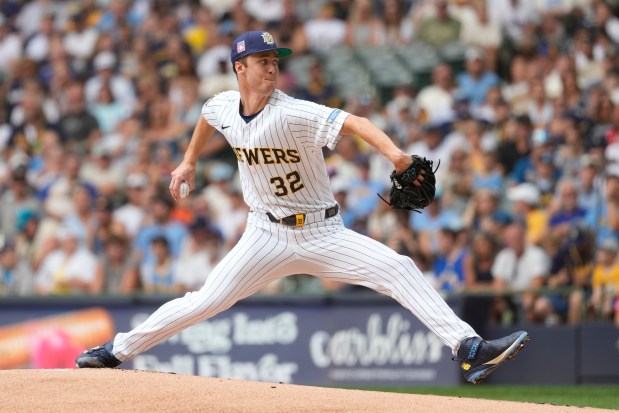 Milwaukee Brewers’ Jacob Misiorowski pitches during the first inning of a baseball game against the Colorado Rockies, Sunday, July 26, 2026, in Milwaukee. (AP Photo/Aaron Gash)
The Rays’ drafted impact players on this current World Series roster are more limited — outfielder Chandler Simpson is the headliner in that regard — because Tampa Bay’s wheeling-and-dealing helped them build a winner.
The Rays led all 2026 playoff teams in terms of players acquired via trade (16) and ’26 WAR from those trades (31.2), including Rasmussen as well as All-Star third baseman Junior Caminero. DePodesta would be a genius if he were able to accumulate traded-for talent on the Rockies roster like that. The Brewers have also been elite on the trade market, with 15 players and 21.9 WAR on its ’26 roster coming via that means.
The Brewers have also struck gold in the international market, with 8.4 WAR this season from outfielder Jackson Chourio, outfielder Luis Lara and reliever Abner Uribe. And they built themselves into baseball’s best regular-season team each of the past two seasons with 200 combined wins thanks to a host of drafted players who helped get them to the Fall Classic.
Milwaukee’s draft list is led by likely NL Cy Young Winner Jacob Misiorowski (2nd round in 2022), plus shortstop Cooper Pratt (6th round ’23), outfielder Sal Frelick (1st round ’21), right-hander Logan Henderson (4th round ’21), center fielder Garrett Mitchell (1st round ’20), and second baseman Brice Turang (1st round ’18).
Until the draft-and-develop Rockies start drafting like that, it will be a steep uphill climb in the NL West.
Style of play
The Rockies made putting the ball in play an emphasis in DePodesta’s first season at the helm, and showed improvement in that area. That improvement was led by a couple of DePodesta additions, rookie first baseman TJ Rumfield and outfielder Jake McCarthy, as well as rookie outfielder Cole Carrigg.
But this World Series is also evidence of how the Rockies’ offense and pitching must continue to evolve.
First, while the long ball is inevitable when playing at Coors Field, a barrage of homers isn’t necessary to win. Both the Rays and Brewers have emphasized speed and getting on base over power. Consider that while the Rockies were 19th in homers at 180 in 2026, the Rays were 22nd (169) and the Brewers tied for next-to-last at 154.
The Rays were also tied for second in steals at 164 and the Brewers were fifth at 162, while the Rockies were 13th at 109. And in OBP, the Brewers were first at .341, the Rays were fifth at .326, and the Rockies were seventh at .322.
 Colorado Rockies’ TJ Rumfield follows the flight of his RBI double off Boston Red Sox starting pitcher Ranger Suarez in the third inning of a baseball game Wednesday, June 24, 2026, in Denver. (AP Photo/David Zalubowski)
The Brewers in particular are adept at putting together great at-bats thanks to elite plate discipline. They drew the second-most walks in the majors with 668 (the Rockies ranked 27th with 500), had the lowest chase rate at 29.1% (the Rockies were last at 37.3%) and had the lowest swing rate at 43.7% (the Rockies had the highest at 52.1%).
Pitching-wise, Colorado could also learn a lot from the Brewers, whose bullpen has posted a scant 1.33 ERA during the playoffs.
Milwaukee’s overall staff is one of the highest-velocity staffs in the game, headlined by Misiorowski’s record-setting heat, and that has contributed to their pitching prowess. And the Rays are adept at pitch development: just look at how Griffin Jax with Cherry Creek/Air Force roots went from a three-pitch reliever to an effective six-pitch starter this season.
Along those lines, the Rockies rotation is a bunch of soft-tossers compared to the Brewers. None of the Colorado starters averaged over 95 mph on their fastball. Colorado’s hardest-throwing starter in 2026 was Feltner, who was 52nd percentile in baseball with a 94.6 mph average, and the eight Rockies pitchers who made six or more starts averaged 92.5 mph.
So the Rockies can’t blow anybody away, and on top of that, the club has not proven it can develop elite pitching in the rotation or the bullpen.
Here’s hoping that DePodesta sits down in front of his TV on Friday with a blank notebook and a pen. Because these rebuilding Rockies have a lot to learn from the perennially overachieving Brewers and Rays.
Want more Rockies news? Sign up for the Rockies Insider to get all our MLB analysis.