
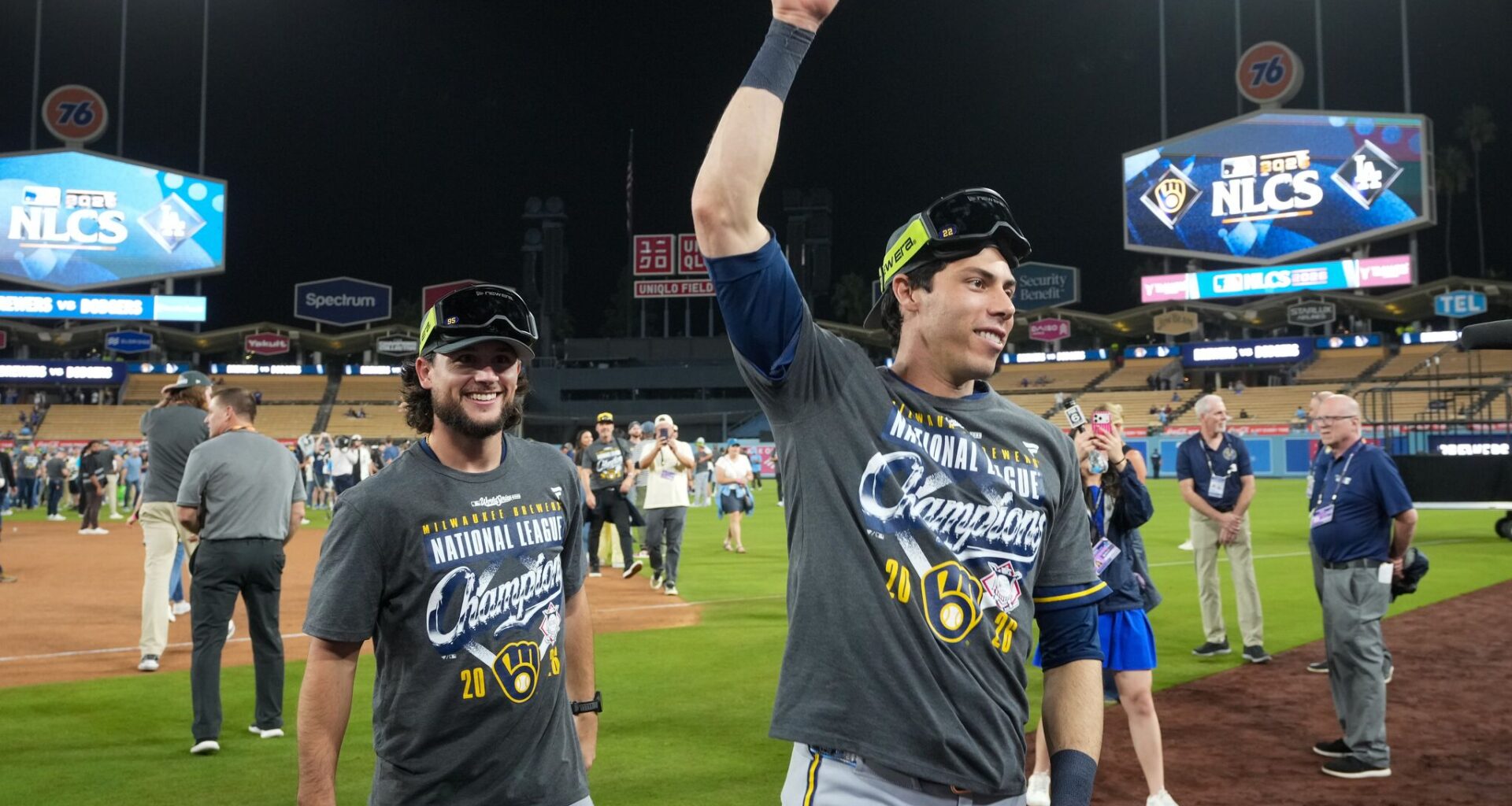
Milwaukee Brewers designated hitter Christian Yelich celebrates after Game 4 of baseball’s National League Championship Series between the Milwaukee Brewers and the Los Angeles Dodgers, Thursday, Oct. 15, 2026, in Los Angeles. (AP Photo/Gregory Bull)
Gregory Bull/AP Photo/Gregory Bull
Suddenly, luxury-taxed payrolls aren’t in vogue anymore.

The Tampa Bay Rays and Milwaukee Brewers — two teams with slight budgets who prioritize analytics and strategic offensive approaches — will play for a World Series. The way each team was built, and the way each team plays on the field, buck recent big-box trends in a bevy of ways.
Texas Rangers President of Baseball Operations Chris Young answered questions from the media during their season ending press conference at Globe Life Field in Arlington, September 28, 2026. The Rangers failed to make the playoffs.
Tom Fox/The Dallas Morning News
Can the Rangers learn anything from this?
Article continues below this ad
Sure, if the Rangers can swing an under-the-radar trade that nets them a young superstar (like the Rays did for third baseman Junior Caminero), find a potential generational arm in the second round of a draft (like the Brewers did with right-handed pitcher Jacob Misiorowski) or build premium rosters on a budget (the Brewers ranked 19th in payroll and the Rays ranked 28th), that’d help, too.
The infrastructure that has allowed the Brewers and Rays to maximize and develop talent on a budget takes years to build, though, but their on-field approaches might be easier to borrow from for a team still in need of a solidified offensive identity. Rangers president of baseball operations Chris Young said the team needs to become “more athletic and more dynamic” at his end-of-year news conference. The Brewers and Rays serve as examples of what that looks like, and for the Rangers, an example of what they could try to emulate.
Texas Rangers President of Baseball Operations Chris Young (center) and General Manager Ross Fenstermaker (right) listens to Manager Skip Schumaker respond to a question from the media during their season ending press conference at Globe Life Field in Arlington, September 28, 2026. The Rangers failed to make the playoffs.
Tom Fox/The Dallas Morning News
Base running matters: The Brewers and Rays get the most juice for their squeeze on the base paths. The Brewers ranked fourth league-wide in base running value, the Rays tied for ninth and the Rangers ranked below average. The Brewers made 483 extra-base advance attempts (fourth-most), the Rays 445 (10th-most) and the Rangers 366 (30th-most). The Brewers finished first in run value via extra bases taken, the Rays finished seventh and the Rangers finished league average. The Brewers went first-to-third on a single the fourth-most times, the Rays went the seventh-most times and the Rangers went the fewest times.
We haven’t even gotten to stolen bases — where the Rays finished with the second-most bases league-wide, the Brewers finished with the fifth-most and the Rangers finished with the 26th-most — though the point has been made.
Article continues below this ad
The Brewers were the fastest team in baseball by sprint speed this season (28.1 feet per second) while the Rays weren’t far behind (27.5 feet per second). The Rangers were below league average at 27.2 feet per second, which doesn’t necessarily aid movement on the base paths, but speed is only one factor. Brewers first baseman Jake Bauers had a 54% extra-base-taken percentage (well above league average and better than every Rangers player) despite a below-average sprint speed. Rays infielder Richie Palacios stole 17 bases (which would’ve tied Rangers outfielder Evan Carter for the team lead) also despite a below-average sprint speed. On both the Brewers and Rays, eight different players stole at least eight bases, while on the Rangers, only three did.
When everyone goes one way, they go the other: We mean, quite literally, in the batter’s box. The Brewers (26.5%) and the Rays (25.4%) ranked first and second league-wide in opposite-field batted balls this season. This makes batters harder to exploit, forces pitchers to use the whole zone and stretches defenses. It also allows offenses to be less reliant on pull-side power and slugging, which is an approach that is easier for a pitcher to exploit, and one that can lead to blackouts.
Just look at the Brewers and Rays who, despite below-average home run totals or hard-hit percentage marks, ranked fourth and seventh league-wide in on-base plus slugging percentage. The Rangers slugged more home runs and hit the ball harder than both of them, for what it’s worth, but scored far fewer runs than each. This is not to say that home runs are bad, or that there isn’t a correlation between exit velocity and offense, but it is to say that a diversified approach at the plate is better than a one-trick pony plan of attack. In 2023, under the direction of manager Skip Schumaker, the Miami Marlins led baseball with a 27.1% opposite-field batted-ball percentage and reached the playoffs that season.
The Rangers aren’t entirely far off. They prioritized the middle of the field and went the opposite way at an above-average clip. The difference is situational: the Rangers were more pull-happy with runners in scoring position than they were with the bases empty while the Brewers stuck to an all-fields approach in both scenarios. The Brewers were baseball’s best offense with runners in scoring position; the Rangers were league average.
Bigger is not always better: Schumaker and the Rangers already know this, but it’s important to reinforce. The Rays led baseball in sacrifice hits (45) and bunt hits (49). The Brewers ranked top five in both categories. The Rangers actually finished fourth league-wide with 39 sacrifice hits, and when they employed that strategy more vigorously midseason, it allowed them to manufacture runs without the necessity of slugging the baseball. Schumaker, a National League manager at his core, ran this play effectively with the Marlins three years ago when they reached the postseason.
Article continues below this ad
It is, of course, easier with the proper personnel. Rays outfielder Chandler Simpson and Brewers infielder David Hamilton led their respective teams in bunt hits this thanks in large part to their 95th percentile speed. On this year’s Rangers roster, only Carter, infielder Cam Cauley and utility player Ezequiel Duran were nearly as quick, and only one of those players should be guaranteed close to everyday starts next season. That’s why, among other reasons, a more athletic roster should be a priority for the Rangers in the future.
That said, the Rays yielded a combined 41 bunt hits or sacrifices from infielder Taylor Walls and outfielder Cedric Mullins this season, two players who posted only above-average sprint speeds. Elite small ball — much like elite base running — is not inherently reserved for burners.