
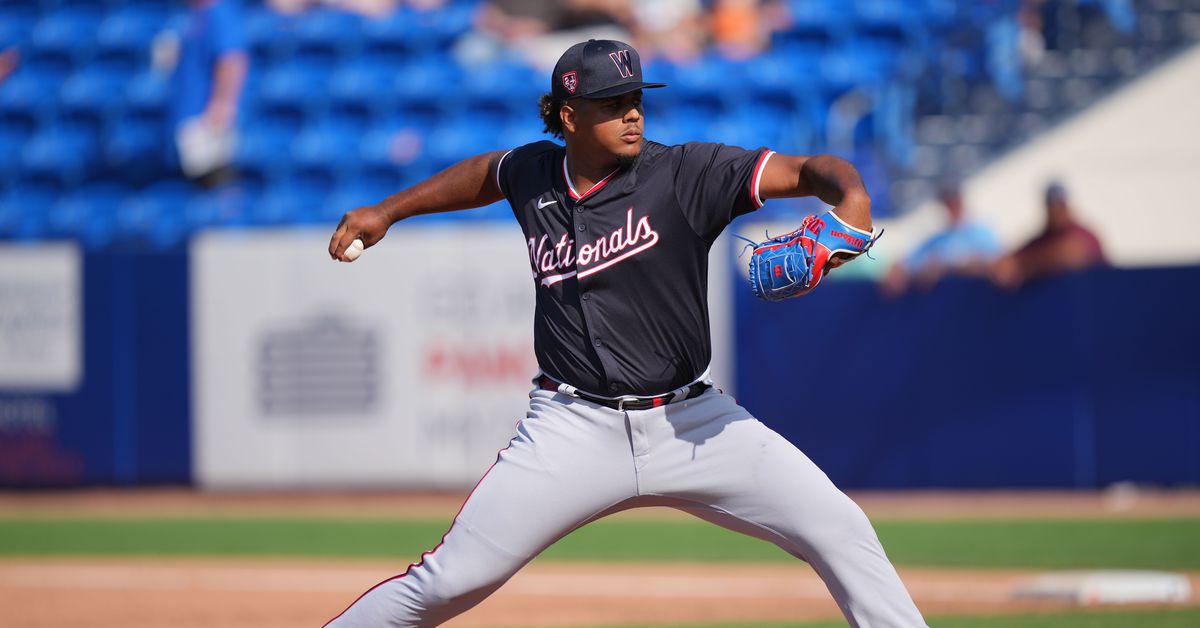
Three years after acquiring MacKenzie Gore, the Nationals are finally seeing him blossom into a true frontline starter in 2025. At the plate, young stars CJ Abrams and James Wood are turning heads with breakout seasons, while arms like Cole Henry and Brad Lord are emerging as potential long-term bullpen pieces. With all of these developments falling into place, one question remains: Who else can the Nationals count on to take the ball every fifth day?
With lots of questions surrounding the rotation, one thing is certain: Washington has options. With some big league arms showing some promise and minor league talent progressing quickly, Washington could have answers soon and figure out their biggest issue.
Here is a breakdown of potential options for Washington’s rotation past the 2025 season.
Irvin is entering his third season with Washington and before this season, he was viewed as a potential replacement for the new starters. After starting 57 games in his first two seasons, 2025 was supposed to be another year of filling innings. However, Irvin has been much more than that and has been one of the biggest contributors to their rotation. The 28-year-old is posting career highs across the board and is on pace to accumulate more WAR this season than in his entire career before 2025.
There are concerns with Irvin’s game. Looking into his advanced numbers, his xERA is at 5.07, xBA is at .282, and xSLG is at .515, which is near the bottom in terms of starters. Even though he has a six-pitch arsenal, all of his pitches have an xSLG of over .400.
The right-hander is a ground ball pitcher and he doesn’t have a go-to pitch he can work off of. Even though I don’t think he can be at the top of a rotation, he has pitched well this season, and I can see him earning a spot in the back half of the rotation in the future.
Verdict: Back-end Rotational Piece
Just like Jake Irvin, Mitchell Parker has been a starter since he came up with Washington last season. Parker started the season, causing people to speculate if he could be a long-term option in Washington. He has since struggled, holding a 4.71 ERA and fans are back to questioning if he has a future in this rotation. He has been around a league-average pitcher the past two seasons, and his Baseball Savant looks very similar to Irvin: Low velocity and low strikeout rate. If Parker can find consistency with how he played at the beginning of the season, there is an argument for him to secure a spot in the rotation.
However, I do not see that happening. The 25-year-old has one of the worst strikeout rates in baseball, his walk rate has jumped three percent since last season, and his hard hit rate has risen almost ten percent since last season.
He is still 25 years old and has shown flashes of being a decent big-league starter, but as of right now, I see no rotation spot for Parker in Washington’s future.
Verdict: Not a Long-Term Fit
Jarlin Susana has grown into one of Washington’s top prospects since being shipped alongside MacKenzie Gore and CJ Abrams for Juan Soto. When initially signed by the San Diego Padres, he was ranked MLB Pipeline’s top pitcher in the 2022 international class. He is currently the No.2 ranked Washington Nationals’ prospect and the No. 65 MLB prospect rankings. He has risen through the ranking due to his overpowering fastball and a perfect complimenting gyro-slider to go along with it.
The question is: Will Susana stick as a starter or will he be turned into a lethal closer? The fastball/slider combo is particularly popular among closers and Susana has the talent to be a top bullpen arm. He has struggled with his command throughout the minors, especially this season, nearly holding a 2:1 strikeout-to-walk ratio. He played very well in Rookie ball in 2022, posting a 2.34 ERA between the two teams. However, he has since posted an ERA lower than 4.15 and is currently posting a 1.69 WHIP.
At 6-foot-6, 235 pounds Susana is a towering and intimidating pitcher. As fun as it would be to see him succeed as a starter, I believe he profiles better long-term as a closer and could become one of Washington’s top bullpen performers.
Verdict: Future Lockdown-Closer
Drafted in the third round of the 2023 MLB Draft by Washington, Sykora has slowly been climbing through the minor leagues this season. He is a few spots ahead of Susana, sitting at No. 61 on MLB’s top 100 prospects list and Washington’s No.1 rated prospect. Sykora has been nothing short of spectacular, holding a 0.47 ERA through six games in three different leagues. He was sensational in 2024 as well, posting a 2.33 ERA through twenty starts, and showed his strikeout potential, finishing the season with 13.7 SO/9.
Sykora has a long way to go before he hits the Major Leagues. Just a month removed from turning 21 years old, he needs to show he can be this consistently good against better competition. Sykora’s scouting grades indicate he has a very balanced pitching arsenal, with his best pitch being his fastball. His arsenal doesn’t scream “ace” potential but it shows the potential of a high floor in the big leagues.
There is no question that if Sykora continues this level of play, he could earn a spot at the top of the rotation in Washington. It is uncertain when he will enter the big leagues, however, if he continues to grow and adapt the way he has, he could be up a lot sooner than people think.
Verdict: High-Floor Starter
Conclusion:
MacKenzie Gore has emerged as the centerpiece of Washington’s future rotation. Fortunately, the Nationals have several internal options who could fill out the rest of the staff. While the future remains unpredictable, with potential signings and rising prospects sure to shake things up, Washington is in a good place. Some in-house arms are showing signs of long-term potential, while others may ultimately fall short of a rotation role. Either way, the foundation is forming and that’s a promising sign for what’s ahead.