

The baseball world lost another Minnesota great this week when Appleton, Minn., native and 1969 World Series winner Jerry Koosman died on October 31.
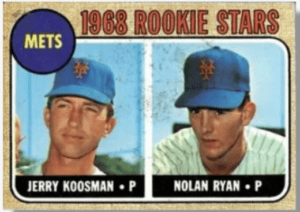
Most young baseball fans today know Koosman as the other guy on Nolan Ryan’s 1968 Topps rookie card. However, for many Minnesotans who grew up watching him, he was much more than that.
Jimmy Lonetti, owner of D&J Glove Repair in Minneapolis, was one of those young Minnesotans who grew up a fan of Koosman’s 19-year career. Although Koosman played only two-and-a-half years with the Minnesota Twins from 1979 to 1981, Lonetti still saw a handful of Koosman’s starts as a Twin at the Old Met.
Lonetti first learned about Koosman through his 1971 Topps card during his card-collecting days. What stood out most to Lonetti, beyond being a star on the 1969 Miracle Mets and two All-Star appearances, was Koosman’s hometown of Morris, Minn. He knew it best as a college town home to the University of Minnesota-Morris, but he could add Koosman to the list. That made it even cooler to Lonetti, knowing a guy from a small Minnesota town could become a World Series champ.

“As I reached high school age, my baseball card collecting had ended and playing baseball and closely following the Twins had been replaced by soccer (the Kicks!), girls and parties,” Lonetti recalled.
“My high school friends and I still had a tradition, though, to skip school on the day of the Twins home opener to go to the game at the old Met. For the 1979 home opener, we did get to see Jerry as the starting pitcher for the Twins. The game was against the Angels, and Rod Carew returned to the Met in front of over 37,000 fans. Koosman was outpitched by Frank Tanana, and the Twins lost 8-1.”
The Twins acquired Koosman from the New York Mets in a trade in December 1978, just two months before the Twins traded Carew to the California Angels. The history books may see Minnesota’s acquisition of Koosman as an upgrade to start that 1978-79 off-season. However, Lonetti recalls it was not quite the case for himself or many Twins fans when the trade went down.
“At that point for many Twins fans, even before the Carew trade, dissatisfaction with Calvin Griffith had already been pretty well established,” Lonetti said, “and truthfully any player moves he made were looked through the lens of him probably just trying to save money (whether true in the Koosman case or not).”
Griffith had more of a reputation for parsimony back then than the Pohlad family did in their years owning the Twins after taking over in 1984.
The Koosman trade had also come three months after Griffith’s infamous meeting with the Waseca, Minn., Lions Club, where he made racist comments about why he moved the Twins to Minnesota, given the small Black population in Minnesota at the time of the move from Washington in 1960.
Those comments ended Carew’s playing time in Minnesota, especially after Griffith called him a ‘damn fool’ for not taking a below-market salary. So Koosman’s Twins tenure came in when the franchise was at an all-time low in the Griffith ownership era.
Fortunately, his bad start on Opening Day of 1979 was just that. He pitched around Carew in his return to Minnesota, going 0-for-2 with three walks. Koosman, along with Roy Smalley, was one of the two bright spots on the Twins’ 1979 team.
Koosman was a 20-game winner in 1979, marking the 10th time in Twins history the team had a 20-game winner. That 79 season was the highlight of Koosman’s time in his home state. He pitched to a 3.38 ERA, 130 ERA+, 1.33 WHIP, and struck out 157 batters in 263 ⅔ innings.

The rest of Koosman’s tenure wasn’t as memorable. He had an ERA over four in both 1980 and 81, and Griffith traded Koosman to the Chicago White Sox on August 31, 1981. The Twins received three minor leaguers, only one of whom would briefly reach the majors: Randy Johnson. (No, not that one).
“Along with Dave Goltz, I viewed Jerry Koosman as a dependable veteran presence on a Twins pitching staff made up of young, unproven arms and older retreads,” said Lonetti. “I always think of him fondly as a ‘Minnesota kid done good.’ Kind of like other Minnesotan-born Twins pitchers like Charlie Walters and Dick Stigman.”
While Koosman’s passing leaves a massive hole in the baseball world, his legacy of a small-town Minnesotan who became one of the best left-handed starters from the late 1960s to the end of the 1970s will never be forgotten.
In 2026, 16 Minnesota-born players played in the majors, but only Caleb Thielbar and Brandon Williamson were from small towns (Randolph and Fairmount). Still, plenty more are in the minor leagues, hoping to create the same legacies for their towns that Koosman did for Morris.