
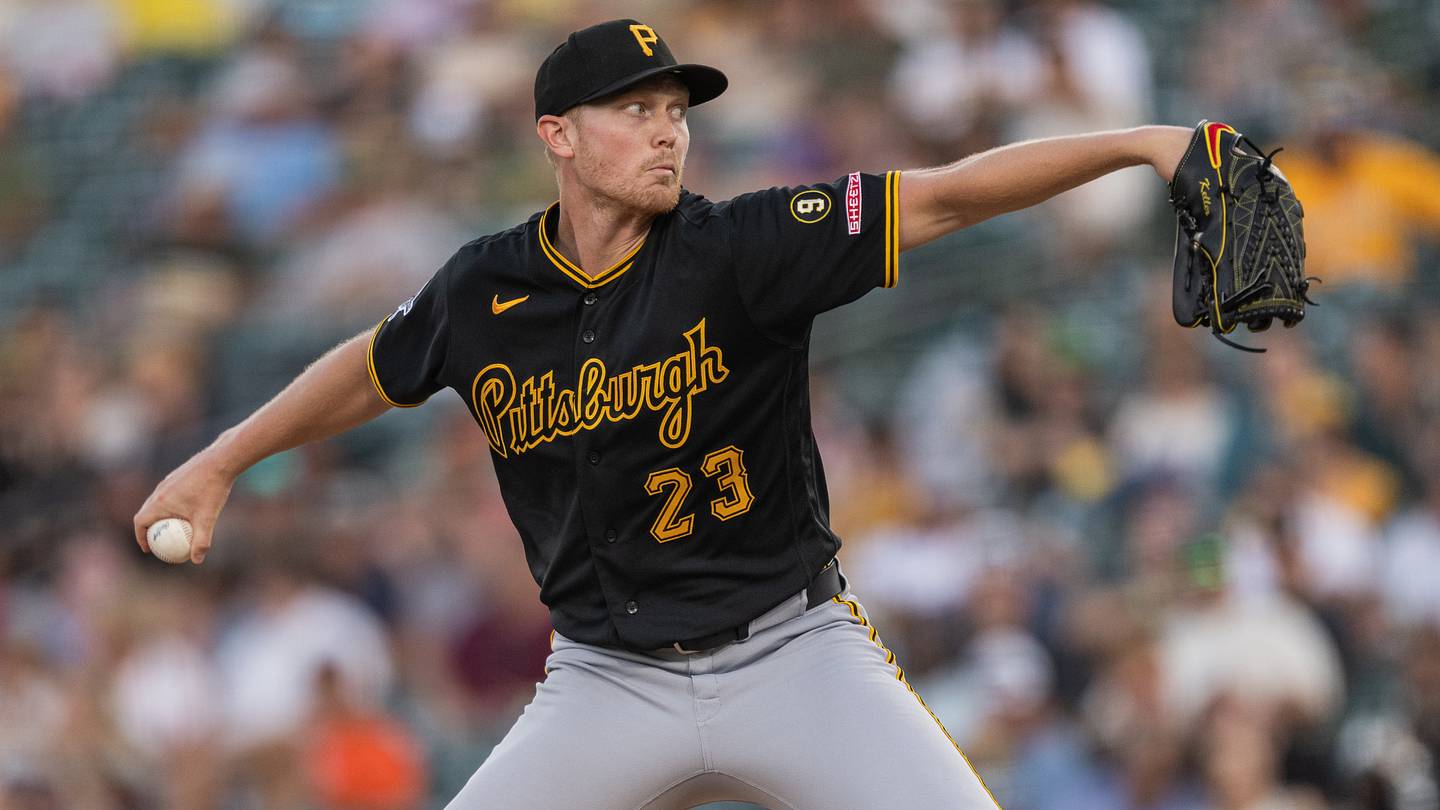
The Pittsburgh Pirates enter this week’s GM Meetings in Las Vegas with a familiar problem: They need to improve their roster without sacrificing the young talent that makes their future promising.
General manager Ben Cherington has several avenues to explore, but the trade market could become particularly important with a potential MLB lockout looming on Dec. 1.
The Pirates have some obvious trade candidates. They also have a few less obvious ones who might actually command significantly better returns. Mitch Keller and Bryan Reynolds have contracts that could make them attractive to a payroll-conscious front office looking to create financial flexibility. Meanwhile, players like Carmen Mlodzinski and Nick Gonzales offer something that might be considerably more appealing to opposing organizations: affordable production and multiple seasons of team control.
So, which Pirates players could realistically generate trade discussions at the GM Meetings? And more importantly, what could Pittsburgh actually expect to receive in return?
Here are five candidates, ranked from lowest to highest based on their potential trade value rather than their likelihood of being moved.
Pirates’ 5 most likely GM Meetings trade candidates, ranked by potential return5. Mitch Keller, RHP
Keller might be Pittsburgh’s most obvious trade candidate, but that doesn’t mean he’s particularly valuable right now.
The 30-year-old right-hander is coming off his worst season in years, posting a 5.29 ERA across 22 starts before a teres major injury ended his campaign in August. That’s an unfortunate combination for a pitcher owed approximately $38.8 million over the next two seasons.
Keller’s previous durability and established track record should generate some interest, particularly among teams desperate for starting pitching. But opposing executives aren’t going to ignore his recent performance, injury concerns or remaining financial commitment.
Movin’ on up! 📈
With this K, Mitch Keller passed Dock Ellis on the Pirates strikeout leaderboard (now 9th) pic.twitter.com/aTXMFii5h6
— SportsNet Pittsburgh (@SNPittsburgh) May 7, 2026
The Pirates might view trading Keller as an opportunity to redirect nearly $39 million toward other roster needs. Potential trade partners, however, could view taking on that contract as a significant risk. Unless Pittsburgh is willing to absorb some salary, the return might be underwhelming.
Realistic trade value: A modest prospect return or a change-of-scenery player, with salary relief potentially representing Pittsburgh’s biggest benefit.
If Cherington expects another organization to surrender legitimate young talent while absorbing Keller’s entire contract, he might be disappointed.
4. Henry Davis, C
There’s a difference between what the Pirates invested in Davis and what another organization would be willing to surrender to acquire him.
The former No. 1 overall pick hit just .172/.272/.313 with 10 home runs in 2026. His offensive development remains one of the organization’s more frustrating disappointments, especially considering the expectations that accompanied his arrival.
But Davis isn’t completely without value. His defensive improvements have been substantial, and reliable catching remains a valuable commodity across baseball. Davis is also projected to earn just $1.4 million through arbitration, making him a relatively inexpensive option for teams seeking depth behind the plate.
Meanwhile, the Pirates have Rafael Flores Jr. emerging as a legitimate major league contributor and Endy Rodríguez working his way back from hip surgery. That doesn’t necessarily make Davis expendable, particularly given the questions surrounding Rodríguez’s health. But it creates enough uncertainty for Cherington to entertain conversations.
Davis reportedly attracted interest around the trade deadline, suggesting other organizations haven’t completely abandoned the possibility of unlocking more offensive production.
HENRY DAVIS. CLUTCH 😤 pic.twitter.com/RYYLYEtzWv
— SportsNet Pittsburgh (@SNPittsburgh) September 1, 2026
Realistic trade value: A lower-level prospect with upside or another controllable player in need of a fresh opportunity.
The Pirates shouldn’t expect anything resembling the value of a former first overall selection. At this point, Davis’ value comes from his defensive ability, affordability and whatever offensive upside another team believes remains.
3. Carmen Mlodzinski, RHP
This is where Pittsburgh’s potential trade assets become considerably more interesting. Mlodzinski doesn’t have Keller’s name recognition or Reynolds’ established offensive résumé, but he possesses several qualities that make him attractive on the trade market.
The 27-year-old right-hander finished 2026 with a 3.95 ERA across 123 innings, making 12 starts and 25 relief appearances. He’s projected to earn just $1.6 million through arbitration and remains under team control through 2029. MLB Trade Rumors ranked Mlodzinski No. 30 on its list of the offseason’s top 40 trade candidates, recognizing the appeal of a pitcher who can contribute in multiple roles.
With Paul Skenes, Jared Jones, Braxton Ashcraft and Bubba Chandler occupying important spots in the Pirates’ future plans, Mlodzinski doesn’t have a clear path to a permanent starting role. He has expressed interest in starting, and another organization could offer him an opportunity Pittsburgh can’t guarantee.
Realistic trade value: A useful, controllable major league contributor or a prospect with a credible path to the majors, depending on how strongly another team values his starting potential.
The Pirates have walked on eggshells around Carmen Mlodzinski trying to cater to his desire to be in the rotation
He has gotten the opportunities he wanted, but has failed to make the most of them.
Is there any case that he should continue to be a starter in 2027? pic.twitter.com/ROM84OPly8
— Bucco Territory (@BuccoTerritory) August 20, 2026
Unlike Keller, Mlodzinski wouldn’t require Cherington to convince another organization to overlook a substantial financial obligation. His affordability is part of the appeal.
The Pirates shouldn’t trade him simply because they have other pitchers, but he might be one of their best opportunities to turn pitching depth into offensive help.
2. Nick Gonzales, INF
If the Pirates were evaluating trade candidates strictly on their 2026 offensive production and years of control, Gonzales would have a compelling argument for the top spot.
The former first-round pick hit .303/.367/.388 with 167 hits, becoming one of Pittsburgh’s most reliable offensive contributors. He’s also projected to earn just $3.1 million through arbitration and remains under team control through 2029.
That combination should appeal to teams looking for an affordable second baseman capable of making consistent contact and getting on base. However, Gonzales struggled defensively at third base, finishing with minus-15 Defensive Runs Saved and minus-11 Outs Above Average.
Gonzales simply hasn’t demonstrated that he can be an effective everyday option at the position. His lack of power also limits his offensive ceiling, particularly if another organization views him as a third baseman rather than a second baseman.
If the Pirates manage to re-sign Brandon Lowe, Gonzales could become a legitimate trade candidate as Pittsburgh attempts to resolve its infield logjam. If Lowe leaves, however, Gonzales could be the club’s most logical replacement at second base.
Realistic trade value: A meaningful major league contributor or a respectable prospect package, particularly from an organization with a clear need at second base.
Gonzales has far more value than a throw-in, and the Pirates shouldn’t entertain offers that treat him like one. But his offensive profile and defensive limitations also mean his .303 batting average shouldn’t be mistaken for proof that he’s an established star.
Trading Gonzales could be worthwhile in the right circumstances. Doing so before resolving Lowe’s future, though, could create another unnecessary hole in Pittsburgh’s lineup.
1. Bryan Reynolds, OF
Reynolds might be the most complicated name on this list, but he’s also the player who could plausibly generate the most substantial return.
After a disappointing 2025 season, the veteran outfielder rebounded in 2026, hitting .261/.365/.424 with 17 home runs, 72 RBI and a major league-leading 40 doubles. He played all 162 games, providing consistency and durability to a Pirates lineup that frequently struggled to sustain offensive production.
Bryan Reynolds goes yard again!
His second homer of the game brings the @Pirates level 🏴☠️ pic.twitter.com/2pT7B3qErq
— MLB (@MLB) June 17, 2026
Reynolds is also under contract through 2030, with approximately $61 million remaining on his deal, plus a club option for 2031. That financial commitment complicates his trade value, especially as he approaches his age-32 season. But it also provides acquiring teams with cost certainty rather than requiring them to negotiate a new contract.
Reynolds isn’t the same player who once inspired blockbuster trade speculation, and the Pirates shouldn’t expect another organization to surrender multiple elite prospects for him. Still, a switch-hitting outfielder coming off a productive, healthy season carries legitimate value.
Realistic trade value: An MLB-ready contributor and potentially an additional prospect, depending on how much of Reynolds’ contract the acquiring club assumes.
The bigger question is whether Pittsburgh should entertain moving Reynolds at all. Losing Lowe would already remove a significant portion of the Pirates’ offensive production, and trading Reynolds without securing an adequate replacement would only make an already difficult situation worse.
Reynolds, like any of these potential trade candidates, should be available only if the return actually improves Pittsburgh’s chances of competing.
 Add us as a preferred source on GoogleFollow