
In 2020, then-St. Petersburg Mayor Rick Kriseman put out a request for proposals to build a new baseball stadium for the Tampa Bay Rays and transform the surrounding 86 acres where a Black neighborhood called the Gas Plant District once stood.
Five years and two collapsed deals later, the dream of replacing the now-dilapidated Tropicana Field seems all but dead. But as that door closes, it opens the possibility for a whole new kind of development in the historic Gas Plant District.
“We’re excited and grateful to start with a look at these parcels of promise, 86 acres that await our community’s imagination on how they will catapult this whole city on the margin from a great, to an iconic place,” said Kanika Tomalin, President and CEO of the Foundation for a Healthy St. Petersburg.
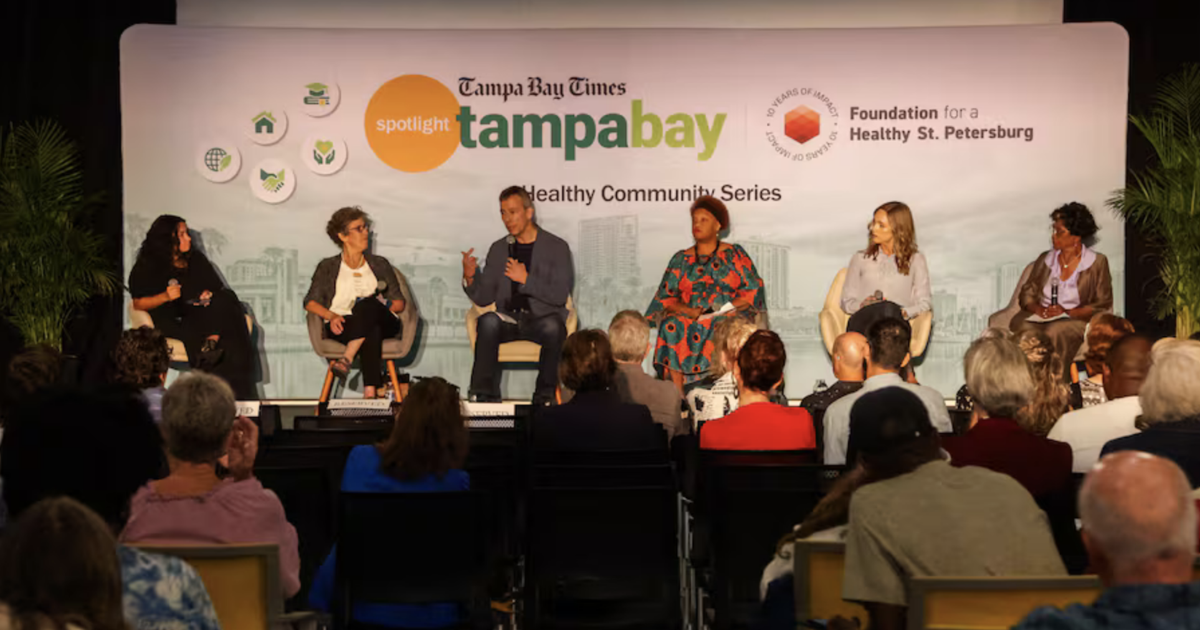
Her foundation, in partnership with the Tampa Bay Times hosted a community conversation June 3 to discuss what the city’s most hotly-debated vacant lot could become, without baseball.
Five experts joined a panel moderated by Colleen Wright, a reporter for the Tampa Bay Times who covers the City of St. Petersburg. They were:
• Jillian Bandes, a local developer and executive board member at Urban Land Institute Tampa Bay
• Mozell Davis, a longtime educator and 92-year-old native of St. Petersburg
• Erica Hall, a community organizer and member of the Sierra Club’s board of directors
• Peter Kageyama, urbanist and author of “For the Love of Cities”
• Elizabeth Strom, an associate professor at the University of South Florida who teaches about the role arts and entertainment plays in cities and affordable housing.
Here are some of the biggest takeaways from the discussion.
The community must play a role in development
What started as a robust community benefit agreement as part of the last stadium deal ended up getting “watered down,” in favor of the interests of business owners and developers, said Hall.
This time around, she would like to see a more inclusive planning process that is spearheaded by a diverse collective of neighbors, not just the people who stand to make money off the project.
Bandes argued that an entirely community-led project would be challenging because of the sheer size of the site and the immense capital required.
She said a master-plan developer should be appointed to lead the way.
Still, she agreed “it’s hard to move forward after everything that happened,” adding that the only way is through another request for proposal process, this time “one that actually respects the community.”
In order to achieve that and regain some of the trust that’s been broken, “the city could provide more clarity on the decisions it’s making and why,” Davis said.
When asked if the future of the site should be put to a referendum, all panelists agreed that the topic was too complicated to boil down to a simple yes or no vote.
At least some of the land should remain public
In her “fantasy world,” Strom said the entire 86 acres would be placed into a community land trust, with all the profits streaming back to the city.
But she admits, that’s extremely unlikely.
A more realistic compromise could allow the city to maintain ownership of some land for things like parks and affordable housing and sell some to companies who can build hotels, restaurants and more.
“There’s 86 acres,” said Bandes. “You can divvy it up and have some public-private partnership.”
The plan must honor the history of the Gas Plant District
Decades before the Tampa Bay Rays came into the picture, the City of St. Petersburg razed the historically Black Gas Plant District, promising to eliminate blight and bring new homes and light industry.
That never happened. Eventually Tropicana Field was built instead.
What was lost was “a city within a city,” said Davis. She remembered the Gas Plant District as a thriving community complete with schools and nurseries, shops and restaurants, entertainment venues, doctors offices, funeral homes and lawyers offices, all run by and for Black families.
Davis said she would like to see that history researched, documented and preserved at a revamped Woodson African American History museum that will be built on the site.
Strom said the new development should include a mix of symbolic gestures — like historical plaques, and buildings named after former residents — and concrete community benefits such as work-training programs, hiring requirements for minority businesses and affordable housing.
When asked whether former Gas Plant residents should be granted some form of reparations, Kageyama said it’s something that should be explored.
“If there’s a way to constructively say ‘I’m sorry’ then we absolutely should figure out a way to do that,” he said.
While preparing for the needs of the future
Several panelists said a significant chunk of the land needs to be dedicated as parkland. This will be particularly important as the downtown becomes more dense with taller buildings.
They also highlighted the importance of eliminating the stretch of Interstate 175 that cuts the city in half and re-connecting the Gas Plant District back to the street grid.
Kageyama said that the property should be less car-centric, with fewer dedicated parking spaces. This would cater to growing demand from young people who want to live in walkable neighborhoods.
Hall mentioned the importance of creating a district that was storm resilient and environmentally friendly. She said she would like to see improvements like a micro-grid for emergency response and buildings that can withstand a category 5 hurricane.
Trying to anticipate what future residents will want from a neighborhood that won’t be completed for several decades can be tricky.
That’s why Strom said the project needs to be developed piece by piece instead of all at once.
“Phasing this, because it will take a while, also means you have a chance to go back to the drawing board if something you had anticipated as being a positive thing turns out not to be a positive thing.”
In Kageyama’s view, the city has nowhere to go but up.
“Anything is going to be better than a parking lot and an ugly stadium,” he said.