
Occasionally the “3 Astros Things” category provides an opportunity to look at a few statistical tid bits related to the Astros. So, here we go:
Astros current favorites for the AL West title?
Every so often we check in on the Astros’ current playoff odds generated by the Fangraphs model. The Astros currently have 76% playoff odds and 59% odds of winning the AL West. Both the Mariners and Rangers have much lower divisional odds: 32% and 9%, respectively. If the Fangraphs WAR model is used, the Astros Division odds are even better (64%), with an accompanying 80% odds of making the playoffs.
The relative odds can turn on a dime, so this trend may or may not continue. But at the moment the probabilistic model likes the Astros’ chances. Given the Astros’ injuries—both in the rotation and the lineup—the Astros are fortunate to be favored.
2. Astros’ Rookies.
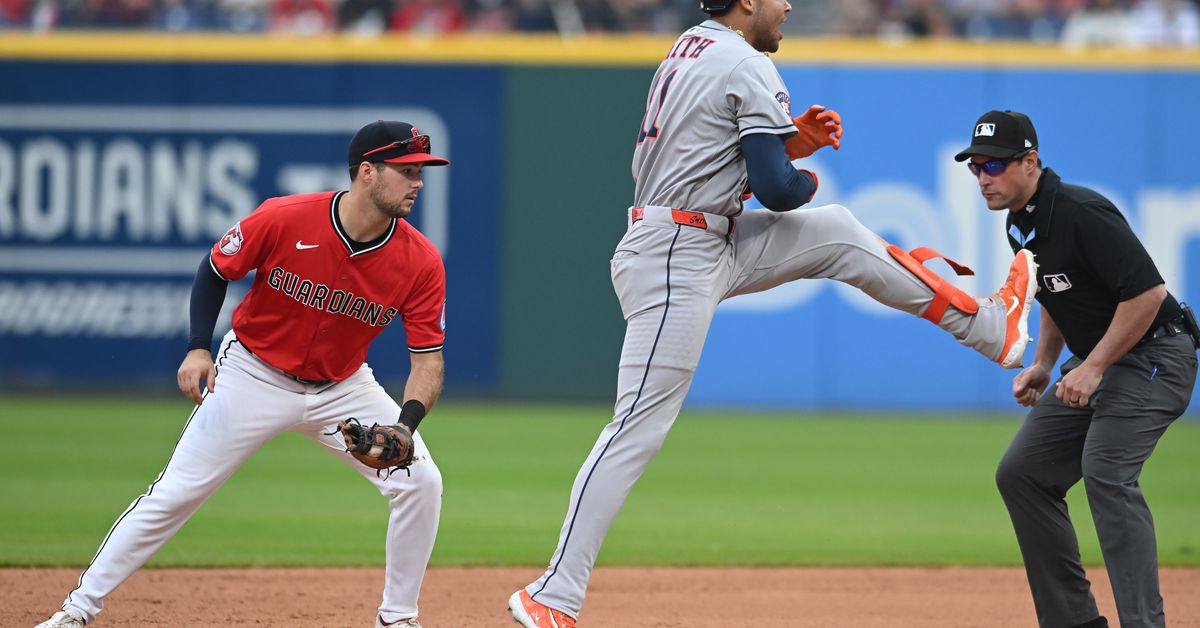
Even though some big names like Bregman and Tucker are gone, we also have some rookies to follow who are making contributions. Zach Dezenzo and Cam Smith are the notable rookie outfielders. Let’s compare their ranking among MLB rookies.
Cam Smith is 8th in WAR (0.8), and Dezenzo is a more distant 19th. Smith and Dezenzo are 13th and 14th, respectively in wRC+ (at 101 and 99). Smith and Dezenzo are also 12th and 14th in OBP with .326 and .321 OBP, respectively. Smith also grades a nice 8th ranking in RBIs, which seems relatively high for a guy who doesn’t play everyday. These rankings are pretty good, but not really close to rookie of the year contention.
Cam and Zach also have a notable negative stat ranking among rookies. Dezenzo has the worst K rate among qualified rookies at 32.9%. Smith has the 8th worse K rate among rookies (29.4%). Zach’s poor K rate perhaps is somewhat offset by his 10.1% BB rate, which is 10th best among qualified rookies.
Given the injuries in the rotation, the Astros also have relied on rookies in the rotation. Among rookie pitchers, Colton Gordon holds the 9th best expected ERA (x-ERA) at 3.15. Gordon’s actual ERA may be in the 5+ range, but his peripherals are quite good. In addition to the 3.15 x-ERA, Gordon’s FIP and x-FIP are a respectable 3.68 and 3.28. Colton also ranks 13th among rookies in SIERA (3.30). At this point, Colton Gordon has been one of the best rookie pitchers based on his peripherals, and this should give the Astros hope that he can continue contributing in the rotation.
3. LMJ has given up some hard hits.
Lance McCullers, Jr. has allowed the second highest Hard Hit Percentage in the MLB (55%). My initial reaction was that this ranking is overly influenced by a couple of bad initial starts. But Lance’s hard hit rate for May and June is still fairly high (64% in June). This is something to watch, since McCullers isn’t really an extreme ground ball pitcher (like Framber).
McCullers is 20th in exit velocity on the fly balls and line drives he has allowed (96.5). But he isn’t alone in allowing hard contact in the air. Bryan Abreu is ranked the 6th highest in exit velocity on flies and line drives (97.5). One thing McCullers and Abreu have in common is a high K/9 rate (12.28 and 11.48 respectively), and the K-rate may insulate them from hard contact damage to some extent.
On the other side of the quality of contact issue is Hunter Brown. Brown has the 6th lowest EV50 in the MLB (72.4). Bryan King, Hunter Brown, and Josh Hader have the lowest hard hit percentage on the Astros (30.1%, 30.0%, and 25.0% respectively). Twenty years ago, some people argued that FIP is not a good metric because it is unfair to “soft contact” pitchers. But the advocates of FIP responded that FIP may be a good proxy for soft contact pitchers (i.e., pitchers who induce swing and miss probably get more mis-hits when contact is made).
I’m not sure there is an answer to the soft contact vs. FIP question. But in this case, the Astros pitchers with the lowest hard hit rates (Brown and Hader) also happen to have the lowest reliever FIP (Hader) and the lowest starter FIP (Brown).
I hope you find these tid-bits interesting.