It’s an exciting time down on the farm for the New York Mets. The organization is loaded with pitching talent on every single level of the minor leagues.
From Nolan McLean at Triple-A to Jose Chirinos, who recently got promoted from the Florida Complex League, and every level in between, there is pitching talent with tantalizing potential throughout the organization.
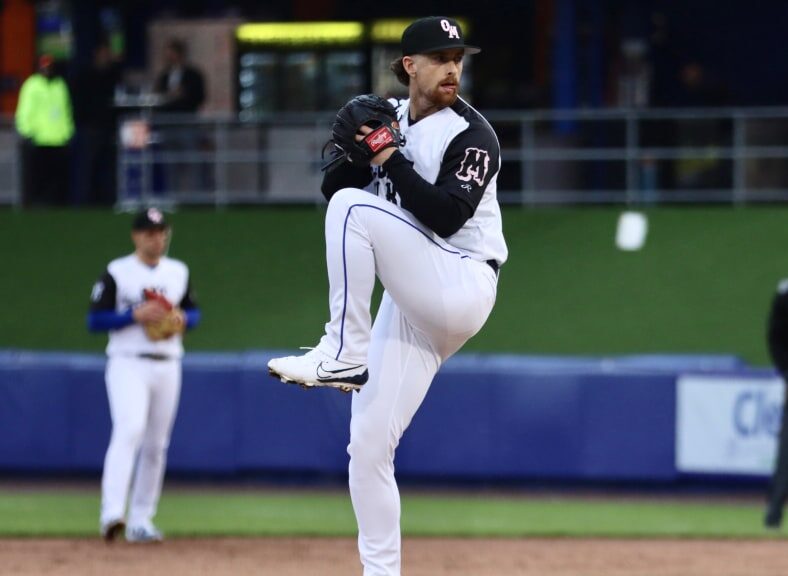
Nolan McLean. Photo Credit: Kylie Richelle
The Stable
The headliners are McLean and Jonah Tong, prospects with big-time helium who are taking off in 2025.
McLean started the year at Double-A, dominated, got promoted to Triple-A, and hasn’t missed a beat. He has an elite sweeper that has been big league ready from the moment he stepped onto a professional mound, a mid-90s heater, a sinker that has been missing bats like crazy, a cutter that has been inducing weak contact, and a changeup and curveball he mixes in occasionally.
Tong boasts the best fastball in the organization. Due to it’s elite IVB (induced vertical break), it was already the best fastball in the organization when he was throwing it in the low-to-mid 90s. Now, he’s routinely throwing it 95 and can get it up to 97. He has a big looping curveball and a slider that can both be plus pitches, but his new Vulcanchange has been a game changer, giving him an effective offspeed pitch that he had been searching for. He’s too good for Double-A, and should probably receive a promotion to Triple-A soon.
There’s also Brandon Sproat, who is probably more of a household name than Tong and McLean despite those two passing him in the prospect ranks. Sproat flew through the minors last year, making it all the way to Triple-A in what was his first season of professional baseball. However, he struggled mightily once he got there, and those struggles have continued in 2025. Sproat has a bunch of solid offerings, but no standout pitch like Tong and McLean. He’s still just 24, and is less than a year removed from dominating hitters at Double-A, so there’s plenty of time for him to right the ship. (He has a 2.25 ERA in his last 16 innings as of publishing.) He remains one of the top pitching prospects in the organization, the hype has just faded a bit.
Blade Tidwell is at Triple-A as well, and he’s been one of the most effective pitchers in the league. Don’t let the 4.02 ERA fool you—that’s pretty good for the International League. It’s also a full run lower since he was returned to Triple-A after making his big league debut a little over a month ago. He got hit around a bit by the Cardinals in that debut, but he has good stuff, and it’s very possible he makes another big league start at some point this season.
Meanwhile, the Binghamton Rumble Ponies have a stacked rotation just one level below. It’s headlined by Tong, but there are multipe probable future big leaguers on that staff as well.
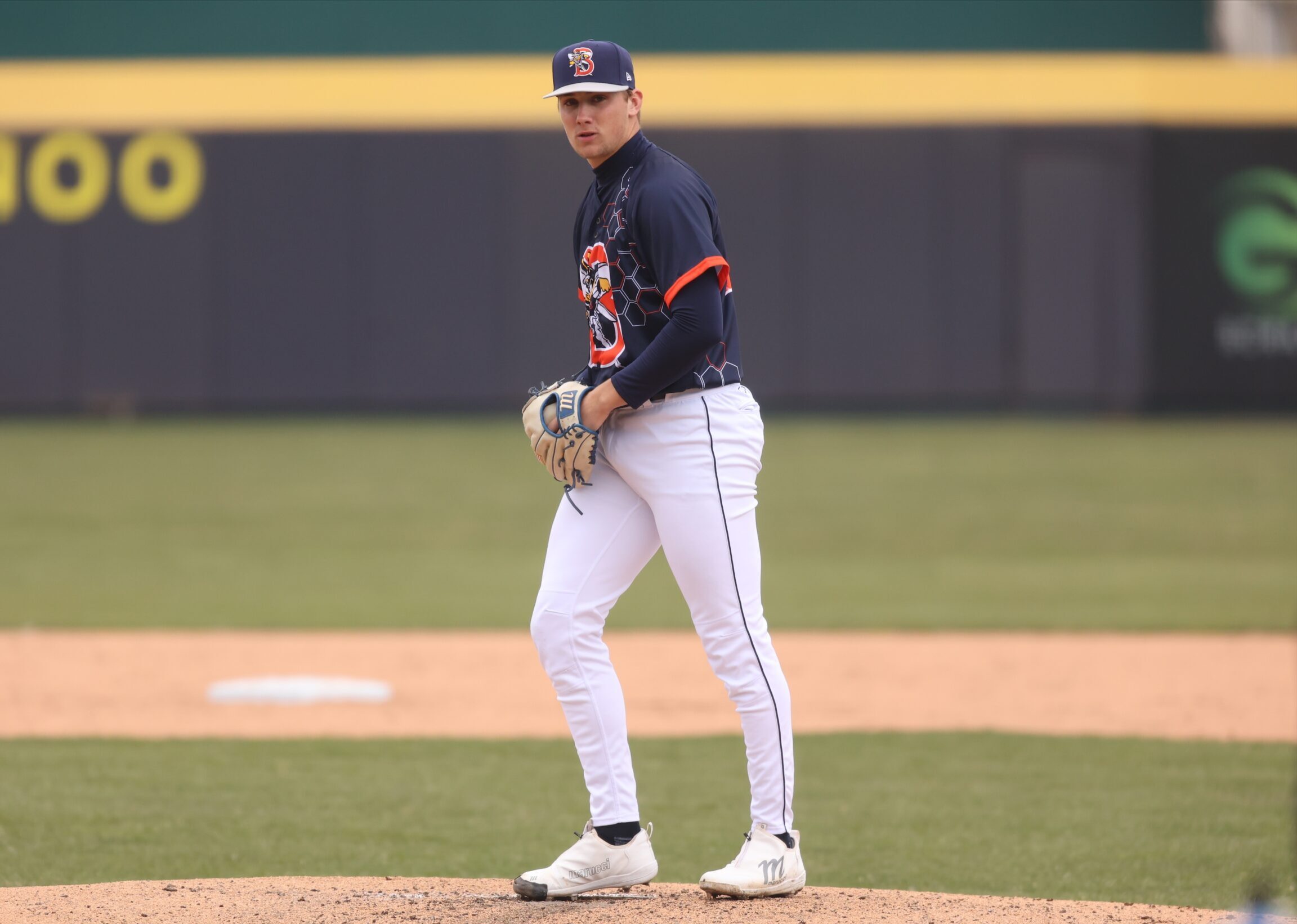
Jack Wenninger. Photo by Kylie Richelle
Jack Wenninger has turned in the fourth-highest strikeout rate among Double-A qualifiers, only behind Tong, top MLB pitching prospect Chase Burns and rising Cardinals prospect Tekoah Roby. Jonathan Pintaro, a former Division II pitcher who was signed out of indy ball last year, would be near the top of those leaderboards as well if he were qualified. He’s a great story, and while he is older at 27, he’s turned himself into a legitimate prospect in this system. Then there’s Zach Thornton, a southpaw, who rarely walks people while still posting a high strikeout rate. Over his last three starts, he’s given up just three hits and one run over 19 innings while striking out 22 and walking four.
High-A Brooklyn has maybe even more talent. 2024 second-round pick Jonathan Santucci actually has the worst ERA of the bunch at 4.32, but after a rough start he’s thrown 20 and 2/3 innings of one-run ball over his last four starts. Third-rounder Nate Dohm has turned in four good starts after his promotion from St. Lucie, and Noah Hall, Brendan Girton and R.J. Gordon all have ERAs under 3.30 in over 40 innings.
The Cyclones actually have too many pitchers for available starts. Gordon and Girton piggybacked each other earlier this week, with Gordon going the first three and 2/3 and Girton going the next four and 1/3. Two days later, Dohm and Hall did the same, throwing a respective five and four scoreless innings en route to a shutout victory.
It continues down to Single-A St. Lucie and the Florida Complex League. Irving Cota has a 1.85 ERA in 35 innings and even threw five scoreless innings in a spot start at Double-A before being sent back to St. Lucie. Will Watson had success, earning a promotion to Brooklyn in early June. Edgar Moreta and Wellington Aracena have both had strong seasons. Jose Chirinos was great in the FCL, and then threw four and 2/3 scoreless with seven strikeouts in his Single-A debut.
There are more. Joander Suarez had a lot of success at Double-A and is now getting his first taste of Triple-A action. Joel Díaz has had a solid season at High-A. Former top prospect Matt Allan is finally back on the mound, pitching for Brooklyn. These guys might be more like organizational depth pieces, but they have all flashed before.
There are also, of course, relievers. Some are former starters, like Douglas Orellana, Felipe De La Cruz, Saul Garcia, Cameron Foster and Dom Hamel. There are a few fireballers, like Ryan Lambert, Dylan Ross and Raimon Gómez, who are capable of touching triple digits. Then there are other relievers, like Ryan Ammons, Anthony Nunez and TJ Shook, who have consistently turned in good results.
The farm system is deeper than it ever has been before.
The Mets have had groups of highly-touted pitching prospects before. Generation K. The Big 5 of the mid-2010s. Maybe it’s a reminder that so often, prospects don’t pan out as expected. But the Mets have also never had the infrastructure to support these pitching prospects as they do right now.
The Big Picture
The Arizona Diamondbacks just provided the baseball world with an unfortunate reminder this past week with the news of Corbin Burnes needing to undergo Tommy John surgery becoming official—don’t sign starting pitchers to long-term contracts. Develop pitchers, that way you’re not forced to sign free agent starting pitchers to big-money, multi-year contracts.
The Mets have leaned heavily into that philosophy in the first two years under David Stearns. They pursued Yoshinobu Yamamoto, a unicorn in the free agent market at 25 years old, but other than that, they’ve stayed away from the big-name, high-priced free agent pitchers. No Burnes. No Max Fried. No Blake Snell. Fried has been great, but it’s an eight-year contract. That’s a long time to count on a pitcher to be healthy. Burnes and Snell are both already on the shelf.
Instead, the Mets opted for shorter deals. In 2024, it was Sean Manaea and Luis Severino. In 2025, it was Clay Holmes, Griffin Canning, Frankie Montas and re-upping Manaea. Montas and Manaea both opened the season on the injured list, but they are signed to two-year and three-year deals, respectively. There’s no true long-term commitment to either.
Is the Big Money Worth It?
Pitchers are inherently a high-risk free agent buy. Burnes signed a 6-year, $210 million deal with the Diamondbacks this offseason. He will miss the rest of 2025, and there’s a good chance he will miss all of 2026 as well. Arizona will pay him roughly $62 million for what could be 11 total starts from 2025 to 2026. The next time he pitches for the Diamondbacks will likely be when he is 32 years old. He already showed some early signs of decline this year before the injury. Who knows how he will look in 2027, especially coming off a major arm injury? Arizona will then be on the hook for four more years, with Burnes making over $30 million each year, and then owe him over $10 million a year for six more years in deferred money starting in 2031.
The Mets are better equipped than most to withstand injuries to players on big contracts, but no team wants that much dead money on the books. Even Steve Cohen wants to avoid paying people to not play as much as possible.
But how does a smaller market team justify that risk? That much dead money can be a backbreaker for a team that only signs a handful of players to big-money contracts — and “handful” might be too optimistic for a few organizations.
Since 2022, 11 pitchers (and Shohei Ohtani, who is yet to pitch for the Dodgers) have signed 9-digit free agent contracts: Max Scherzer, Robbie Ray, Kevin Gausman, Carlos Rodón, Edwin Díaz, Aaron Nola, deGrom, Yamamoto, Burnes, Fried and Snell. Eight of those 11 pitchers have made at least one trip to the 60-day IL. That includes the youngster Yamamoto, who made just 18 starts for the Dodgers in his rookie season.
Aaron Nola hasn’t, but after signing a seven-year, $172 million deal entering his age-31 season, he’s regressed so much just one year later that his contract is beginning to look like an albatross. He’s also currently on the 15-day IL and just had his return timeline pushed back. Fried hasn’t, and again, has looked fantastic, but he’s just two months into an eight-year deal. Gausman is the outlier, not taking a single trip to the injured list over the three years and change of his five-year deal, and has remained productive.
It’s an unfair line of thinking for pitchers, and it raises a lot of questions about a much larger issue. How does the league balance a need to compensate pitchers fairly for their work with the obligations of a front office to do what’s best for their organization?
Organizations getting what may be the best years of a pitcher’s career, while significantly underpaying them for six years for the value they are providing, and then tossing them aside when they finally have the opportunity to get paid is, to put it bluntly, a pretty crappy way to treat pitchers. However, organizations should always do what is in their best interests as they pursue the ultimate goal of winning a championship, and that includes wisely distributing their payroll. Smart organizations pay players for what they believe they will do over the course of their new contract, not what they have already done.
History shows it is not smart to sign free agent pitchers to long-term contracts, but underpaying pitchers for years only to cut them loose when it’s finally time for them to make money feels borderline predatory. Short-term contracts for pitchers will always exist, but even if they have high average annual values, they lack the security many players desire.
Is the solution players hitting free agency earlier, maybe after four years instead of six (or seven if their service time is manipulated)? That way, players hit free agency younger, they can cash in earlier, and maybe long-term deals for pitchers are more justifiable if that pitcher is 26 or 28 instead of 30 or 32.
Of course, that opens a much, much, MUCH larger can of worms, and would likely have a ripple effect on many other parts of the Collective Bargaining Agreement — too much to get into right now.
It’s such a difficult issue. Players deserve to be compensated fairly for the value they create, but ultimately, teams need to do everything possible to win, and anything less is malpractice. Unfortunately, that usually means staying away from giving long-term free agent deals to pitchers, signing pitchers to short-term deals when needed, and ideally, developing your own pitchers instead of buying them.
The Mets didn’t have a ton of MLB-ready, quality arms in the minor leagues in 2024 or to begin 2025. They turned to undervalued veterans with good tools like Manaea, Canning and the others, and focused on getting the most out of them. Soon, some of those big league starts will be taken by players the Mets have developed through the minor leagues themselves. McLean has the best combination of talent and proximity, but Sproat, Tidwell, Tong, Wenninger, Pintaro and Thornton are all at least at Double-A. Once you reach that level, the big leagues are within striking distance.
Not everyone will stick in the big leagues, but some will, and that’s an exciting thing for Mets fans to look forward to.