
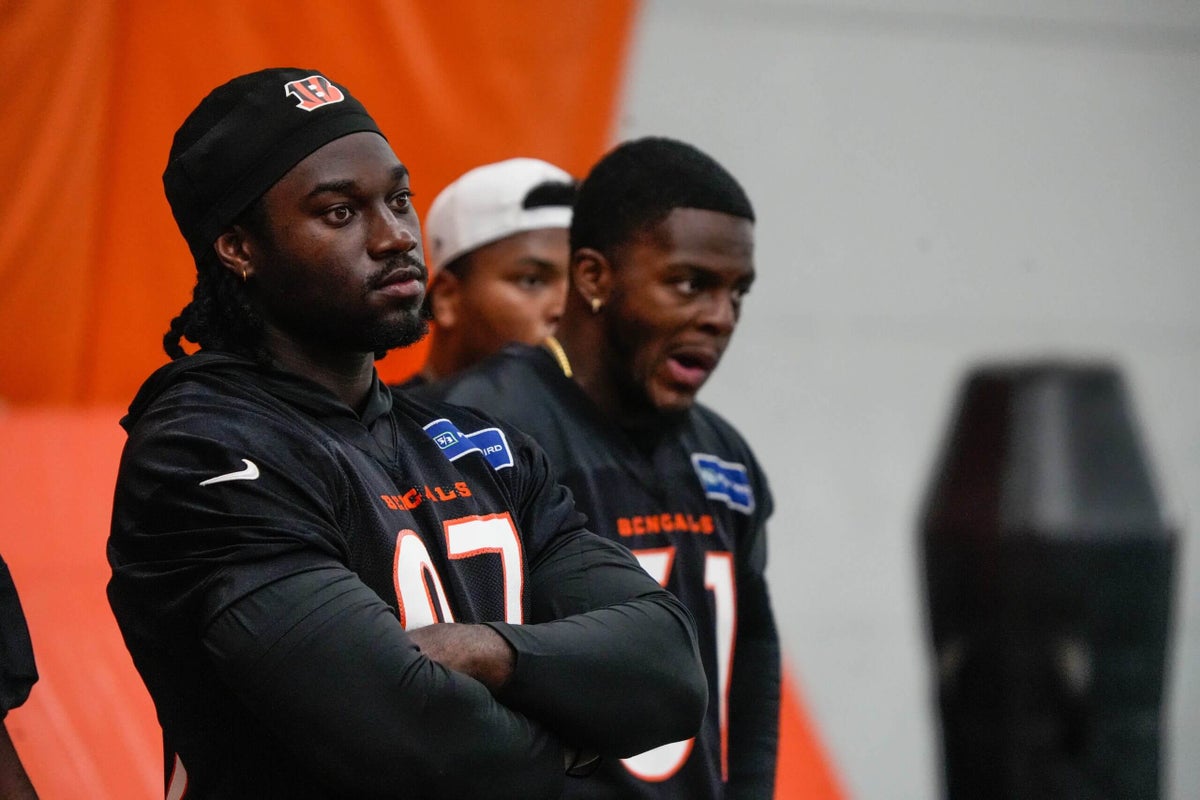
CINCINNATI — The way Bengals first-round pick Shemar Stewart fired off the line, it sounded like it could have come out of the mouth of any agent in a negotiation, NFL insider sharing information on a call or a Bengals fan sitting at a corner barstool.
“I’m 100 percent right,” he said, sitting in front of his locker on Tuesday, sounding like he was speaking directly to management. “I’m not asking for nothing y’all have never done before. But in y’all case, y’all just want to win arguments (more) than winning more games.”
Stewart’s situation is complicated. If you want to go deep into the lawyer language about voided guarantees and waivers, that’s the thrust of this individual issue. The sides are divided over language in the contract where the Bengals are trying to set a new precedent compared to what was given to previous first-round picks. He is refusing to sign the injury waiver to practice while the negotiation gets figured out, as many rookies do. Then, he used Tuesday’s media availability to air grievances against the organization about all of it.
“Trying to implement something new, to me, is unfair,” Stewart said. “And I feel like I’ve been nothing but fair. I’m not asking for nothing crazy. I could understand if I was asking for more on my signing bonus, which I’m not. They trying to do all of this is crazy.”
He sounded frustrated and disenchanted with his surroundings. His comments were more explosive than just about anything Trey Hendrickson has said, and Hendrickson has been fighting these contract battles for four years. Stewart was drafted six weeks ago.
In fairness to him, he merely wants the standard slotted contract that’s been the case around here and is the case among picks around him. He’s a 21-year-old who has never been through anything like this and couldn’t have expected to have to go through it in a league where rookie contracts are glorified rubber stamps. Advocating for himself is admirable.
In fairness to the Bengals, they’d probably just ask him to sign the injury waiver and practice if he really wants to be on the field. Unsigned second-round pick Demetrius Knight Jr. did the same and has spoken about putting the business element aside for now to get in his work. It’s likely a long-term strategy to keep your grievances against the team that drafted you and will employ you for the next four to five years to yourself, even with the right to speak about disagreements in terms of a deal.
Nothing about this quickly escalating from issue to debacle was good for anybody.
There’s always a need to take sides in an impasse like this one. It’s what we do in the age of embracing debate.
The problem in even considering siding with the Bengals here is that any benefit of the doubt has long been gone.
Even if casting aside the undeniable history of the organization’s negotiating history, the last 12 months have been full of these same issues chipping away at the treatment of the players and the pride of the culture, one incident at a time.
They lead to an undercurrent of distrust. In some of the most concerning words of the day, Stewart vocalized that exact sentiment.
“It’s made it very easy when the people in here, in the locker room, say, ‘you’re doing the right things,’ especially the star players,” Stewart said.
Some very frank and direct comments from Shemar Stewart, and why he continues to feel he’s 100 percent right to sit out. Clearly very upset and frustrated with Bengals that he is not signed and on the field. pic.twitter.com/WawvWU8QKu
— Mike Petraglia (@Trags) June 10, 2025
In an offseason as challenging as any the front office has faced in recent memory, the Bengals brass haven’t proven capable of rising to the moment and instead emphasized hard lines of business over cleaner paths to a championship.
Yes, they found deals with Ja’Marr Chase and Tee Higgins, but what went down last year with Chase cost games (and money). Higgins’ deal came only after years of tags, trade requests and squabbling. The hard path in negotiations this year bled into free agency and took attention away from better executing that aspect of the offseason.
The Bengals have let the Hendrickson situation drag out, failing to either trade or sign the edge rusher, knowing the on-field advantages of being decisive and proactive in one way or the other.
As if it needed to be said following Hendrickson’s surprise drop-in and media session last month, but even Joe Burrow admitted on Tuesday that the Hendrickson situation was a distraction.
“Of course, of course,” Burrow said. “Last year we had two, this year we have one. So we do have less. You’d love to have none, but that’s life in the NFL.”
How these situations repeatedly draw out in disputes is now a punchline from the face of the franchise instead of a point of pride.
And yes, other places in the NFL have contract disputes. T.J. Watt is in the same position in Pittsburgh. But, around these parts, it is every single summer with this stuff.
Even consider the Germaine Pratt situation. A decision that was obvious six months ago officially ended Tuesday morning with his release. The Bengals produced a post on social media thanking him and a delightful tribute video.
Really, though, he probably would have preferred not being held hostage in his career this offseason. The Bengals never had a plan for Pratt to return this year, and everyone knew it. He was never an option. That’s why he asked to be traded in any hope he could collect all the money remaining on his contract. Nobody was going to do that. All sides knew it.
Fine, wait to be sure you end up selecting a linebacker in the draft and squat on Pratt’s rights in the process. It’s not the most empathetic play, but their right. The Bengals then drafted two linebackers in April. It then took six more weeks for them to finally let him go so he could move on, thus missing out on opportunities to make an impression with another team, start carving out a new spot and impressing new teammates.
Pratt was tied as the longest-tenured Bengal on the roster with fellow 2019 draft pick Drew Sample. He authored some of the most memorable moments in franchise history. He was a captain. Yes, last season went sideways and it was obviously time to move on, but he deserved better.
There’s just too rarely the feeling of all sides working together rather than against each other. When it comes to the front office, whether in communication or contracts, players are too often treated like numbers and assets more than faces and families.
These are merely the latest stories in years littered with them. From Andrew Whitworth to Carlos Dunlap to Jessie Bates to DJ Reader to Jonah Williams to, well, you get the point.
NFL business is cutthroat everywhere. No question. It’s just hard to get past the relentlessness of it in Cincinnati.
The Bengals have changed their ways in many areas in recent years. From fan engagement to contract structures for stars to game presentation to free agency involvement to staff sizes and even facility investment.
This one, though? The constant feeling of management versus players chipping away at the culture in an effort to win an argument? That hasn’t gone anywhere. The last 12 months only amplified it.
All Shemar Stewart did was say the quiet part out loud.
(Photo: Phil Didion / Imagn Images)