
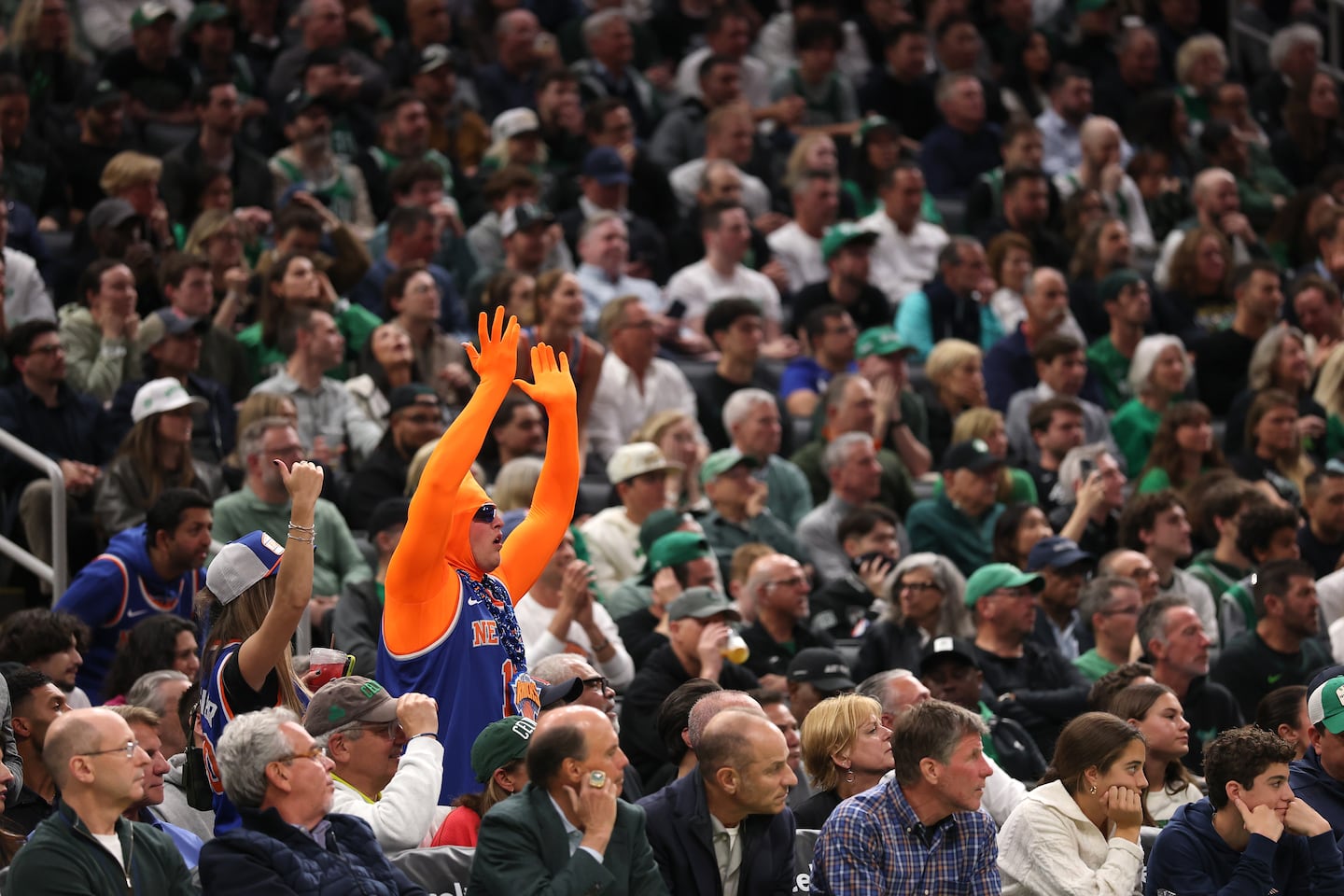
Like every other long-suffering Knicks fan, I’m hoping they can do to the Celtics in the Eastern Conference semifinals what the Red Sox did to the Yankees in 2004: knock out their traditional foe in the playoffs on their way to winning their first title in generations.
Get The Gavel
A weekly SCOTUS explainer newsletter by columnist Kimberly Atkins Stohr.
The Knicks got off to a great start this week by stunning the Celtics on their home court, twice coming back from 20-point deficits, to take a 2-0 series lead. Game 2 on Wednesday night was especially satisfying, with the Knicks mounting a 21-2 run in the fourth quarter. It’s tempting to get excited and start thinking two rounds ahead to the NBA Finals. But as someone who’s followed this franchise for decades, I’ve also learned to curb my enthusiasm in the postseason, which has always ended in disappointment.
True, Knicks fans haven’t had to wait as long for a title as Red Sox fans did. Many in New England were born, raised families, retired, and lived into their 80s without seeing their favorite baseball team win a championship. It’s been “only” 52 years since New York won its last NBA championship, in 1973. Still, most Knicks fans today, myself included, have no memory of their team ever winning it all.
It’s not just that the Knicks always find a way to lose in the postseason. It’s the way they lose. The 1990s were an especially excruciating era, in part because those teams, anchored by center Patrick Ewing, were so talented.
In 1992-93, under coach Pat Riley, the Knicks went a conference-best 60-22 and made it to the Eastern finals against the Chicago Bulls and Michael Jordan. In the final seconds of Game 5 at Madison Square Garden, with the series tied at two games each, the Knicks were down by 1 point with the ball. Ewing, the team’s leading scorer that year, lost his footing as he drove to the basket and passed the ball to forward Charles Smith, who was under the hoop. I was ready to celebrate the game-winning basket. Instead, this description from broadcaster Marv Albert will always haunt me:
“Ewing for Smith, Smith stripped, Smith stopped, Smith stopped again! By Pippen! What a play by Scottie Pippen!”
As time expired, Smith channeled every fan in the building, spiking the ball in anger and frustration. I remember sitting in my parents’ den on Long Island, shocked and demoralized.
The Bulls went on to win the next game and the series, on their way to their third consecutive championship.
“I thought this was my year. It was right there in the palm of my hand,” Ewing said after the series.
The next season, New York earned a trip to the NBA Finals for the first time since 1973, and took a 3 games to 2 lead over the Houston Rockets. In Game 6, their shooting deserted them — Ewing was 6-for-20 — as they lost by two. John Starks provided the only reliable offense, scoring 27 points, including five 3-pointers. But he missed what would have been a series-clinching 3-pointer, and as Chris Herring wrote in “Blood in the Garden: The Flagrant History of the 1990s New York Knicks,” that had a serious carryover effect.
A tormented Starks couldn’t sleep for three nights between Game 6 and 7, and he launched miss after miss after miss in the deciding game. I loved Starks, but after a while, I started thinking, is there a limit? Albert read my mind when he said on the broadcast, “It’s going to reach a point where you’ve got to stop shooting.” But that point never came. Starks had one of the worst Game 7 performances in history — 2-for-18, 0-for-11 from three — as the Rockets won the clincher, 90-84.
And of course who can forget Reggie Miller scoring 8 points in nine seconds in Game 1 of the 1995 NBA conference semifinals to stun the Knicks, 97-95? I know I can’t, especially since the Indiana Pacers wound up winning the seventh game on my birthday.
When the NBA was in its infancy, the Knicks owned the Celtics, knocking them out of the playoffs three consecutive years in the early 1950s. But consistent with their modern-day reputation, they couldn’t close the deal, losing the NBA Finals in each of those seasons.
The Celtics’ ascent in the late 1950s coincided with the Knicks’ downfall. Under coach Red Auerbach, with center Bill Russell dominating the opposition, Boston won eight consecutive NBA titles starting in 1959. In all but that first season, the Knicks came in last place in the East Division.
The last time New York won an NBA title, it had to first get past Boston in the playoffs. That year, the Knicks got blown out in the opening game of the 1973 Eastern Conference Finals in Boston and stormed back to take a 3-1 series lead, only to lose two straight, forcing a seventh game at Boston Garden. The Knicks won that game, 94-78, behind point guard Walt “Clyde” Frazier’s 25 points, becoming the first team to eliminate Boston on its home court. Then the Knicks went on to beat the Los Angeles Lakers in the NBA Finals.
Even though most Knicks fans alive today don’t remember that championship, it’s in our collective fan DNA because the team needed five future Hall of Famers to overcome the Celtics. The Knicks’ coach that year, Red Holzman, recalled in his autobiography, “Red on Red,” written with my late father, Harvey Frommer, how Auerbach, then the Celtics president, put the Knicks through “psychological warfare” at the Boston Garden. The Celtics kept relocating the Knicks’ dressing rooms, each one worse than the last — a hoops version of Milton getting relegated to the outer fringes of his company in the movie “Office Space.”
The Celtics restored league order the next year, beating the Knicks in a conference finals rematch on their way to the NBA title. Many Knicks fans could tell you that Boston has won seven titles since New York’s last one.
With apologies to George Santayana, the philosopher who said, “Those who cannot remember the past are condemned to repeat it,” the Knicks are better off forgetting their tortured history. Instead, they’d be better off borrowing from the 2004 Sox, who blissfully dubbed themselves “idiots,” unaware of the weight of 8½ decades of baseball futility.