
Chicago journalist Peter von Buol was in Honolulu last week, and I took him to Iolani Palace, where we met with historian and docent educator Zita Cup Choy.
Von Buol wanted to see the huge portrait of Queen Lili‘uokalani that hangs in the Blue Room. He wrote an article in “Hana Hou,” the Hawaiian Airlines magazine, about the portrait traveling to Washington D.C. and back several months later for a 2024 display at the Smithsonian’s National Portrait Gallery.
I was more interested in a small couch in a corner of the room. Honolulu Advertiser columnist Bob Krauss reported that, when it was being reupholstered in 1982, a bullet fell out of it. How did the bullet get there in the first place? That’s what we’ll explore this week.
Blue Room
The Blue Room at Iolani Palace is on the upper floor on the Ewa end, facing King Street. King Kalakaua, Queen Kapiolani and Queen Lili‘uokalani greeted guests to Iolani Palace in the Blue Room, before entering the state dining room.
The room’s name came from the several chairs and couches that were upholstered in bright blue fabric.
Don’t miss out on what’s happening!
Stay in touch with breaking news, as it happens, conveniently in your email inbox. It’s FREE!
One piece is called a chaise longue — French for “long chair.” It has a lengthened seat that forms a leg rest for reclining.
Wilcox Insurrection
Former Iolani Palace Curator Jim Bartels told Krauss that he believed the bullet was fired at the palace during the Wilcox Insurrection on July 30, 1889.
King Kalakaua and Queen Kapiolani were the monarchs then. Iolani Palace had just been completed in 1882.
In 1887, a coalition of American, European and Native Hawaiian businessmen forced the king to adopt a new constitution that restricted King Kalakaua’s powers and limited voting to wealthy residents. It was called the “Bayonet Constitution.”
Robert Wilcox
The instigator of the insurrection was Robert Wilcox. He was the half- Hawaiian son of Maui royalty and not related to the Wilcoxes of Kauai. He was 6 feet tall, handsome and had great charisma.
“Hawaiian hero Robert Wilcox led 80-150 men armed with 35 rifles and about as many bird guns to the Iolani Palace grounds at 3 a.m. on July 30, 1889, to protest the new constitution,” said Krauss.
“Wilcox wanted to depose King Kalakaua and put his sister, Princess Liliuokalani, on the throne. Or possibly he wanted to help Kalakaua abrogate the constitution.
“In any event, Kalakaua did not support the rebellion, in spite of repeated invitations by Wilcox.
“The Wilcox forces, wearing red, occupied Aliiolani Hale, across the street from the palace, the King’s Bungalow, and the palace grounds, but not Iolani Palace.”
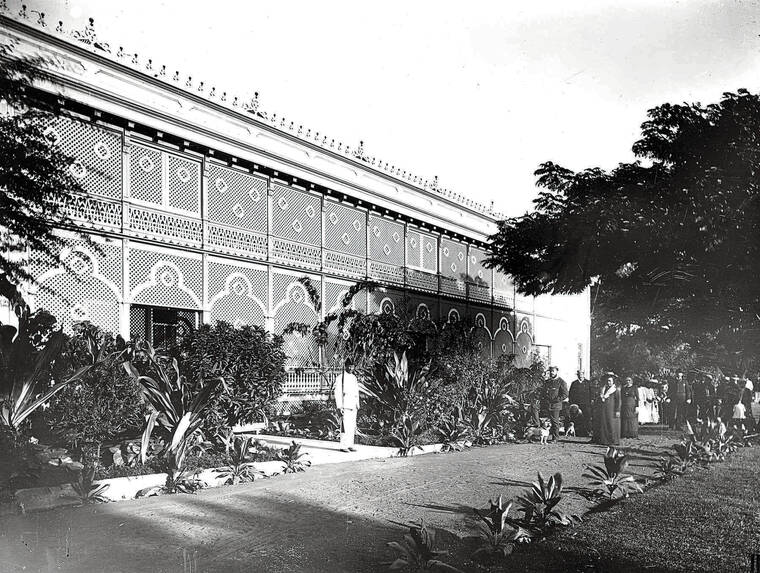
The King’s Bungalow, called Hale Akala (“Pink house”) was a two-story building situated where Iolani Barracks is today, near Richards Street. It was a traditional sleeping house for the king and queen. The palace was mostly used for public functions.
King in hiding
The king was absent from the palace at the time of the insurrection, the Pacific Commercial Advertiser reported. “He had slept at the Punchbowl Street residence of his consort, but an alarm was sent to him using a new technology. Telephones had first arrived on Oahu less than 10 years earlier, and King Kalakaua was an early adopter.”
Telephones were used to spread the alarm. The Honolulu Rifles, volunteer guards, were immediately ordered to report to their armories.
“The royal party then hastened to the King’s boathouse, located in Honolulu Harbor Diamond Head of Pier 7. They remained there during the day, guarded by about a dozen household troops.”
Defending the palace
Lt. Robert Waipa Parker defended the palace with about a dozen of the King’s Guard. Wilcox wore an Italian artillery school uniform he had brought to Hawaii from Turin, Italy, where he had studied.
Wilcox demanded he surrender. Parker refused. Wilcox fired at him, grazing the officer’s shoulder and tearing the epaulet from his coat.
The shooting had begun. The rebels had cannon, but the King’s Guard had sharpshooters. They kept up a steady fusillade upon any men who tried to fire these artillery pieces.
The rioters had taken shelter in the bungalow situated on the palace grounds, and the fire of the rifles slackened to only an occasional shot.
A squad of the Honolulu Rifles had also occupied positions in Kawaiahao church, the Opera House, and in private houses where the palace grounds could be seen.
Baseball players
The San Francisco Examiner wrote about the insurrection 10 days later. The palace defenders made bombs to try to dislodge Wilcox and the rebels who were holding up in the King’s Bungalow.
The question was, how would they fire the bombs at the bungalow? “At last, someone suggested that they throw them. It was a good long throw, and in their dilemma, they secured the services of J. Hay Wodehouse, the catcher of the Honolulu Base Ball Club,” the Examiner said.
Wodehouse was the son of the British Minister in Hawaii, James H. Wodehouse.
“Wodehouse took up his position in a building mauka of the bungalow. He had to throw over a house to reach the bungalow, which he could not see. It was well over 100 feet away. The first bomb struck the side of the bungalow about a foot from the roof, causing much damage.
“Hay Wodehouse picked out another bomb. He took a step back, made a half turn and sent it whizzing. It landed on the roof of the bungalow, and the detonation sounded like a boiler explosion.”
The bombs were too much for the rebels. A minute later, Wilcox came out with a white flag and offered a complete surrender.
Damage
Seven or eight men were killed that day, and a dozen were wounded. The King’s Bungalow was badly damaged, as was the Opera House.
Several windows at Iolani Palace were broken. Three bullets struck the large portrait of Louis Philippe I, the king of the French. The furniture appeared undamaged, until the bullet fell out of the chaise longue during the renovation in 1982.
“We believe a shot from the Opera House across the street came in through the window and hit the chaise longue,” Iolani Palace curator Jim Bartels told Krauss.
Bullet
I went to look at the bullet last week. It is stored in the attic of the palace. I was surprised at how large it was — nearly an inch in length, and heavy.
Von Buol said, “Thomas Gnoske, who is a scientist at Chicago’s Field Museum, said the bullet is commonly referred to as Minie ball. These were much deadlier than musket balls.
“They are a hollow-based bullet designed by France’s Claude-Etienne Minie. They were made for muzzle-loaded musket rifles. These guns were used in the Crimean War and the U.S. Civil War to deadly effect. They were, however, already obsolete by the late 1800s.”
Epilogue
Wilcox was tried for treason and found innocent by an all-Hawaiian jury. He led another rebellion in 1895, attempting to return Queen Lili‘uokalani to the throne. He was tried, convicted and jailed but was pardoned in 1898.
He was elected as Hawaii’s first delegate to Congress in 1900. He ran for reelection in 1902 and was defeated by Prince Jonah Kuhio Kalanianaole. Wilcox died in 1903. In 1993, a bronze statue of Wilcox was erected at King and Fort streets.
Bob Sigall is the author of the five “The Companies We Keep” books. Contact him at Sigall@Yahoo.com or sign up for his free email newsletter at RearviewMirrorInsider.com.