
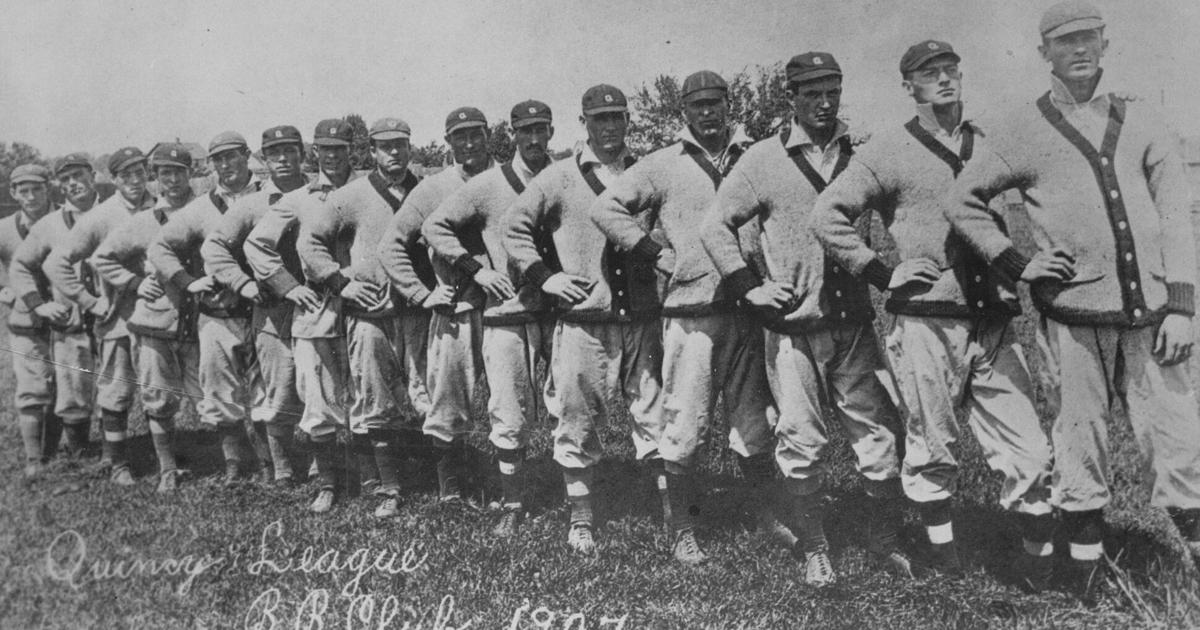
In September 1907, with the Chicago Cubs on the brink of making history by clinching the first of their back-to-back World Series titles, the team took an interesting detour that would forever echo in Illinois baseball folklore. Riding high after a commanding 107-45 regular season and brimming with confidence ahead of the postseason, the Cubs delighted local fans by accepting a $500 offer to play the Quincy Buds, a minor league team in Quincy, Illinois, on September 16, 1907.
The timing could not have been more opportune. The Iowa Baseball League had just wrapped up and the Cubs had a rare day off before the playoffs began. Rather than rest, the Cubs seized the opportunity to barnstorm, joining a popular trend among successful big-league teams of the era, who often traveled to smaller towns on off days to showcase their talent, thrill local crowds, and pocket some extra cash. What began as a simple exhibition game would soon become a legendary tale, adding a colorful twist to the Cubs’ already remarkable season.
The Quincy Buds endured a relatively lackluster 1907 season, finishing with just a .500 record. However, a matchup against the powerhouse Chicago Cubs, who boasted several 20-game winners and had dominated the National League, sparked new inspiration in the team from western Illinois. Undeterred by their formidable opponents, the Buds approached the challenge with renewed determination.
The town was transformed as Quincy buzzed with anticipation. Local businesses shuttered their doors early, or for the entire day, with Gardner Governor Company closing at noon, Electric Wheel Works following at 12:30 p.m., and Comstock-Castle remaining closed all day so employees could witness the spectacle. Trains and riverboats delivered fans from Keokuk, Iowa, Northeast Missouri, and beyond, including more than 150 supporters from Macomb who arrived earlier in the day. The city’s streets took on a festive, carnival-like atmosphere as 2,398 fans packed into Sportsman’s Park, all eager to watch the mighty Cubs, who were favorites to win the upcoming World Series, face off against their hometown heroes from the Gem City.
The game began with the Cubs capitalizing on three Quincy errors, converting them into two unearned runs in the first inning. Yet the underdog Quincy Buds quickly proved their resilience. In the bottom of the third, they launched a thrilling rally against Cubs ace Jack Pfiester, who had posted an impressive 1.15 ERA over 195 innings in 1907, scoring three runs and sending the hometown crowd into a frenzy. Not only had the Buds seized the lead, but they did so against one of the premier pitchers in the majors. As the September 17, Quincy Daily Whig described it, “The fans became nearly frantic and yelled and applauded until their throats were hoarse and their hands sore.”
Nineteen-year-old pitcher “Brother” Walter Rause emerged as the unexpected hero of the day, confounding the Cubs with his masterful blend of off-speed pitches and holding the future champions to only a handful of hits. Quincy’s defense rose to the occasion after the inauspicious start, locking down the Cubs while the offense tacked on two crucial insurance runs, clinching a remarkable 5-2 triumph. The city erupted in celebration as the newspapers hailed it as “the greatest baseball day in the history of Quincy.” Following the game Walter Rause received an offer from St. Louis, and the Quincy team received an offer to play in the Three-I League. The Three-I League consisted of teams from Illinois, Iowa, and Indiana.
News of Quincy’s upset win spread rapidly, making headlines not only in Chicago but as far away as New York. The unexpected victory sent shockwaves through the baseball community, as few had anticipated that a middling minor league team like Quincy could topple the mighty Cubs. In an effort to minimize the embarrassment, the Chicago Tribune attempted to downplay the loss, suggesting that the Cubs had not fielded their regular lineup. However, a review of the official records reveals that this claim was largely unfounded. Only three starters-Frank Chance, Harry Steinfeldt, and Joe Tinker-were missing from the lineup, all sidelined due to injuries. The remainder of the roster featured the same core of star players who, just weeks later, would go on to sweep the Detroit Tigers in the 1907 World Series.
The magnitude of Quincy’s achievement was underscored by the fact that the Cubs were considered one of the most dominant teams of their era, boasting a roster stacked with future Hall of Famers, all stars, and seasoned veterans. The Cubs’ visit left an unforgettable mark on Quincy. For the Cubs, it was a rare blemish in an era defined by dominance, a vivid reminder that even the most formidable teams can be humbled by local talent and an electrified crowd. For Quincy, it was a day when the entire city paused, united by baseball and the exhilaration of an underdog victory. The memory of that single autumn afternoon still resonates in Quincy’s sporting history, a lasting testament to the unpredictable magic of America’s pastime.
Rob Mellon is currently the Executive Director of the Historical Society of Quincy and Adams County and an U.S. Army Reserve Officer serving as an instructor with the University of Missouri ROTC program. He has served 27 years in the United States Army. He is on the Board of Directors of the Ulysses S. Grant Tail Association.
The Historical Society of Quincy and Adams County is preserving the Governor John Wood Mansion, the History Museum on the Square, the 1835 Log Cabin, the Livery, the Lincoln Gallery displays, and a collection of artifacts and documents that tell the story of who we are. This award-winning column is written by members of the Society. For more information visit hsqac.org or email info@hsqac.org.