
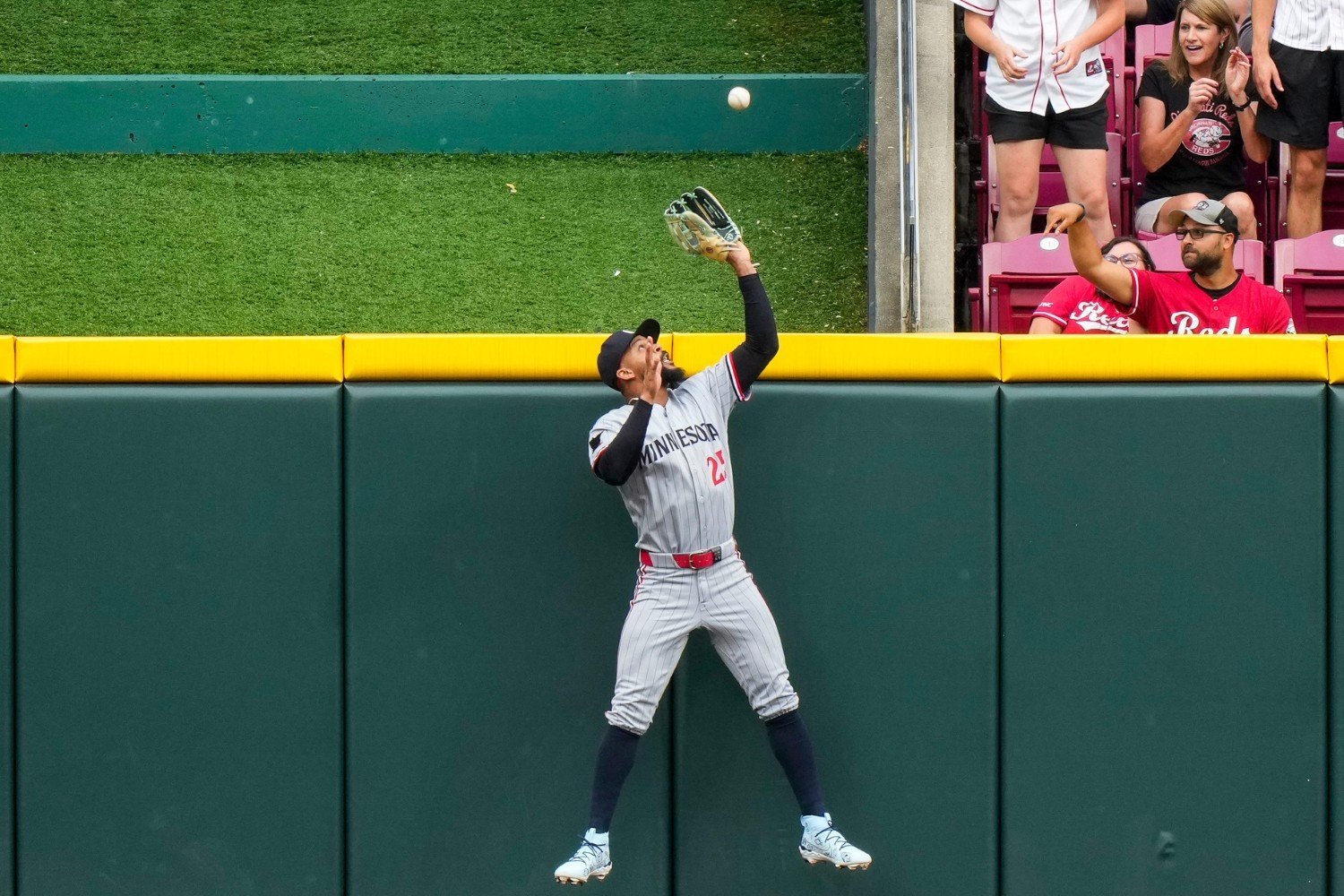
As defensive metrics continue to evolve and become more publicly available, fans now have more ways than ever to measure what their eyes see on the field. The Society for American Baseball Research (SABR) has once again released its first installment of the SABR Defensive Index (SDI) for the 2025 season, offering some interesting insight into how members of the Minnesota Twins are stacking up with the glove compared to the rest of the American League.
For those unfamiliar, the SABR Defensive Index has been used since 2013 as part of the process for determining the Rawlings Gold Glove Award winners. The metric pulls together multiple defensive statistics, including those derived from Statcast batted-ball tracking and traditional play-by-play data, to form an overall defensive value. These rankings are current through games played on June 8, 2025.
France Flashes the Leather at First
One of the biggest surprises on this list comes at first base, where Ty France ranks third in the American League with a 2.1 SDI. France was acquired as a buy-low acquisition this past offseason to replace Gold Glove winner Carlos Santana at first base, but his glovework has clearly exceeded expectations. First base has not been a defensive stronghold for the Twins in recent years, so seeing France rate so highly in the early SDI rankings is a welcome sight for the club.
France’s defensive metrics tanked last year as he played through an injury. However, this season he’s had some conversations with players like Carlos Correa about how to improve. His Fielding Run Value ranks in the 88th percentile and his OAA is in the 95th percentile. His defensive value has quietly made a difference for a pitching staff that still induces plenty of ground balls.
Bader Shines, Buxton Disappoints
Most assumed Byron Buxton would lead the way for the Twins’ outfielders in the early SDI release. After all, when healthy, he’s long been considered one of the best defenders in baseball. However, it’s Harrison Bader who holds the team’s best outfield SDI mark so far. Bader’s 2.4 SDI in left field is tied for third among AL left fielders, a strong showing for a player who has also seen time in center.
Bader’s instincts, jumps, and ability to cover ground have clearly transferred well to his new role. His presence in left has provided some flexibility for the Twins. He ranks in the 93rd percentile in Fielding Run Value and the 97th percentile in OAA. Bader also unofficially ranks in the 100th percentile in losing his hat when chasing after a ball.
Meanwhile, Buxton sits at 0.1 SDI, ninth in the American League among center fielders. It’s a solid but unspectacular mark, especially with how strong he has looked this season. He ranks in the 90th percentile in OAA and the 84th percentile for Fielding Run Value. If Buxton stays healthy, he should rise on these rankings in the second half.
The Twins did not have a qualified player in right field, as the position has been impacted by injury. Matt Wallner and Trevor Larnach have both played over 185 innings but no one has played enough innings to crack the leaderboard.
The Infield: A Mixed Defensive Bag
There are some surprises and a few concerns on the infield. Correa, previously heralded as one of baseball’s premier defensive shortstops, comes in at 0.2 SDI (tied for seventh in the AL). His OAA is still strong in the 91st percentile. While these numbers aren’t poor by any stretch, it’s a far cry from the elite territory he occupied in his Houston days or during his strong 2022 season in Minnesota. The Twins need Correa to provide defensive value as his bat has lagged behind this season.
Brooks Lee ranks eighth among AL third basemen but has a -1.0 SDI. This isn’t unexpected for a young player still adjusting to big-league speed and angles. Lee’s bat has shown signs of life in recent weeks, but the defensive side remains a work in progress. He has a Fielding Run Value and OAA in the 34th percentile or lower. His development at the hot corner will be worth watching closely as Royce Lewis is on the injured list for the second time this season.
At second base, Willi Castro sits at -1.1 SDI, further highlighting the Twins’ infield inconsistency. He is tied for fifth in the AL but the top-four players all have a 2.5 SDI or higher. Castro’s versatility has long been his calling card, but his defensive metrics can sometimes suffer when he’s asked to bounce between positions. His glove at second base hasn’t graded out well early on, though positional flexibility keeps him valuable on the roster.
Catchers Hover Near the Middle
Behind the plate, neither of the Twins’ primary catchers has stood out by SDI measures. Christian Vázquez posted a -0.2 SDI (eighth in the AL), while Ryan Jeffers came in slightly lower at -0.5 SDI (10th). Both catchers have been praised at times for handling the pitching staff well, but neither is considered an elite defender by modern framing or blocking metrics. The rankings confirm that perception: steady, serviceable, but unspectacular.
The Pitchers: Paddack Impresses, Ryan Struggles
Among the pitchers, Chris Paddack leads the Twins staff with a 0.7 SDI, tying him for 13th in the American League. Pitcher defense is often overlooked, but Paddack’s ability to field his position whether on comebackers or bunts has earned him quiet praise.
Bailey Ober sits at 0.5 SDI, good for 20th, showing he holds his own when fielding his position. However, Joe Ryan brings up the rear at -0.7 SDI (36th), suggesting he’s struggled when asked to handle balls in play near the mound. While pitcher SDI is typically a small component of overall defensive value, these numbers can sometimes explain why certain plays unravel the way they do.
The first wave of SDI rankings offers a mixed bag for the Twins. Players like France and Bader have exceeded expectations defensively, but concerns remain at key infield positions and behind the plate. The numbers show potential but also areas in need of shoring up if Minnesota hopes to remain in contention as summer heats up.
As always with defensive metrics, these rankings represent just part of the picture. But for a front office that values data, and a fan base always hungry for insight, the SDI update provides another reason to keep a close eye on the field especially with the AL playoff picture far from settled.
What surprises you most about these rankings? Leave a comment and start the discussion.