
KANSAS CITY, Mo. — Typically, the offseason and spring training would seem the time for experimentation.
Especially for starting pitchers, who are creatures of habit and wedded to routines by nature. And who spend considerable time perfecting their repertoires.
But the reach of technology’s impact on the game in recent years has created an immense flow of nearly immediate data.
It has enabled pitchers to try significant changes and emboldened coaches to make suggestions with some sense of security that they will work before trying them in a game.
Sometimes, it starts as informally as one pitcher asking another how he throws a certain pitch and mimicking him while playing catch. Other times. it comes from the coaching staff or maybe even the team’s R&D or analytics crew.
The result can be a small adjustment, such as a quarter inch on the grip or the amount of pressure on a seam, to a major shift.
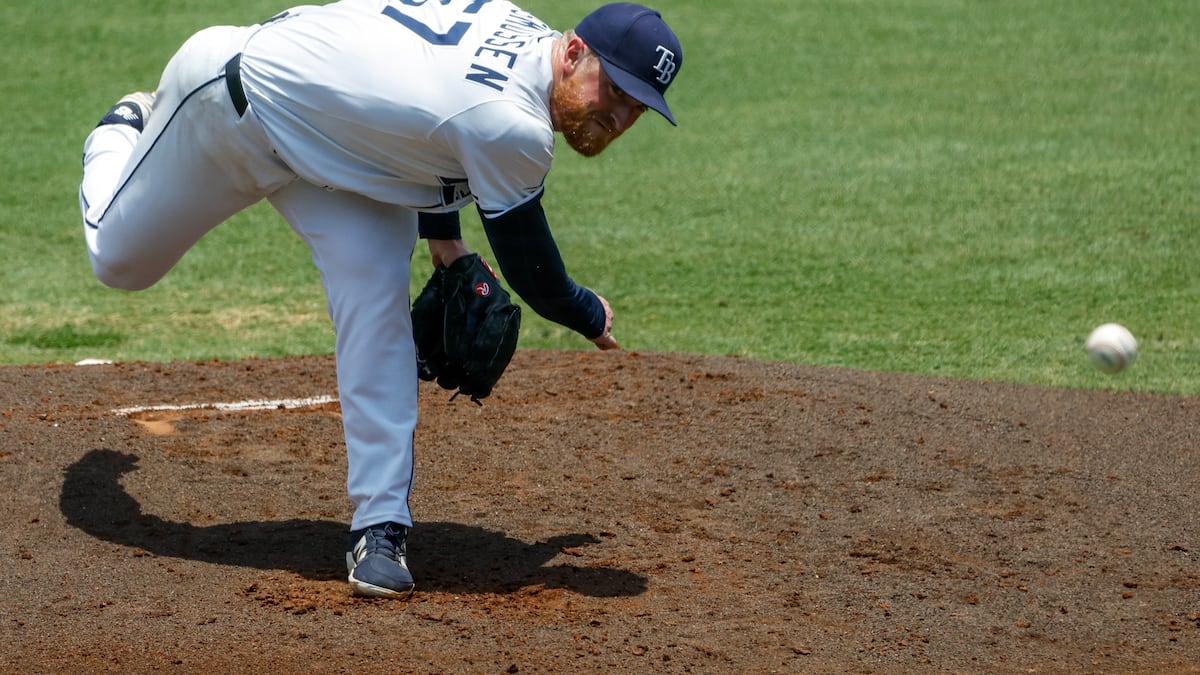
Such as adopting new pitches on the fly, during the season, even between outings, which three Rays starters — Shane Baz, Taj Bradley and Drew Rasmussen — have done in recent weeks.
Pitching coach Kyle Snyder said the transitions are not that traumatic, even with three-fifths of the rotation making changes at the same time.
“It’s subjective, so it all depends on the person,” Snyder said. “It depends on their aptitude. It depends on their willingness, too.”
It also has become part of the modern game.
“This is not the first year that this has happened,” Snyder said. “We’ve been doing this for probably at least a handful of years since the (technology) became more popular and once we started to realize the developmental benefit that it provided.”
 Tired of struggling to command his slider and watching it get hit around, and worn down by pitching coach Kyle Snyder suggesting he try throwing a cutter instead, Shane Baz made the change in two days. [ PAMELA SMITH | AP ]
Teams have the ability through Trackman machines, high-speed cameras, instantly accessible data and (somewhat) easily understandable graphing, to get immediate reads on where pitches are going, the ways they’re getting there and how that can be adjusted.
“You get the feedback really quickly,” said Ryan Pepiot, who made tweaks last season to create separation between his cutter and slider, and earlier this season started experimenting with a sinker.
“You can understand this is what it’s supposed to look like, but if I throw it this way then, oh, I messed it up. Now, I can make the quick adjustment to make it actually what we were trying to achieve.”
Stay updated on Tampa Bay’s sports scene
Subscribe to our free Sports Today newsletter
We’ll send you news and analysis on the Bucs, Lightning, Rays and Florida’s college football teams every day.
You’re all signed up!
Want more of our free, weekly newsletters in your inbox? Let’s get started.
Baz was tired of struggling to command his slider and watching it get hit around. Worn down by Snyder suggesting he try throwing a cutter instead, Baz made the change in two days.
“Kyle’s kind of been suggesting it all year, and I probably have been a little hard-headed about it, just wanting to stick with the slider,” Baz said.
“It had just been such a good pitch for me my whole career. So, it’s hard to put that in your pocket and not throw it. But he’s kind of just been preaching it to me, and I’m trying to listen to him.”
The idea was to add another higher-velocity pitch that moved differently than his fastball, knowing his curve was his best off-speed pitch.
“Anything that looks like a fastball that can just miss a barrel, I think is a good pitch,” Baz said.
What helped Baz was that he used to throw the cutter in the minors and didn’t need long to recall the grip, release and proper feel.
“It was a matter of just trying to remember, honestly,” he said. “I just threw it in catch play, and it felt good. And I was like, ‘You know what? I’m going to throw it today (in a bullpen session).”
Taj Bradley added a version of a sinker — a one-seam fastball, which is a slight variation of the traditional two-seamer — as a weapon to run in on right-handed hitters. [ JEFFEREE WOO | Times ]
Two days later, he threw it in a game and has made it another legitimate option. “It’s just putting that in my arsenal and figuring out the best times to use it,” Baz said.
Similarly, Bradley has been notably inconsistent this season. Snyder felt it would do him good to have another option besides his four-seam fastball at the top of the zone and his cutter, curve and change-up.
Thus, Bradley added a version of a sinker — a one-seam fastball, which is a slight variation of the traditional two-seamer, and a weapon to run in on right-handers.
Bradley said he didn’t even know there was such a thing as a one-seam fastball until Snyder mentioned it.
“When he said ‘One,” I was like, all right. It’s different,” Bradley said. “So, ignorance is bliss in that aspect. So, I just threw it.”
Any apprehension is negated by the confidence Snyder — “a genius in that aspect” — instills, putting the ball in Bradley’s hand and showing him the grip.
“You can’t be scared to throw it,” Bradley said. “The more you think about it, the more self-conscious you get.”
Rasmussen’s change wasn’t as much corrective as choreographed.
Given his return to a starting role after 2023 elbow surgery and that he worked in relief last August-September, the Rays wanted to wait a few months before adding a change-up to his power repertoire.
Rasmussen said he has full faith in Snyder, noting how his previous suggestions have helped.
“I think the conversation with me is pretty easy,” Rasmussen said. “It’s, ‘Hey, we think this can benefit you.’ And then early on, it’s about working it in spots that … even if you make a mistake with it, it’s not something that could really hurt the team. So, the track record of what this organization can do with pitch development and just development of players in general, there’s already buy-in.”
For whatever reason the changes are made, there is a definite upside.
“You’re just trying to add wrinkles, because the more starts you get out, the more information is out there, the more data they have as a lineup to see your tendencies,” Pepiot said. “So it’s, how can I throw in an extra wrinkle and how can I throw in something to keep you on your toes and make you just have that split second reaction like, ‘Oh, is it this, or is it that?’ Because if they’re in between pitches, they don’t have as much of a chance to barrel something up and do some damage.”
• • •
Sign up for our Sports Today newsletter to get daily updates on the Bucs, Rays, Lightning and college football across Florida.
Every weekday, tune into our Sports Day Tampa Bay podcast to hear reporter Rick Stroud break down the biggest stories in Tampa Bay sports.
Never miss out on the latest with your favorite Tampa Bay sports teams. Follow our coverage on X and Facebook.