
A couple of weeks ago, I argued that the Royals should not sell at the upcoming deadline. Instead, with the American League wide open, and with the extra playoff spot, the Royals owe it not only to their fans but to their young core of players to make the most of this opportunity. To do that, the Royals need not sell but buy.
Naturally, the Royals faceplanted after that article published. They righted the ship a bit with a sweep of Texas and taking one in San Diego, but they remain under .500 at 38-40. The clock’s always ticking, but now that ticking is louder with the midway point of the season just beyond the horizon.
But that article I wrote, about going for it? Yeah, it didn’t garner especially positive responses. That didn’t surprise me in the least. Nothing I write seems to rally fans in a progressive sort of way. Which is fine. That’s not why I write these things.
However, responses did lead me to one giant question—why would this collective fanbase have its team sell now, and thus lose now, for the possibility of winning down the line (itself not guaranteed) instead of taking the risk to trade for parts to win in 2025?
In other words, it seemed to me that fans would rather take the losses now, because losing is what Royals fans mostly know, than risk prospects in order to compete, because winning (or succeeding) is such a foreign, unknown concept.
The more I thought about it, the more it confounded me. I needed clarification.
Thankfully, I know a sociologist who happens to be a lifelong Royals fan.
And he had some thoughts.
***
My friend threw out to me several sociological ideas on which this could be based. The one that caught my attention the most was the idea of imagined communities.
This concept comes from Benedict Anderson who wrote about it in his 1983 book called—you’re not going to believe this—Imagined Communities: Reflections on the Origin and Spread of Nationalism.
This is high-brow blogging, people.
As my friend, who wishes to remain anonymous, wrote to me, “You could use the concept of imagined communities, which is this idea that we feel connected to communities even when we don’t know the people in the group. Like a sports fan base. The way to build these is through shared histories, symbols, and rituals.”

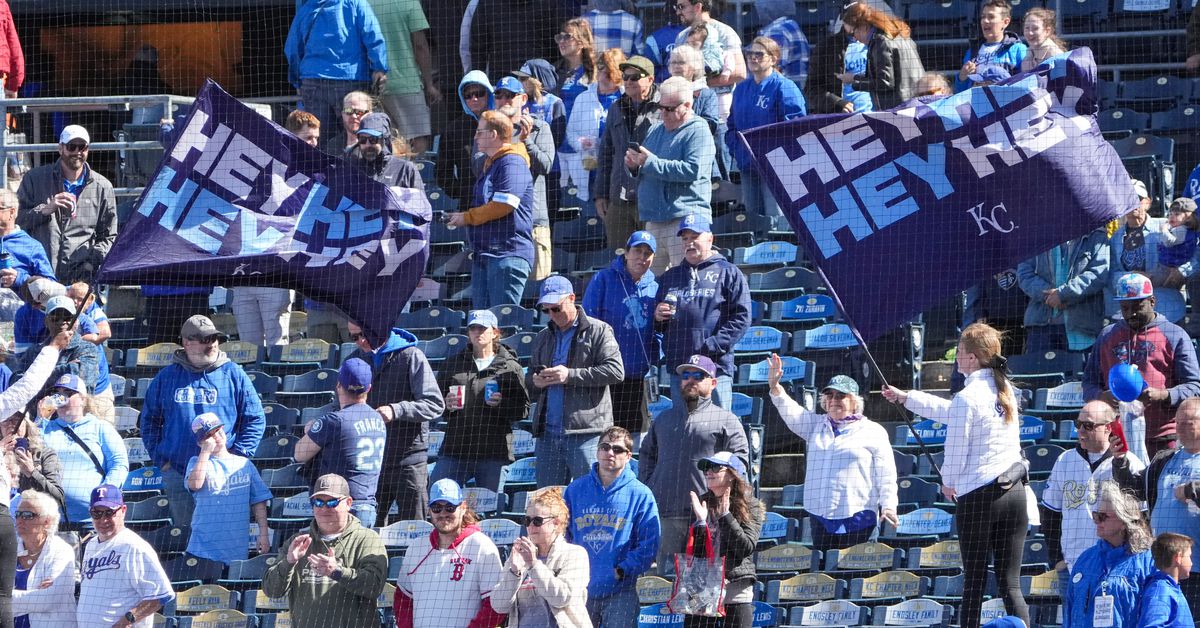
Royals fans have been through a lot.
Jay Biggerstaff-Imagn Images
But how does that relate to being more comfortable with the idea of selling off players and losing?
First, he noted that my buy-now, take-the-risk idea is “offering an optimistic take to a rightly pessimistic fan base.” Later, when specifically discussing imagined communities, he stated, “[P]art of being in the Royals community is ritualistic associating and anticipating losing.”
Is that true? Are Royals fans pessimistic? Do we associate with and anticipate this franchise losing?
I’d answer yes to all of those questions. When this team has a tough stretch, the masses want to tear it down to the foundation and rebuild again. And when that rebuild doesn’t go smoothly…well, the masses want to tear it down to the foundation and rebuild again. It’s a stupid cycle perpetuated by a league without a salary cap that torments small-market club fanbases, like that of the Kansas City Royals.
This is going to sound very pessimistic (because it is), but I also think it’s easier for fans to relate to a struggling club than a succeeding club. After all, recent Royals history, aside from a couple of years between 2013 through 2016 and then again last season, is riddled with bad teams. Losing has become second nature. It’s weird, almost unfathomable, when a losing team turns things around. And then for it to go right back to struggling? I get the anxiety.
A parallel view to Royals fandom is Chiefs fandom. I have been a Chiefs fan all my life, and I am certainly enjoying the string of success the team’s had since Patrick Mahomes took over at the starting quarterback. Still, nearly every week, especially last season, doubt creeps in, and I begin feeling like I did as a younger Chiefs fan, certain that the team is going to falter and the good times will come crashing down.
Younger Chiefs fans don’t feel that way because winning is all they’ve known.
Losing connects Royals fans of all generations. The club has never truly enjoyed sustained success. Even when the Royals won consecutive pennants, those were the only two years of the decade in which the organization reached the playoffs. The last time the Royals made the playoffs in three consecutive seasons was in 1976 through 1978.
In fact, that’s the only time that the Royals made the postseason three times in a row.
To end, I’ll go back to what I wrote before this season began: relax and enjoy the ride for what it is. The season has many bumps in it.
The 2025 Kansas City Royals are battling, and really, for what more can fans ask?